


Xi'an Huilin Bio-Tech Co., Ltd. is one of the leading manufacturers and suppliers of usnic acid powder in China. With abundant experience, we are committed to providing high quality natural products with competitive price. Please feel free to wholesale bulk pure usnic acid powder for sale here from our factory.
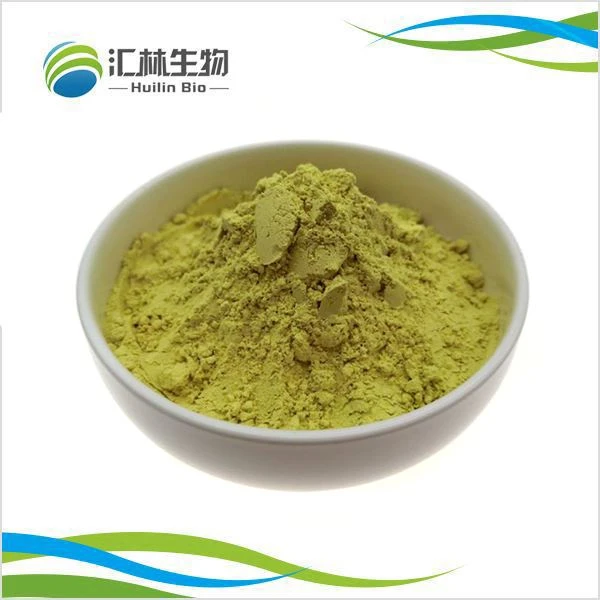
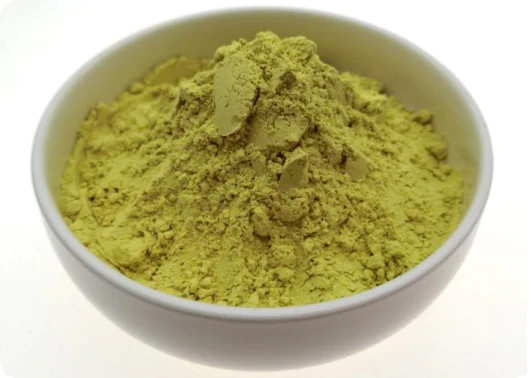
Usnic acid 99.5 % is a single-compound lichen acid supplied as a yellow crystalline powder for laboratory work - in-vitro assay development, method validation and analytical reference use. It is a dibenzofuran derivative of formula C18H16O7 and molecular weight 344.32, and it is one of the few lichen substances available at reagent-grade purity.
The molecule is not a botanical extract. A Usnea extract is a mixture sold by ratio or by its usnic acid content; this grade is the isolated compound, specified by chromatographic purity, and it is the form used when the experiment needs a defined concentration of one substance rather than a reproducible mixture.
Three properties decide how it is handled: it is poorly soluble in water, it is a strong yellow chromophore, and its oral toxicity is documented in the clinical literature. That last point is why this page describes laboratory use only.
Identity
| Item | Value |
| Chemical name | 2,6-diacetyl-7,9-dihydroxy-8,9b-dimethyldibenzo[b,d]furan-1,3(2H,9bH)-dione |
| Molecular formula / weight | C18H16O7 / 344.32 |
| CAS | 125-46-2 (racemic, ±) - the CAS of this grade; 7562-61-0 (R-(+)); 6159-66-6 (S-(−)) |
| PubChem CID | 5646 |
| Structural class | Dibenzofuran derivative; lichen secondary metabolite |
| Reported melting point | 204 °C |
| Appearance | Yellow crystals or powder |
| Grade | Research grade, ≥ 99.5 % by HPLC |
Identity on the certificate is carried by retention time against a reference standard and by the melting range of the lot. The literature value of 204 °C is a check on identity, not a purity criterion.
What Usnic Acid Is
Usnic acid is produced by lichens - Usnea, Cladonia, Alectoria and others - as a secondary metabolite, and it is one of the few lichen compounds that accumulates to a workable fraction of the thallus. Chemically it is a dibenzofuran: two aromatic rings fused through a furan oxygen, carrying two acetyl groups, two phenolic hydroxyls and two methyl groups.
That arrangement explains the two properties that matter in a laboratory. The phenolic system is what makes the molecule a yellow chromophore with strong absorbance in the UV range, which is why it is quantified spectrophotometrically as well as by HPLC. And the acetyl and hydroxyl groups make it lipophilic enough to dissolve in acetone and chloroform while staying poorly soluble in water.
Three CAS Numbers, One Product
Usnic acid is chiral, and the registry carries a number for each form. This grade is the racemic material, and 125-46-2 is the number that goes with it.
| CAS | What it is |
| 125-46-2 | ±-Usnic acid - the racemic form, and the CAS of this grade |
| 7562-61-0 | (R)-(+)-usnic acid, a single enantiomer sold as a separate material |
| 6159-66-6 | (S)-(−)-usnic acid, the other single enantiomer |
The racemate and the single enantiomer are two products, not two grades of one. A specification that cites 125-46-2 describes the ± mixture; if a lot has to be the (+)-enantiomer, the reference moves to 7562-61-0 and chiral purity becomes the number that matters. Our certificate names the CAS of the lot and reports the enantiomeric composition, so the two statements are never separated.
What the 99.5 % Figure Covers
This grade is a single compound, so the assay figure is a genuine purity rather than a summation across a mixture - but it still depends on how the laboratory calculates.
Area normalisation divides the main peak by the total peak area. External standard calculation compares the peak against a reference standard of known purity. On the same sample the two can differ by several tenths of a percentage point, which at 99.5 % sits exactly where incoming inspection draws its line.
Our certificate states which calculation was used, the wavelength, and the reference standard, and it carries the enantiomeric composition alongside the assay.
Specification and Release Basis
| Item | Specification | Test Method |
| Assay, usnic acid | ≥ 99.5 % | HPLC |
| Appearance | Yellow crystals or powder | Visual |
| Identification | Retention time corresponds to reference | HPLC |
| Enantiomeric composition | Racemic (±), confirmed per batch | Chiral HPLC |
| Melting range | Reported per batch | Capillary |
| Loss on drying | Reported per batch | Gravimetric, 105 °C |
| Ash | Reported per batch | Gravimetric |
| Residual solvents | Reported per batch | GC |
| Heavy metals, as Pb | ≤ 10 mg/kg | ICP-MS |
| Lead, cadmium, mercury | Pb ≤ 2; Cd ≤ 1; Hg ≤ 0.5 mg/kg | ICP-MS |
| Arsenic | ≤ 2 mg/kg | ICP-MS |
| Total plate count | < 1,000 CFU/g | Plate count |
| Yeast and mould | < 100 CFU/g | Plate count |
| E. coli and Salmonella | Negative for both | Culture |
| Particle size | ≥ 95 % through 80 mesh | Sieve |
Every lot of usnic acid is released against this table. Tested per batch - see Certificate of Analysis. Tighter limits are available on request.
Handling and Safety Note
This grade is supplied for laboratory work. It is not supplied for ingestion, and this page does not describe any ingestible use.
The restriction is not a formality. Oral exposure to usnic acid is the route with documented harm: case reports in the medical literature describe severe hepatotoxicity, including fulminant hepatic failure, in people who had taken dietary supplements containing usnic acid, and the US Food and Drug Administration issued a safety alert in November 2001 concerning a supplement that contained sodium usniate.
In the laboratory the material is handled as a fine organic powder: weigh in a fume hood or a balance enclosure, avoid dust generation, and use gloves and eye protection. Solutions are prepared in acetone, chloroform or ethanol rather than in water, and they are kept protected from light because the chromophore is photolabile in solution.
Solubility, Stability and Packaging
Usnic acid is sparingly soluble in water - of the order of one gram per litre - soluble in acetone and chloroform, and partially soluble in ethanol. In practice that means aqueous protocols start from a concentrated organic stock, and the stock is what gets diluted into the assay buffer.
The powder is light-sensitive and should be kept dry. Packaging is a moisture and light barrier: 1 kg foil bags, and 25 kg fibre drums with a double polyethylene liner. Storage is sealed, cool, dry and away from light; under those conditions the material is stable for 24 months in unopened packaging.
Usnic Acid Against Three Related Materials
Four substances appear in the same search results. Only the first is this grade.
| Substance | Relation to this grade | What it changes in work |
| Usnea extract | Botanical mixture containing usnic acid among other lichen acids | Sold by extract ratio or by usnic acid content; not a defined single-compound concentration |
| Sodium usniate | The sodium salt of usnic acid | Different solubility and different counter-ion; the form named in the 2001 FDA alert |
| (+)-Usnic acid | The single (+)-enantiomer, CAS 7562-61-0 | A different product from this grade, not a higher-purity version of it |
| (−)-Usnic acid | The single (−)-enantiomer, CAS 6159-66-6 | Not interchangeable in chiral assays |
Where This Grade Is Used
In-vitro assay development. A defined single-compound concentration is what dose-response work needs; a botanical extract cannot deliver it reproducibly across lots.
Analytical reference material. The 99.5 % grade and the reported enantiomeric composition make it usable as a system-suitability or identification standard for methods that quantify usnic acid in lichen materials.
Method development and validation. Linearity, recovery and specificity work on a lichen matrix all require a characterised standard of the target compound.
Formulation research. Supplied to laboratories studying the molecule's physical behaviour. Any placement in a finished product - cosmetic, food or otherwise - is a separate regulatory determination in the destination market, made by the manufacturer of that product.
Questions Buyers Ask Before the First Order
Q: Which CAS number applies to this grade?
A: 125-46-2, the racemic (±) form - that is the CAS of this grade. The single (+)-enantiomer is 7562-61-0 and the (−)-enantiomer is 6159-66-6; both are separate materials, not grades of this one.
Q: Is the 99.5 % area normalisation or external standard?
A: The certificate states which was used, together with the wavelength and the reference standard. At this purity the two calculations can differ enough to matter at incoming inspection.
Q: Is this the same as Usnea extract?
A: No. The extract is a mixture sold by ratio or by usnic acid content; this is the isolated compound, specified by chromatographic purity.
Q: Can it be used in a dietary supplement?
A: No. This grade is supplied for laboratory work and is not supplied for ingestion. Oral exposure is the route with documented hepatotoxicity, and the clinical case reports concern supplement use specifically.
Q: Why is residual solvent on the certificate?
A: Because the compound is isolated and purified through organic solvents, so the solvent profile belongs to the specification rather than being assumed absent.
Q: Does it dissolve in water?
A: Sparingly - about one gram per litre. Working solutions are prepared as a concentrated stock in acetone, chloroform or ethanol and then diluted.
Q: Why does the certificate report enantiomeric composition?
A: Because usnic acid is chiral and three CAS numbers exist for the three forms. Reporting both the assay and the enantiomer ratio is what fixes which material the lot actually is.
Q: What documents come with a batch?
A: Certificate of analysis, technical data sheet and SDS. Documentation to support import requirements in the destination market is available on request.
Supplier
Xi'an Huilin Bio-tech Co., Ltd. supplies usnic acid 99.5 % and the related lichen material - Usnea barbata extract - from Shaanxi. Material is sourced against a written specification, and every batch ships with the certificate that carries the figures shown on this page. Documentation to support import requirements in the destination market is available on request.
This page describes a raw material supplied for laboratory and industrial use. It is not a finished product and it is not supplied for ingestion. Final application and the regulatory determination in the destination market belong to the manufacturer of the finished product.
Hot Tags: usnic acid powder, China, suppliers, manufacturers, factory, wholesale, buy, price, bulk, pure, natural, high quality, in stock, for sale


