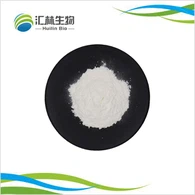


Xi'an Huilin Bio-Tech Co., Ltd. is one of the leading manufacturers and suppliers of l-phenylephrine bitartrate powder in China. With abundant experience, we are committed to providing high quality natural products with competitive price. Please feel free to wholesale bulk pure l-phenylephrine bitartrate powder for sale here from our factory.
L-Phenylephrine bitartrate 98 % is the acid tartrate salt of levophenylephrine, supplied as a white to off-white crystalline powder for laboratory and analytical work. It is a single compound with its own registry number - CAS 17162-39-9 - not a mixture, so the 98 % figure is a chromatographic purity rather than a summed content.
The salt is what makes this page worth reading carefully. Phenylephrine is dosed as the base, and the bitartrate carries only 52.70 % of its weight as base - less than half of what the same weight of the hydrochloride would carry. Anyone weighing this material against a base figure needs that conversion before the balance is touched.
Because the buyers for this grade are laboratories and resellers rather than pharmaceutical manufacturers, the specification below is our own, stated openly, with the calculation basis named. No pharmacopoeial compliance is claimed, and none should be inferred from the assay figure.
Identity
| Item | Value |
| Chemical name | L-Phenylephrine bitartrate; phenylephrine hydrogen tartrate |
| CAS | 17162-39-9 |
| Molecular formula / weight | C13H19NO8 / 317.29 |
| Free base | Phenylephrine, C9H13NO2, 167.21 |
| Base fraction | 52.70 % of the salt weight |
| Salt type | Acid tartrate (hydrogen tartrate) |
| Appearance | White to off-white crystalline powder |
Identity on the certificate is carried by retention time against a reference standard, by the assay, and by the salt's own registry number. Because the material is a single compound, a melting range and an infra-red spectrum both apply to it - unlike the mixtures elsewhere on this site, where neither exists.
What the Bitartrate Salt Is
Phenylephrine is a small molecule with one phenolic hydroxyl, one benzylic alcohol, and a secondary amine. The bitartrate pairs it with tartaric acid at a 1:1 ratio, which is why the formula carries C4H6O6 on top of the C9H13NO2 base.
That pairing does three things to the material: it raises the molecular weight from 167.21 to 317.29, it makes the salt freely soluble in water, and it gives the solid an acidic reaction in solution. The first of those is the one that causes errors, because it is invisible in the powder.
The 52.70 % Base Fraction
167.21 ÷ 317.29 = 0.5270. Expressed as weight of base per weight of salt, this grade carries 52.70 %.
| Form | Molecular weight | Base fraction |
| Phenylephrine base, C9H13NO2 | 167.21 | 100 % |
| Phenylephrine hydrochloride, C9H14ClNO2 | 203.67 | 82.1 % |
| Phenylephrine bitartrate, C13H19NO8 | 317.29 | 52.70 % |
Two worked figures follow from that. A specification calling for 10 mg of base requires 18.98 mg of this salt. And 100 mg of this salt delivers 52.7 mg of base - the same 100 mg taken as the hydrochloride would deliver 82.1 mg.
The three forms are not interchangeable at equal weight, and the difference is not a rounding error: the bitartrate needs roughly 1.56 times the mass of the hydrochloride to deliver the same base.
What the 98 % Figure Covers
For this material 98.0 % is a purity, reported against the dried substance. It is the share of the chromatographic response that belongs to phenylephrine bitartrate, or the share calculated against a reference standard - and the certificate names which of the two was used, because the same lot can read differently under the two calculations.
Three things sit outside that figure and each has its own line in the table below: water, related substances, and residual solvents. A purity figure alone does not tell a laboratory whether a lot is dry, clean of process impurities, or free of the solvent it was crystallised from.
No pharmacopoeial grade is claimed for this material. A laboratory that needs compliance with a published monograph needs a certificate stating compliance with that monograph, and that is a different supply than this one.
Specification and Release Basis
| Item | Specification | Test Method |
| Assay, as phenylephrine bitartrate, dried basis | ≥ 98.0 % | HPLC |
| Appearance | White to off-white crystalline powder | Visual |
| Identification | Retention time corresponds to reference standard | HPLC |
| Enantiomeric purity | Reported per batch | Chiral HPLC |
| Related substances | Reported per batch | HPLC |
| Loss on drying | Reported per batch | Gravimetric, 105 °C |
| Residual solvents | Reported per batch | GC |
| Heavy metals, as Pb | ≤ 10 mg/kg | ICP-MS |
| Lead, cadmium, mercury, arsenic | Pb ≤ 2; Cd ≤ 1; Hg ≤ 0.5; As ≤ 2 mg/kg | ICP-MS |
| Total plate count | < 1,000 CFU/g | Plate count |
| Yeast and mould | < 100 CFU/g | Plate count |
| E. coli and Salmonella | Negative for both | Culture |
| Solubility | Freely soluble in water | Visual |
| Particle size | ≥ 95 % through 80 mesh | Sieve |
Every lot of L-phenylephrine bitartrate is released against this table. Tested per batch - see Certificate of Analysis. Tighter limits are available on request.
Solubility, Stability and Packaging
The salt dissolves freely in water and gives an acidic solution; the base does not dissolve to anything like the same extent. For laboratory work that difference is usually the reason this salt is chosen over the free base.
The molecule carries a phenolic hydroxyl, which is the part that reacts with light and with oxygen over time. Storage is therefore sealed, protected from light, cool and dry, and the packaging is a light- and moisture-barrier: 1 kg foil bags, and 25 kg fibre drums with a double polyethylene liner. Under those conditions the material is stable for 24 months in unopened packaging.
Regulatory and Use Boundary
This material is supplied for laboratory and analytical use. It is not supplied for medicinal, diagnostic or household use, and nothing on this page describes a therapeutic application.
Phenylephrine is a medicinal active substance in every major market, and the consequences differ by market. In the United States it is an over-the-counter monograph ingredient, and in November 2024 the FDA proposed to remove the oral form from the monograph for nasal decongestion after concluding that the oral route is not effective; nasal, ophthalmic and injectable uses were not part of that proposal. In China and in the European Union the substance is handled as a medicinal ingredient rather than a food or supplement material.
What that means for a laboratory or a reseller is straightforward: the regulatory position of the material belongs to whoever puts it into a finished product, and it is not conferred by this page or by the certificate. Laboratories use it as a reference and analytical material; resellers pass it on with the documentation that came with the lot.
Where This Material Goes
Analytical reference work. The salt is used to prepare standards and to check identity and assay methods where a defined salt form matters.
Method development. Because the base fraction is a fixed property of the salt, it is the natural check for methods that calculate results as the base.
Redistribution. Supplied to resellers who hold their own documentation and their own customer base. The certificate travels with the lot.

Questions Buyers Ask Before the First Order
Q: Is this the same as phenylephrine hydrochloride?
A: No. Same base, different salt. The hydrochloride is 203.67 and carries 82.1 % base; the bitartrate is 317.29 and carries 52.70 %. Equal weights do not deliver equal base.
Q: What does the 98 % mean?
A: Purity of the salt, on the dried substance, by HPLC. It is not a base content and it is not a pharmacopoeial claim.
Q: How much base is in 100 mg of this material?
A: 52.7 mg. The reverse calculation is 10 mg of base requires 18.98 mg of the salt.
Q: Why supply the bitartrate rather than the base?
A: Solubility in water and a stable crystalline solid. The acid tartrate also gives an acidic solution, which some methods rely on.
Q: Is it the L-form?
A: The material is levophenylephrine bitartrate, as named. Enantiomeric purity is reported per batch on the certificate.
Q: Can it be used in a medicine?
A: Not from this supply. It is sold as a laboratory material, and any medicinal use requires the buyer's own authorisation and documentation.
Q: How should it be stored?
A: Sealed, protected from light, cool and dry. The phenolic hydroxyl is the part that degrades, and light is the usual trigger.
Q: What documents come with a batch?
A: Certificate of analysis, technical data sheet and SDS. The certificate carries the batch number, the assay basis and the figures for the items reported per batch. No pharmacopoeial compliance statement is issued unless it is arranged in advance.
Supplier
Xi'an Huilin Bio-tech Co., Ltd. supplies L-phenylephrine bitartrate 98 % and other research-grade active substances from Shaanxi. Material is sourced against a written specification, and every batch ships with the certificate that carries the figures shown on this page. Documentation to support import requirements in the destination market is available on request.
This page describes a raw material supplied for laboratory and analytical use. It is not a medicine, a food, a supplement or a cosmetic ingredient, and it is not intended for medicinal, diagnostic or household use. Final application and the regulatory determination in the destination market belong to the party placing the finished product on the market.
Hot Tags: l-phenylephrine bitartrate powder, China, suppliers, manufacturers, factory, wholesale, buy, price, bulk, pure, natural, high quality, in stock, for sale