



Xi'an Huilin Bio-Tech Co., Ltd. is one of the leading manufacturers and suppliers of amygdalin powder in China. With abundant experience, we are committed to providing high quality natural products with competitive price. Please feel free to wholesale bulk pure amygdalin powder for sale here from our factory.
Amygdalin as a Laboratory Reagent
Amygdalin (CAS 29883-15-6) is a cyanogenic diglucoside isolated from the kernels of Prunus armeniaca L. It is a single, well-characterised molecular species: the β-gentiobioside of mandelonitrile, C₂₀H₂₇NO₁₁, MW 457.43. Supplied here as a crystalline powder at ≥98.0% by HPLC on an anhydrous basis, it is intended for use as an analytical reference material, as an enzyme substrate, and as a model compound in cyanogenic glycoside method development.
Xi'an Huilin Bio-Tech Co., Ltd. supplies this grade to analytical laboratories, contract research organisations, phytochemical reference laboratories, food-safety testing facilities and university research groups. It is not supplied for food, supplement, cosmetic, pharmaceutical or any other human or veterinary use.
The distinction that matters commercially is between a characterised single compound and a botanical extract. Bitter almond or apricot kernel extract contains amygdalin alongside its epimer, related cyanogenic glycosides, oils and plant matrix; its amygdalin content is variable and its chromatogram is not a single peak. A reference material must be one peak with a documented purity, a documented counter-ion and water content, and a documented specific rotation. That is the basis on which this grade should be evaluated - not on price per kilogram of "extract equivalent".
|
|
|


Specification
| Item | Specification | Test Method |
|---|---|---|
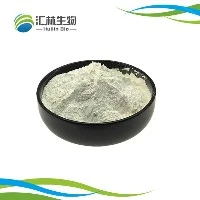
| Appearance | White to off-white crystalline powder | Visual |
| Identification | IR and HPLC retention time concordant with reference standard | FT-IR; HPLC-UV |
| Assay (amygdalin, anhydrous basis) | ≥98.0% | HPLC-UV, external standard |
| Neoamygdalin (C-epimer) | ≤1.0% peak area | HPLC-UV |
| Melting point | 223–226 °C | Capillary method |
| Specific rotation | −40.0° to −43.0° | Polarimetry, c = 1 in water, 20 °C, 589 nm |
| Water | ≤8.0% | Karl Fischer |
| Residue on ignition | ≤0.5% | Gravimetric |
| pH (5% suspension) | 4.5–6.5 | pH meter |
| Lead | ≤2.0 mg/kg | ICP-MS |
| Arsenic | ≤1.0 mg/kg | ICP-MS |
| Cadmium | ≤1.0 mg/kg | ICP-MS |
| Mercury | ≤0.5 mg/kg | ICP-MS |
| Residual solvents | Within ICH Q3C limits for declared solvents | Headspace GC |
| Free cyanide (as HCN) | Reported per batch | Spectrophotometric |
| Total aerobic count | ≤1,000 CFU/g | Plate count |
| Yeast and mould | ≤100 CFU/g | Plate count |
| E. coli | Absent / g | USP <2022> |
| Salmonella spp. | Absent / 10 g | USP <2022> |
| Conclusion | Conforms to Specification | - |
The limits above are the standard specification for this grade. Batch-specific measured results, including the free cyanide figure, are stated in the Certificate of Analysis issued with each lot.
Final specifications can be confirmed according to analytical application, destination market and purchasing requirements.
Grade and Regulatory Status
- Grade designation. Research reagent grade. Sold for laboratory and analytical use by qualified personnel. Not a food, food ingredient, dietary supplement, cosmetic ingredient, drug or drug substance, and not for human or veterinary use, diagnostic use or therapeutic use of any kind.
- Regulatory position. Amygdalin is not approved by the U.S. FDA, the European Medicines Agency or Health Canada for the treatment of any disease, and sale for human consumption is restricted or prohibited in a number of jurisdictions. The compound is listed under EC number 249-925-3. Buyers are responsible for confirming that import, possession and use of this material are lawful in their own jurisdiction and that the intended application is within the scope of their institutional licence.
- Hazard classification. Classified under GHS as Acute Toxicity Category 4 (oral), hazard statement H302 - harmful if swallowed. Signal word: Warning. Pictogram: GHS07. Precautionary statements P264, P270, P301+P312 and P501 apply. A Safety Data Sheet in the current revision is supplied with every shipment and on request.
- Labelling. Outer packaging carries the GHS pictogram, signal word, hazard and precautionary statements in the destination-market language where required. Inner bags are labelled with product name, CAS number, lot number, net weight and storage condition.
Why Huilin
- Batch-level COA, not a generic certificate. Every lot is released against the specification above, with the measured assay, water content, specific rotation and heavy metals printed on the certificate for that lot number. Ask for a sample COA of a lot we have already shipped.
- Identity confirmed on two independent principles. IR spectrum plus HPLC retention time against a reference standard. A single chromatographic peak at the expected retention time is not, on its own, adequate identification for a reference material.
- Epimer content is controlled, not ignored. Amygdalin epimerises to neoamygdalin in solution; a supplier who does not measure the epimer cannot tell you what fraction of the stated assay is the labelled compound. We report it as a specification line.
- Moisture-controlled packing. The solid is hygroscopic and water content directly affects the anhydrous-basis assay. Each 1 kg bag is heat-sealed with desiccant inside a second barrier, and the water content at release is stated on the COA.
- Documentation package on request. COA, TDS and SDS for the current lot; additional statements (non-animal-origin of the extraction route, allergen, heavy-metal summary) can be issued with the batch documentation.
Chemistry and Reactivity
Amygdalin is composed of one mandelonitrile unit glycosidically linked to a gentiobiose disaccharide - two β-D-glucose units joined 1→6. The molecule is neutral, non-volatile and crystalline, and is stable as a dry solid when protected from moisture.
Hydrolysis. In the presence of β-glucosidase (emulsin) or dilute acid, the glycosidic bonds cleave sequentially, releasing D-glucose, benzaldehyde and hydrogen cyanide. This is the property that underlies its use as an enzyme substrate and as a model cyanogenic glycoside - and it is also why the material must be handled as a toxic substance rather than as an inert botanical powder. Cyanide release is enzymatic or acid-catalysed, not spontaneous in neutral dry storage.
Epimerisation. In aqueous solution, the chiral centre at the mandelonitrile carbon equilibrates, converting amygdalin to its C-epimer neoamygdalin. The two are diastereomers with different retention times but nearly identical mass. Consequences for the laboratory:
- Prepare solutions immediately before use and do not hold aqueous stock solutions for extended periods.
- Avoid prolonged contact with alkaline buffers; epimerisation and hydrolysis both accelerate as pH rises.
- If the method quantifies amygdalin only, a stored solution will show a falling result that reflects epimerisation, not decomposition of the starting material.
- Both peaks should be integrated in stability-indicating methods.
Solubility behaviour. 50 mg/mL in water at 25 °C gives a clear to slightly hazy solution; solubility increases markedly in hot water, which is useful for recrystallisation but not for preparing standards, since hot solutions epimerise faster. Ethanol dissolves the compound sparingly; ether and chloroform do not dissolve it.
Amygdalin vs Laetrile vs Bitter Almond Extract
Buyers regularly conflate these three materials, and the difference determines whether a purchase order is fit for purpose.
| Amygdalin (this product) | Bitter almond / apricot kernel extract | Laetrile | |
| Chemical identity | β-gentiobioside of mandelonitrile | Multi-component botanical extract containing amygdalin | Mandelonitrile-β-D-glucuronide |
| CAS | 29883-15-6 | Not applicable (mixture) | Trade name for a semi-synthetic preparation; not a single CAS-assigned substance |
| Sugar moiety | Gentiobiose (two glucose units) | Gentiobiose, in a plant matrix | Glucuronic acid |
| Typical assay | ≥98.0% single compound by HPLC | Amygdalin content variable and batch-dependent | No defined assay |
| Chromatogram | One principal peak, epimer reported | Multiple peaks; matrix interference | Depends on preparation |
| Documentation focus | Purity, epimer, water, rotation, heavy metals | Marker content, pesticide residues, cyanide potential | Not normally supplied as a reference material |
| Suitable as an HPLC reference standard | Yes | No - matrix and variable content | No |
Choose amygdalin when you are building or validating a quantitative method, preparing calibration standards, or measuring β-glucosidase activity and need a defined molar concentration.
Choose a botanical extract when your application is a formulated botanical ingredient and the specification is written against a marker content rather than a single molecular species - in that case the extract's own marker specification and residue profile are the relevant documents.
Laetrile is not a synonym. It is a semi-synthetic glucuronide derivative with a different molecular formula and different hydrolysis products, and it is not interchangeable with amygdalin in an analytical method.
Benefits of Amygdalin Powder in Laboratory and Analytical Work
- A defined molar basis. Assay is stated on an anhydrous basis, with water content reported separately, so a weighed portion converts to moles without a hidden moisture assumption.
- Epimer reported as a number. Methods can be validated against a known neoamygdalin level instead of discovering it during the first stability run.
- No carrier, no excipient. The powder is the compound, not a trituration on lactose or maltodextrin, so it will not introduce a second peak or an interfering matrix into a chromatogram.
- Solubility that supports standard preparation. 50 mg/mL in water at 25 °C allows working concentrations in the millimolar range without co-solvent, which keeps the injection solvent simple.
- Pack sizes matched to consumption. 1 kg minimum with subdivision available, so a method-development programme is not forced to buy a drum to obtain a reference-grade lot.
- Documentation aligned to the analytical use. COA reports the parameters a laboratory must transcribe into its own qualification record: identity, assay, epimer, water, rotation, heavy metals.
Suitability for a specific analytical method depends on the method's own validation criteria, matrix and acceptance limits, and remains the responsibility of the receiving laboratory.
Applications
- Analytical reference standard. Used to prepare calibration standards and system-suitability solutions for the quantification of amygdalin and related cyanogenic glycosides by HPLC-UV or LC-MS, including in apricot kernel, bitter almond and Prunus-derived materials.
- Enzyme substrate. Serves as a defined substrate for β-glucosidase and emulsin activity assays, where the rate of glucose or cyanide release is measured against a known starting concentration.
- Cyanogenesis and in vitro toxicology models. Applied in controlled in vitro systems studying cyanide release, detoxification pathways and concentration–response relationships at the cellular or enzymatic level.
- Method development for cyanogenic glycosides. Used as an authentic standard when developing extraction, cleanup and detection procedures for cyanogenic glycosides in food and botanical matrices, where co-elution and epimer formation are the usual failure modes.
Final suitability depends on the analytical method, sample matrix, detection mode and validation requirements of the receiving laboratory.
Frequently Asked Questions (FAQ)
Q: Is amygdalin the same as laetrile?
A: No. Amygdalin is a β-gentiobioside of mandelonitrile - two glucose units attached to the cyanohydrin. Laetrile is mandelonitrile-β-D-glucuronide, in which the sugar moiety is glucuronic acid. The two differ in molecular formula, molecular weight and hydrolysis products, and they are not interchangeable in an analytical method. The terms are used interchangeably in popular writing, which is the source of most confusion in purchase enquiries.
Q: Is amygdalin the same as vitamin B17?
A: No. "Vitamin B17" is a commercial term with no standing in nutrition science; amygdalin is not a vitamin, and no dietary requirement for it has been established by any authoritative body. The name appears on consumer-facing material and in search queries, so it is listed here to prevent mis-ordering, not as a product claim.
Q: What is neoamygdalin, and why is it on the specification?
A: Neoamygdalin is the C-epimer of amygdalin, formed when the chiral centre at the mandelonitrile carbon inverts. It has a different retention time but almost the same mass, so it is invisible to a method that only integrates one peak. It forms in aqueous solution and faster at higher pH. Because it reduces the amount of the labelled compound present, we control it as a specification line rather than leave it to be discovered during a stability study.
Q: Why does the measured assay fall after a solution has been stored?
A: Two processes run in parallel: enzymatic or acid-catalysed hydrolysis releasing glucose, benzaldehyde and hydrogen cyanide, and epimerisation to neoamygdalin. In a neutral, sterile, enzyme-free solution at low temperature the loss is slow; in an alkaline buffer it is fast. Prepare standards immediately before use, keep the pH at or below neutral, and integrate both peaks in stability-indicating methods.
Q: Can this material be used as an HPLC reference standard?
A: It can be used as a working standard, provided the laboratory qualifies the lot against its own acceptance criteria - identity by two principles, assay, water content and epimer level are all reported on the COA for that purpose. For a primary reference standard traceable to a pharmacopoeial reference substance, the laboratory should establish traceability through its own qualification protocol.
Q: What documentation is supplied with each batch?
A: Certificate of Analysis for the specific lot, Technical Data Sheet and Safety Data Sheet in the current revision. On request we can add a heavy-metal summary, a residual-solvent declaration naming the solvents used in the extraction route, and a non-animal-origin statement for the manufacturing process.
Q: What are the handling requirements?
A: Handle as an acute toxicity category 4 material by the oral route. Weigh in a fume hood or a ventilated balance enclosure, wear nitrile gloves, safety glasses and a particle mask, and avoid generating dust. Do not allow the material to contact acids or β-glucosidase-containing preparations outside a controlled experiment, since that is when hydrogen cyanide is released. Waste containing the material or its hydrolysis products must be disposed of as cyanide-bearing laboratory waste under local rules.
Q: Can you supply a different assay, particle size or pack size?
A: Yes, within the limits of the process. Assay grades up to ≥99.0% by HPLC, a defined mesh cut, and subdivided pack sizes from 100 g upward can be quoted against a written specification. Custom specifications are confirmed in writing before the lot is produced.
OEM/ODM SERVICES

Packing

Shipping

Our certification

Payment method
After confirming with good related products information and orders, we will send a proforma invoice to you, or you can from Alibaba online trade.
100% payment before shipment, you can choose your convenient payment.
We offer a variety of payments, including bank transfer, Escrow, PayPal, western union, and money gram, you can choose which you are convenient.

Supplier
Xi'an Huilin Bio-Tech Co., Ltd. manufactures and exports phytochemical reference materials and biochemical research reagents from China. This grade is produced to a written specification, released lot by lot against a Certificate of Analysis, and packed for moisture-sensitive solids.
For a quotation, a sample, or a sample COA from a previously shipped lot, contact sales@huilinbio-tech.com or WhatsApp +86 189 9287 8573. FOB, CIF and DDP terms are quoted with the shipping schedule at the time of order; lead time is confirmed in the proforma invoice together with the destination port and Incoterm.
For laboratory and analytical use only. Not for human or veterinary use. Not a food, food ingredient, dietary supplement, cosmetic ingredient or drug. The buyer is responsible for compliance with the laws and regulations of the destination country governing import, possession, handling and use of this substance.

Why choose us?
- Our Natural Ingredients are known for their high quality and purity.
- Our company has introduced excellent processing equipment, trained a number of professional talents, and constantly introduced the old to bring forth the new, improved product diversity and flexibility, tailored to different customers and meet different needs.
- Our state-of-the-art facility ensures that our Natural Ingredients are produced to the highest standards.
- We regard Amygdalin Powder quality as the root of enterprise survival and service quality as the bridge to our success.
- Our team is passionate about creating the best possible Natural Ingredients for our clients.
- Our company's business philosophy is "customer first, employee oriented" and extraordinary independent innovation, extraordinary rigor and truthfulness.
- We are committed to providing our clients with the best possible Natural Ingredients at all times.
- We are committed to build our company into a modern enterprise with international first-class level in management, service, technology and quality.
- Our team is skilled and knowledgeable in all aspects of Natural Ingredients manufacturing.
- People-oriented, hard work and responsibility are the core of our corporate culture, which is a characteristic cultural system produced and gradually formed by our company in the course of development.
Hot Tags: amygdalin powder, China, suppliers, manufacturers, factory, wholesale, buy, price, bulk, pure, natural, high quality, in stock, for sale


