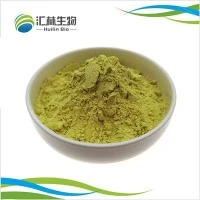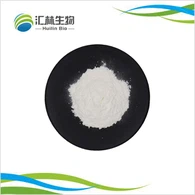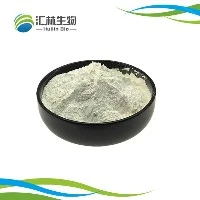
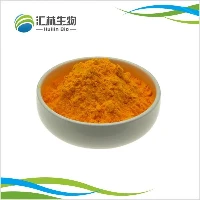

Xi'an Huilin Bio-Tech Co., Ltd. is one of the leading manufacturers and suppliers of l-rhamnose monohydrate powder in China. With abundant experience, we are committed to providing high quality natural products with competitive price. Please feel free to wholesale bulk pure l-rhamnose monohydrate powder for sale here from our factory.
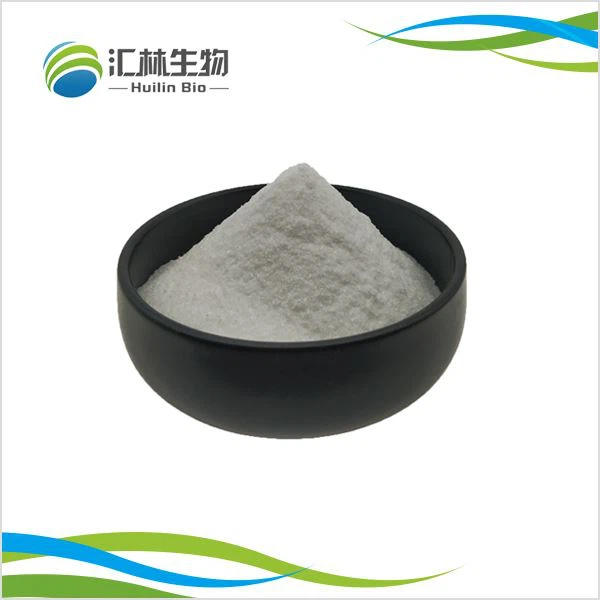
L-rhamnose monohydrate arrives as a white crystalline powder - 182.17 g/mol as the hydrate, 164.16 g/mol as the sugar itself, CAS 10030-85-0, released at 98.0 % minimum by HPLC.
Two figures on the label do most of the work, and they are easy to read the wrong way round: the assay, stated against the hydrate, and the water, which is nearly a tenth of the mass. Read them backwards and a 10 mM solution comes out 11 % weak, with no error anywhere on the balance sheet.
What follows covers the four substances that answer to the name rhamnose, the arithmetic of the crystal water, how a sugar with no chromophore is assayed, and where the material is actually used.
Which Rhamnose Is in the Drum
Rhamnose is a 6-deoxy sugar, and in nature it is almost always the L enantiomer - one of the few common sugars that is not D. The commercial article is the L form as a monohydrate, and that single sentence rules out three of the four things the name can mean.
The hydrate and the anhydrous sugar are different articles with different numbers. The monohydrate, CAS 10030-85-0, is C6H12O5·H2O at 182.17 g/mol and melts at 90 to 91 °C. The anhydrous sugar, CAS 3615-41-6, is C6H12O5 at 164.16 g/mol and melts at 122 °C. The 18.02 g/mol between them is water of crystallisation, and it is the source of every weighing error described below.
D-rhamnose exists, but it is a bacterial polysaccharide component and a research item, not a bulk material. A supplier who cannot say which enantiomer is in the drum has not specified the product.
One notation worth correcting. The hydrate is sometimes written C6H14O6, which is what C6H12O5·H2O sums to - but it is also the formula of mannitol and sorbitol, so the line tells a buyer nothing about which white powder is in the bag. Writing the hydrate as C6H12O5·H2O takes one line and removes the ambiguity.
The Water in the Crystal
The water of crystallisation is 18.02 ÷ 182.17 = 9.89 % of the mass. A monohydrate lot therefore carries close to a tenth of its weight as water, and every downstream figure starts from that.
The sugar fraction is 164.16 ÷ 182.17 = 0.901. One gram of powder contains 0.901 g of rhamnose; to obtain 1 g of rhamnose you weigh 1.11 g of powder. Neither number is a property of a particular lot - they follow from the formula, which is what makes them safe to design around.
A certificate that reports 98.0 % against the hydrate describes a powder that is 98.0 × 0.901 = 88.3 % rhamnose. The same certificate reporting 98.0 % on the dried basis, at 10 % water, describes 98.0 × 0.90 = 88.2 % rhamnose. Both are ordinary; neither is interchangeable with a 98 % figure written for the anhydrous article.
Solutions make the gap concrete. A 10 mmol/L solution takes 1.82 g of monohydrate per litre, 10 × 182.17 mg. The same solution written against the anhydrous sugar takes 1.64 g. A protocol copied from a paper that used the anhydrous material and weighed against the hydrate comes out 11 % concentrated; the reverse comes out 11 % dilute. Neither failure announces itself.
What the 98 % Is Counted Against
Rhamnose has no chromophore. There is no aromatic ring and no conjugated system, so an ultraviolet detector sees nothing at any useful wavelength, and the assay has to come from one of three routes: refractive index, evaporative light scattering, or derivatisation before an ultraviolet detector.
That matters when two certificates are compared. A refractive-index method responds to everything that elutes, water included, and its calibration is sensitive to temperature and flow; an evaporative light scattering method responds to mass and needs its own curve; a derivatisation method measures the labelled sugar and depends on the labelling going to completion. All three can report 98.0 %, and they are not the same measurement.
There is a second convention, which the previous section started: the figure can be stated against the hydrate or on the dried basis. The certificate states which, and the water figure is what lets one be converted to the other.
One chromatographic detail belongs here as well. Rhamnose is a reducing sugar, so in solution the ring opens and closes and the molecule equilibrates between two anomers. A method that resolves them reports two peaks; the assay is the sum, not the larger one. A method that does not resolve them reports one, and the difference is invisible on the certificate.
Specification and Release Basis
The table below is the release specification for this grade. Every row is tested per batch, and the results travel on the certificate for that lot rather than on this page.
| Item | Specification | Test Method |
| Appearance | White crystalline powder | Visual |
| Assay (C6H12O5·H2O) | ≥ 98.0 % | HPLC, refractive index or ELSD |
| Identification | IR spectrum and retention time correspond to reference | IR; HPLC |
| Specific rotation | Reported per batch | Polarimetry, c = 10 in water |
| Melting range | 90.0–93.0 °C | Capillary method |
| Water content | 9.0–11.0 % | Karl Fischer |
| Residue on ignition | ≤ 0.1 % | Gravimetric |
| Heavy metals (as Pb) | ≤ 10 mg/kg | ICP-MS |
| Arsenic | ≤ 2 mg/kg | ICP-MS |
| Total aerobic count | ≤ 1,000 CFU/g | Plate count, 35 °C |
| Yeast and mould | ≤ 100 CFU/g | Plate count, 25 °C |
| E. coli | Absent in 1 g | Culture |
| Salmonella | Absent in 25 g | Culture |
Specific rotation is reported rather than limited, because the value that matters depends on the concentration and the time allowed for mutarotation, and both belong on the certificate with the number. The water range brackets the 9.89 % that the formula requires; a lot outside it is not a monohydrate.
Limits are the release specification, not a description of the best lot the plant can produce. A tighter rotation window, a narrower water range or an added residual solvent screen is written as a separate specification.
Where the Sugar Comes From
L-Rhamnose is not isolated as a free sugar from a plant. It is released from glycosides, where it sits as the terminal sugar on a flavonoid or a saponin, and the hydrolysis that frees it is the same step that frees the aglycone.
Rutin is the clearest example, and its registry name says it outright: quercetin 3-O-rutinoside, described as the 6-O-α-L-rhamnosyl-β-D-glucoside, CAS 153-18-4, C27H30O16 at 610.52 g/mol. One molecule of rutin carries exactly one rhamnose. By mass, 164.16 ÷ 610.52 = 26.9 %, so a tonne of rutin holds about 269 kg of rhamnose equivalent, released alongside 302.24 g/mol of quercetin per mole.
That co-production is why the sugar is available at all in the volumes it is: it is a by-product of the flavonoid business, not a product with its own dedicated plant. The rutin behind this grade is extracted from the flower buds of Sophora japonica, the material sold in China as Huai Mi, and the sugar is released from that rutin by hydrolysis. Quercetin is the other product of the same step, so the two are supplied from one chain rather than two.
Rotation, and the Checks That Follow
Specific rotation is the check that separates enantiomers, and it is the only one on this page that does. Melting range separates the hydrate from the anhydrous sugar, 90 to 93 °C against 122 °C, but it cannot tell L from D - both enantiomers melt in the same place.
The sign does the work. The registry entry for this sugar names it L-(+)-rhamnose, and the sign is the useful part: the D form rotates the same magnitude the other way, so a reading near zero or of the wrong sign means the drum is not what the label says. Fucose shows why this matters: L-fucose, CAS 2438-80-4, has the same formula C6H12O5, the same mass 164.16 and a melting point of 140 °C, and it is the (−)-form of its pair. Same mass, same formula, opposite sign, different sugar.
The value is reported per batch rather than fixed here, because a rotation depends on concentration, solvent, temperature and the time allowed for mutarotation to finish. The certificate states the conditions with the figure, and the figure is only comparable against the same conditions.
What It Is Not
Three substances get confused with this one, and one gets confused with its chemistry.
| Substance | CAS | Key figures | Practical difference |
| L-Rhamnose monohydrate | 10030-85-0 | 182.17, mp 90–93 °C | The article on this page |
| L-Rhamnose, anhydrous | 3615-41-6 | 164.16, mp 122 °C | Same sugar without the water; 11 % more sugar per gram |
| L-Fucose | 2438-80-4 | 164.16, mp 140 °C | Same formula and mass; different stereochemistry and opposite rotation |
| Rhamnolipid | - | glycolipid | A biosurfactant built from rhamnose; a different product category |
Rutin and naringin are not substitutes - they are the glycosides the sugar is cut from, and buying them to obtain rhamnose means running a hydrolysis. Rhamnolipid is the reverse case: it contains rhamnose as its hydrophilic head, and it is bought as a surfactant, not as a sugar.
Where It Is Used
Chiral building block. L-Rhamnose is one of the few abundant sugars that is not D, which makes it a starting point for furanones, for chiral pools and for glycosidic linkages that have to carry the natural configuration.
Glycobiology and glycosylation. Rhamnosides are synthesised from it as donors; it is also a substrate in enzyme work on rhamnosidases and rhamnose isomerases.
Cosmetic formulations. The sugar is used as a moisture-binding monosaccharide in skincare and personal care.
Rhamnolipid chemistry. The rhamnose head-group is what makes the rhamnolipids surface-active; most industrial rhamnolipid is fermented directly, and the sugar is used where the synthesis is assembled rather than grown.
Permeability research. Dual-sugar studies use rhamnose alongside a larger sugar as markers; that is a research application and says nothing about the material's own behaviour in the body.
Analytical reference. Sugar composition analysis and quantitative NMR work use it as a standard.
Regulatory Position and Scope
This grade is supplied for laboratory and industrial use, and for cosmetic formulation. Food and beverage use is outside the scope of this page, and nothing here should be read as a food-grade release.
In cosmetic use the sugar is a monosaccharide ingredient rather than an active, and it is supplied as a raw material to the formulator, not as a finished product.
The safety data sheet that travels with the drum carries the classification and the handling information for the lot. Documentation to support import requirements in the destination market is available on request.
Questions Buyers Ask Before the First Order
Q: Is this L- or D-rhamnose?
A: L. The natural and commercial form is L-rhamnose; D-rhamnose comes from bacterial polysaccharides and is a research item. The certificate carries a specific rotation, which is the check that distinguishes them.
Q: Why does 1 g of powder contain only about 0.9 g of rhamnose?
A: Because it is a monohydrate. The crystal is 182.17 g/mol, of which 18.02 is water - 9.89 % of the mass. The sugar fraction is 164.16 ÷ 182.17 = 0.901, so 1 g of powder holds 0.901 g of rhamnose and 1 g of rhamnose needs 1.11 g of powder.
Q: Monohydrate or anhydrous - which CAS applies?
A: 10030-85-0 is the monohydrate, 182.17 g/mol, melting at 90 to 91 °C. 3615-41-6 is the anhydrous sugar, 164.16 g/mol, melting at 122 °C. They are different articles at different weights, and a method written for one does not transfer to the other by mass.
Q: How is the assay measured if rhamnose has no UV chromophore?
A: By refractive index, by evaporative light scattering, or after derivatisation ahead of a UV detector. Each responds to something different, so the certificate should name the route together with the figure.
Q: Is rhamnose the same as rhamnolipid?
A: No. Rhamnolipid is a glycolipid biosurfactant that uses rhamnose as its hydrophilic head. One is a sugar, the other a surfactant, with different specifications, handling and uses.
Q: Is it the same as fucose?
A: No, though the two are easy to confuse on paper. L-Fucose is also C6H12O5 at 164.16, but it melts at 140 °C against 122 °C for anhydrous rhamnose, and it is the (−)-form where L-rhamnose is the (+)-form.
Q: Does it dissolve in water?
A: Freely. Unlike most of the flavonoid glycosides it is cut from, the free sugar is water-soluble, which is why it partitions into the aqueous phase during hydrolysis and is recovered from there.
Q: What does the certificate test?
A: Appearance, assay by HPLC, identification by IR and retention time, specific rotation, melting range, water, residue on ignition, heavy metals, arsenic and the microbiological set in the table, with the assay route and the basis stated alongside the result.
Supplier
Xi'an Huilin Bio-tech Co., Ltd. supplies L-rhamnose monohydrate at 98.0 % minimum by HPLC, alongside rutin, quercetin, Sophora japonica extract and naringin - the glycosides this sugar is released from - from Shaanxi. Material is bought against a written specification rather than a catalogue entry, and each batch leaves with the certificate that carries the figures shown above.
Sealed, dry and at ambient temperature, the powder holds its specification for 24 months in unopened packaging.
This page describes a raw material supplied to laboratories and to manufacturers for research, industrial and cosmetic use. It is not a finished product and it is not a medicinal product. Final application and the regulatory determination in the destination market belong to the manufacturer of the finished product.
Hot Tags: l-rhamnose monohydrate powder, China, suppliers, manufacturers, factory, wholesale, buy, price, bulk, pure, natural, high quality, in stock, for sale