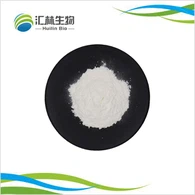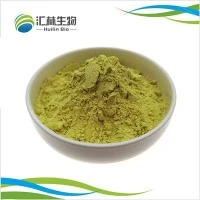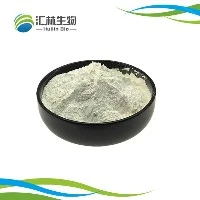
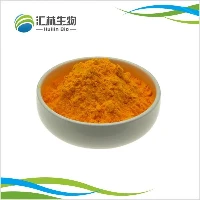

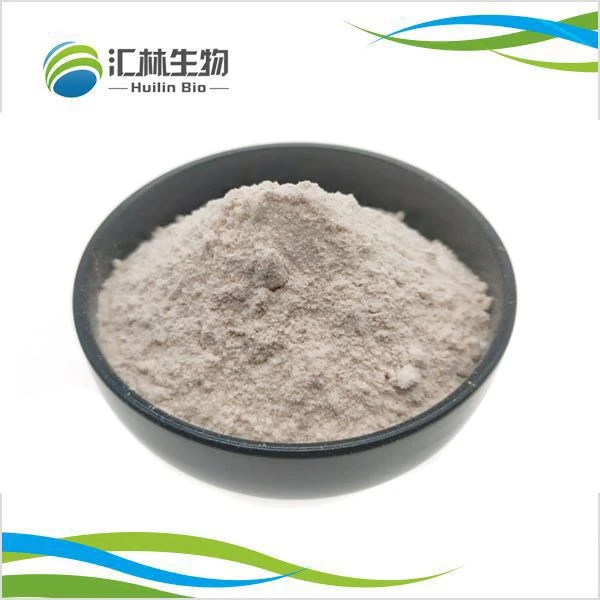
Xi'an Huilin Bio-Tech Co., Ltd. is one of the leading manufacturers and suppliers of 7-hydroxycoumarin powder in China. With abundant experience, we are committed to providing high quality natural products with competitive price. Please feel free to wholesale bulk pure 7-hydroxycoumarin powder for sale here from our factory.
7-Hydroxycoumarin powder is umbelliferone: a coumarin ring carrying a single phenolic hydroxyl at the 7-position, C9H6O3 at 162.14 g/mol, CAS 93-35-6, released at 98.0 % minimum by HPLC.
Two figures describe this material better than the assay does. The first is its melting point, 230 °C with decomposition, which sits 134.5 °C above that of the isomer most often confused with it. The second is a behaviour rather than a number: the molecule fluoresces, and whether it does so strongly depends on the state of one hydroxyl group.
What follows covers the isomer problem, the phenol that switches the fluorescence, what the 98 % figure does and does not measure, and where the compound is used.
One Formula, Two Melting Points
C9H6O3 at 162.14 g/mol describes at least two commercial compounds, and the melting points are 134.5 °C apart.
The article on this page, CAS 93-35-6, carries its hydroxyl on the benzene ring at position 7. It melts at 230.5 °C by the registry value, or 230 °C with decomposition as most catalogues state it, and its calculated density is 1.404 g/cm3.
4-Hydroxycoumarin, CAS 1076-38-6, carries the hydroxyl on the pyranone ring instead, where it exists in the enol form. It melts at 96 °C - below the boiling point of water - with a calculated density of 1.447 g/cm3 and a calculated boiling point of 352.4 °C against 382.1 °C for the 7-isomer.
Nothing about the two is interchangeable. The mass is identical, the formula is identical, the elemental analysis is identical, and a melting point settles the question in one tube.
The same naming pattern hides a longer list. Hydroxyls at 3, 5 and 6 give three more compounds, and the disubstituted members have their own names: 6,7-dihydroxycoumarin is esculetin, 7-hydroxy-6-methoxycoumarin is scopoletin. In Chinese trade listings all of them shorten to "hydroxycoumarin", and in English they differ by one digit. The position number is the specification, not a detail of it.
A Phenol on a Lactone
The molecule is two functional groups sharing one ring system: an α-pyrone lactone fused to a benzene ring, with a phenol at the far end of the benzene.
That arrangement explains most of its behaviour. The lactone is the chromophore and the reason the compound absorbs strongly in the ultraviolet, which is also why an HPLC assay needs no derivatisation. The phenol is the reactive end: it acetylates, alkylates, forms ethers and esters, and it ionises.
The two are not independent. Pulling electron density through the ring changes the absorption and the emission together, which is the mechanism behind the next section.
Why the Fluorescence Switches On
7-Hydroxycoumarin fluoresces, and the intensity depends on whether the phenol is protonated.
In neutral or acidic solution the hydroxyl holds its proton and the emission is modest. Raise the pH past the phenol's pKa and the phenolate forms; the excited state relaxes through a different pathway and the emission becomes strong. The compound is therefore a pH-sensitive fluorophore rather than a constant one, and any fluorescence measurement has to state the buffer and the pH, because without them the number means nothing.
The same switch is the basis of an entire product family. Esterify or glycosylate the 7-hydroxyl and the fluorescence largely disappears; let an esterase, a phosphatase or a glycosidase cut that bond and the phenol is released, the switch closes, and light comes out. 7-Hydroxycoumarin is the aglycone behind a large share of the fluorogenic substrates sold for enzyme assays, which is why laboratories buy the free phenol rather than a derivative.
Built, Not Extracted
The coumarin ring in this product is built by chemical synthesis, not extracted from plant material. The compound does occur in plants as a glycoside, which is where the name comes from, but the commercial article is made in a reactor and the difference shows up in the documentation.
Three things follow. There is no crop year, so a specification does not have to carry a seasonal caveat. There is no pesticide residue profile to declare, because nothing was grown. And the impurities that matter belong to a reaction scheme rather than to a harvest, which is why the related coumarins, not plant pigments, are what a certificate screens for.
Specification and Release Basis
The table below is the release specification for this grade. Every row is tested per batch; the results travel on the certificate for the lot rather than on this page.
| Item | Specification | Test Method |
| Appearance | White to pale yellow crystalline powder | Visual |
| Assay (C9H6O3) | ≥ 98.0 % | HPLC, UV detection |
| Identification | IR spectrum and retention time correspond to reference | IR; HPLC |
| Melting point | 230 °C with decomposition, reference; reported per batch | Capillary method |
| Water content | ≤ 0.5 % | Karl Fischer |
| Residue on ignition | ≤ 0.1 % | Gravimetric |
| Heavy metals (as Pb) | ≤ 10 mg/kg | ICP-MS |
| Arsenic | ≤ 2 mg/kg | ICP-MS |
| Total aerobic count | ≤ 1,000 CFU/g | Plate count, 35 °C |
| Yeast and mould | ≤ 100 CFU/g | Plate count, 25 °C |
| E. coli | Absent in 1 g | Culture |
| Salmonella | Absent in 25 g | Culture |
The melting point is reported rather than windowed for a physical reason. A solid that decomposes as it melts gives a value that moves with the heating rate and the immersion temperature, so two laboratories can disagree by several degrees on the same lot without either being wrong. The certificate states the conditions with the figure, and a comparison is only valid against the same conditions.
Where a narrower melting range, a defined related-substance limit or a residual solvent screen is required, it is written as a separate specification and released against it.
What the 98 % Is Counted Against
The assay runs by HPLC with ultraviolet detection. The conjugated lactone absorbs strongly, so the measurement is direct and a 98.0 % figure is easy to obtain.
The figure describes the main peak. It does not describe which isomer the peak belongs to - the two C9H6O3 compounds share a chromophore and much of their retention behaviour - and it does not describe the related coumarins that elute nearby. Identification is a separate line in the table for exactly that reason, and a melting point is the least demanding independent confirmation a buyer can run.
The basis is the material as received. With the water limit at 0.5 %, a lot at 98.0 % as received is 98.49 % on the dried basis, from 98.0 ÷ 0.995.
What It Is Not
| Substance | CAS | Key figures | Practical difference |
| 7-Hydroxycoumarin | 93-35-6 | 162.14, mp 230 °C dec. | Phenol at C7; the article on this page |
| 4-Hydroxycoumarin | 1076-38-6 | 162.14, mp 96 °C | Same formula; hydroxyl on the pyranone ring; different chemistry entirely |
| Esculetin | 305-01-1 | C9H6O4, 178.14, mp 276 °C | Two hydroxyls, at 6 and 7; a different substitution pattern |
| Scopoletin | 92-61-5 | C10H8O4, 192.17, mp 204 °C | 7-hydroxy with a 6-methoxy; one methyl more |
| Coumarin | 91-64-5 | C9H6O2, 146.14, mp 71 °C | The parent ring without the hydroxyl; a different substance with its own rules |
Coumarin deserves a sentence of its own, because the names sit next to each other in every catalogue. It is the unsubstituted lactone, C9H6O2 at 146.14, and it carries regulatory limits in food and fragrance that apply to it and not automatically to a hydroxylated derivative. This page describes 7-hydroxycoumarin and makes no statement about the regulatory position of coumarin.
Handling: Light, Air and Colour
Phenols oxidise, and this one is no exception. The visible sign is colour drift from white or pale yellow towards tan, and it appears first at the surface of a poorly sealed container.
Light accelerates the same process, and the compound absorbs strongly in the ultraviolet, so storage is dark, dry and sealed rather than merely cool. Ambient temperature is adequate; refrigeration adds condensation without adding stability.
The material dissolves in ethanol and in dilute alkali, and only sparingly in water. In alkali the solution is the phenolate, which is both more soluble and more brightly fluorescent - a convenient way to get it into solution, and a reminder that the resulting solution is no longer the neutral compound.
Where It Is Used
Fluorescent probes and references. The pH dependence makes it a working indicator in solution studies, and a reference compound when a coumarin fluorophore has to be calibrated.
Fluorogenic substrate chemistry. Esters, phosphates and glycosides of the 7-hydroxyl are the standard substrates for esterase, phosphatase and glycosidase assays; the free phenol is the parent those substrates release.
Intermediate for 7-substituted coumarins. Alkylation and acylation of the phenol give the 7-alkoxy and 7-acyl series, which are the building blocks for probe, dye and material chemistry.
Analytical reference. Retention and spectral identity work on coumarins uses the 7-hydroxy compound as a defined standard.
Regulatory Position
This material is supplied as a research and industrial reagent against the specification above. It is not a finished product, it is not a food ingredient, and it is not supplied for cosmetic formulation on this page.
Documentation to support import requirements in the destination market - certificate of analysis, technical data sheet and safety data sheet - is available on request. The safety data sheet that travels with the drum carries the handling information for the lot.
Questions Buyers Ask Before the First Order
Q: Is 7-hydroxycoumarin the same as coumarin?
A: No. Coumarin is the unsubstituted lactone, C9H6O2 at 146.14; this compound carries a hydroxyl at position 7 and is C9H6O3 at 162.14. They are different substances, and the limits that apply to coumarin do not follow automatically from the name.
Q: What is the difference from 4-hydroxycoumarin?
A: The position of the same hydroxyl. 4-Hydroxycoumarin melts at 96 °C and exists in an enol form; the 7-isomer melts at 230 °C with decomposition. Same formula, same mass, 134.5 °C apart.
Q: Why is the melting point given with decomposition?
A: Because the solid breaks down as it melts, so the observed value depends on heating rate and immersion temperature. Two laboratories can differ by a few degrees on the same lot; the certificate states the conditions.
Q: Why does the fluorescence depend on pH?
A: The emitting species is the phenolate, not the neutral phenol. Below the pKa the emission is weak, above it strong, which is why any fluorescence figure has to name the buffer and the pH.
Q: Is it used as a UV filter?
A: The compound absorbs in the ultraviolet, and that absorption is a physical property. It is supplied as a reagent, and no protection factor, photostability or skin claim is made for it here.
Q: What does it dissolve in?
A: Ethanol and dilute alkali; water solubility is low. In alkali the phenol ionises, which raises both solubility and fluorescence, and the solution no longer contains the neutral compound.
Q: Is it natural or synthetic?
A: Synthetic. It is produced by chemical synthesis rather than extracted from plant material, and the coumarin ring is built in the reactor. The compound does occur in plants as a glycoside, but this grade does not come from that source.
Q: What does the certificate test?
A: Appearance, assay by HPLC, identification by IR and retention time, melting point, water, residue on ignition, heavy metals, arsenic and the microbiological set in the table, with the assay route and the basis stated alongside the result.
Supplier
Xi'an Huilin Bio-tech Co., Ltd. supplies 7-hydroxycoumarin powder at 98.0 % minimum by HPLC from Shaanxi. Material is bought against a written specification rather than a catalogue entry, and each batch leaves with the certificate that carries the figures shown above.
Sealed, dry and protected from light, the powder holds its specification for 24 months in unopened packaging.
This page describes a raw material supplied to laboratories and to manufacturers for research and industrial use. It is not a finished product and it is not a medicinal product. Final application and the regulatory determination in the destination market belong to the manufacturer of the finished product.
Hot Tags: 7-hydroxycoumarin powder, China, suppliers, manufacturers, factory, wholesale, buy, price, bulk, pure, natural, high quality, in stock, for sale