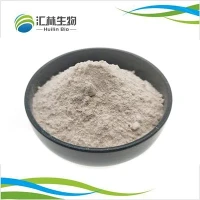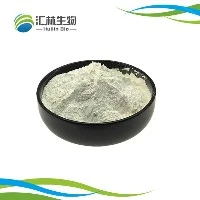


Xi'an Huilin Bio-Tech Co., Ltd. is one of the leading manufacturers and suppliers of 3,5-diaminobenzoic acid powder in China. With abundant experience, we are committed to providing high quality natural products with competitive price. Please feel free to wholesale bulk pure 3,5-diaminobenzoic acid powder for sale here from our factory.
3,5-Diaminobenzoic acid (CAS 535-87-5) carries two amines and one acid on a single benzene ring, with the amines meta to each other and one on either side of the carboxyl. It is a white to grey powder, C7H8N2O2, molecular weight 152.15, and it decomposes at 235 - 238 °C rather than melting cleanly.
Producers of iodinated contrast media take it as the core that receives three iodine atoms; peptide chemists use it as a bifunctional aromatic acid; synthesis groups use it wherever a benzoic acid with two nitrogen handles is wanted.
Two structural facts drive everything else. The two amines are equivalent by symmetry, so a reaction at one is a reaction at both unless the conditions are controlled. And the molecule is very soluble in water - unusual for an aromatic acid, and a direct consequence of having two basic centres on a small ring.
Specification
| Item | Specification | Test Method |
| Physical Description | / | / |
| Appearance | White to grey powder | Visual |
| Melting Range | 235 - 238 °C with decomposition | Capillary method, USP Chapter 741 |
| Identification | Conforms to reference standard (retention time) | HPLC |
| Chemical Tests | / | / |
| Assay | ≥ 98.0% | HPLC, area normalization |
| Water | ≤ 0.5% | Karl Fischer |
| Residue on Ignition | ≤ 0.1% | Gravimetric, USP Chapter 281 |
| Heavy Metals | / | / |
| Heavy Metals (as Pb) | ≤ 10 ppm | ICP-MS |
Grade limits only. Every batch is delivered with its own data sheet.
Symmetry and the Two Equivalent Amines
The ring has a mirror plane running through C1 and C4. The amines sit at C3 and C5, which are mirror images of each other, so the two are chemically identical: same environment, same pKa, same reactivity. There is no "first" and "second" amine in the way there is in a 3,4-disubstituted ring.
That symmetry is convenient when both amines are meant to react and awkward when only one should. A mono-substitution has to be stopped statistically or steered by protecting one side, and the product of a partial reaction is a mixture unless the second equivalent is withheld deliberately.
For the contrast media route the symmetry is not a problem: all three positions around the ring are meant to be substituted, and the molecule is designed for that. For a researcher building an unsymmetrical target, it is the first thing to plan around.
Why an Aromatic Acid Dissolves in Water
Most aminobenzoic acids are sparingly soluble in water; this one is very soluble. The difference is not the carboxyl - it is the two amines. In acidic solution both are protonated, giving a doubly charged cation that hydrates readily; in neutral water the zwitterionic forms add to the same effect.
The practical consequence is a work-up that behaves differently from the rest of the family. Extraction into an organic solvent from water does not simply follow pH, because the molecule partitions as an ion over a wide window. Isolation is usually by pH adjustment - acidification to about pH 3 precipitates the free acid - rather than by solvent extraction.
The reported first pKa of 5.30 belongs to the carboxyl. The amines are far less basic than an aliphatic amine would be because the ring withdraws electron density, which is why the compound can exist as a stable salt without the amines being tied up.
Three Aminobenzoic Acids, Different Handles
The position of a single amine changes a great deal; adding a second changes more. The table sets out what each of the three common aminobenzoic acids offers, without ranking them - the route decides which pattern is useful.
| Acid | Amine positions | Formula / MW | What it enables |
| 3,5-Diaminobenzoic acid | Two, meta to each other and flanking the carboxyl | C7H8N2O2 / 152.15 | Symmetrical tri-substitution, or a difunctional acid for polymer and peptide work |
| 4-Aminobenzoic acid | One, para to the carboxyl | C7H7NO2 / 137.14 | A linear donor-acceptor arrangement; the basis of the ester and amide family |
| 3-Aminobenzoic acid | One, meta to the carboxyl | C7H7NO2 / 137.14 | An angled arrangement, used where the para isomer gives the wrong geometry |
Note that the two mono-amino acids share a formula and a molecular weight, so a certificate listing only those two values cannot say which one is in the drum. Position matters in the route even when the mass does not change.
Applications
Iodinated Contrast Media Intermediates - the aromatic core that carries three iodine atoms, with the two amines and the acid providing the positions the route needs.
Peptide and Amide Synthesis - a bifunctional aromatic acid whose two amines are equivalent, used where a symmetrical linker is wanted.
Polymer and Resin Monomers - a tri-functional aromatic building block for crosslinked or branched systems, where the symmetry simplifies the statistics of substitution.
Dye Intermediates - a coupling component carrying two diazotisable amines, which allows two azo links to be built on one ring.
What a route delivers depends on the pH profile, the stoichiometry and the order of addition; the description here covers the material as supplied.
FAQ
Q: Are the two amines equivalent?
A: Yes. The ring has a mirror plane through C1 and C4, and the amines sit at the mirrored positions 3 and 5. They have the same environment, the same acidity and the same reactivity, so a mono-substitution cannot be directed by choosing the "right" amine - it has to be controlled by stoichiometry or by protecting one side.
Q: Why is it so much more water-soluble than 4-aminobenzoic acid?
A: Because of the two amines rather than the acid. Protonated or zwitterionic forms hydrate readily, so the molecule stays in the aqueous phase over a wide pH range. That changes the work-up: isolation is by pH adjustment rather than by extraction, since the compound does not partition cleanly into an organic solvent.
Q: What does the decomposition point mean for handling?
A: It means the material does not have a true melting point: at 235 - 238 °C the molecule reacts before it liquefies, losing carbon dioxide as the acid decarboxylates. The range is therefore an identity check, not a processing window, and a depressed onset indicates residual moisture or an impurity.
Q: Which impurities are visible on the certificate?
A: Partially reduced material from the nitro precursor and residual 3,5-dinitrobenzoic acid are the two that appear if the hydrogenation is incomplete. Both elute separately from the main component, which is why assay is reported by area normalisation.
Q: Is the pKa relevant to formulation?
A: The reported first pKa of 5.30 belongs to the carboxyl and governs salt formation and the pH at which the free acid precipitates. The amines are much less basic than aliphatic amines because the ring withdraws electron density, which is why the compound can be handled as a stable salt.
Q: How should it be stored?
A: Keep it sealed and dry, out of the light, at ordinary room temperature. The powder takes up moisture readily given its solubility, and both amines oxidise slowly, so colour deepens before assay moves.
Q: Can a low-metal grade be supplied for contrast media work?
A: Yes, on request. A tighter heavy-metal screen can be written into the release specification before the batch is made, and the certificate then reports the measured values against that limit rather than against the standard one.
Supply, Documentation and Contact
3,5-Diaminobenzoic acid ships as a white to grey powder, 1 kg to a foil bag and 25 kg to a fibre drum. Bags are filled after release and sealed with a desiccant where the pack allows, because the powder picks up moisture readily.
For contrast media and polymer work, a tighter metal screen or a residual solvent panel can be added to the release specification before packing. Ask for the import documents your market requires and they will be prepared.
Contact: sales@huilinbio-tech.com
A description of the substance, not an authorisation. Each jurisdiction decides what is allowed.
Hot Tags: 3,5-diaminobenzoic acid powder, China, suppliers, manufacturers, factory, wholesale, buy, price, bulk, pure, natural, high quality, in stock, for sale