

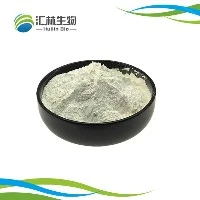


Xi'an Huilin Bio-Tech Co., Ltd. is one of the leading manufacturers and suppliers of 4-aminobenzamide powder in China. With abundant experience, we are committed to providing high quality natural products with competitive price. Please feel free to wholesale bulk pure 4-aminobenzamide powder for sale here from our factory.
4-Aminobenzamide (CAS 2835-68-9) differs from the rest of the 4-aminobenzoic acid family by one group: where the others carry an acid or an ester, this one carries an amide. It is an off-white to beige crystalline powder, C7H8N2O, molecular weight 136.15, melting at 181 - 183 °C.
Dye and pigment producers use it as the amine half of an azo coupling; synthesis groups use it where a carboxamide has to survive conditions that would hydrolyse an ester.
The amide is the whole point. It is not a protected acid waiting to be unmasked - it is a terminal group that hydrogen-bonds in two directions, resists hydrolysis, and pulls the melting point well above that of the corresponding ester.
Specification
| Item | Specification | Test Method |
| Physical Description | / | / |
| Appearance | Off-white to beige crystalline powder | Visual |
| Melting Range | 181 - 183 °C | Capillary method, USP Chapter 741 |
| Identification | Conforms to reference standard (retention time) | HPLC |
| Chemical Tests | / | / |
| Assay | ≥ 98.0% | HPLC, area normalization |
| Water | ≤ 0.5% | Karl Fischer |
| Residue on Ignition | ≤ 0.1% | Gravimetric, USP Chapter 281 |
| Heavy Metals | / | / |
| Heavy Metals (as Pb) | ≤ 10 ppm | ICP-MS |
What follows is the specification, not a test report. The report travels with the batch.
The Amide, Not an Ester
An ester and an amide both connect a carbonyl to something else, and the difference in behaviour between them is larger than the difference in structure. An ester is hydrolysed by aqueous base at room temperature within hours; an amide under the same conditions is largely unchanged and needs hot concentrated alkali to go anywhere.
That resistance is why the material is bought. A route that carries an ester through a basic step needs a protecting strategy; a route that carries an amide does not. What it gives up is the ease of removal, since an amide is not designed to come off.
The other consequence is physical. An amide has two hydrogen-bond donors on the nitrogen and a carbonyl to accept them, so the molecules associate in the solid and melt high. At 181 - 183 °C the melting range is far above the esters in the same family, and the compound is only slightly soluble in water.
Diazotisation and Coupling
The amine is primary and aromatic, so it diazotises in the usual way and the resulting diazonium salt couples with phenols and with aromatic amines. In pigment work that is the step that builds the chromophore, and the amide rides along on the ring as a substituent.
A substituent is not a passive passenger in a pigment. It changes how the molecules pack, which in turn changes shade, opacity and the behaviour of the pigment in a binder. That is why an amide is chosen where a methyl or a chlorine would also have been possible: it participates in the crystal lattice through hydrogen bonds that the alternatives cannot form.
The same amine is the handle for the other routes into the molecule - acylation, sulfonylation, conversion to the nitrile by dehydration. Each of those leaves the amide untouched, which is the practical meaning of calling the group terminal.
What the Specification Covers
Assay is by reversed-phase HPLC at ≥ 98.0%, resolved against residual 4-aminobenzoic acid and against the nitrile that forms if the amide is over-dehydrated. Those two are the impurities that matter, and both appear as separate peaks rather than as an undefined tail.
Melting range and water are reported per batch. On a compound this high-melting, a depressed onset is a sensitive indicator of residual acid, because even a small amount disrupts the hydrogen-bonded lattice. Water is limited to ≤ 0.5% and checked by Karl Fischer rather than by loss on drying, since the compound holds moisture in the lattice rather than on the surface.
Colour is specified as off-white to beige and is recorded rather than used as a purity index. The aromatic amine oxidises slowly, and a beige cast in material that has been handled is normal.
Applications
Azo Pigments and Dyes - the diazotisable amine half of a coupling, with the amide left on the ring as a substituent that shapes the pigment lattice.
Benzamide Building Blocks - a 4-substituted benzamide used where the amide is the group of interest rather than a protected acid.
Routes That Cannot Carry an Ester - a stand-in for the ester when the sequence contains aqueous base that would hydrolyse it.
Analytical Reference Work - a crystalline solid with a sharp melting range and a strong UV chromophore, used as a retention-time and melting-point reference.
What a coupling or a route yields depends on the diazotisation conditions, the coupling partner and the pH; this description covers the material as supplied.
FAQ
Q: What is the practical difference between this and the methyl ester?
A: Hydrolytic stability. The ester is opened by aqueous base within hours at room temperature; the amide resists the same treatment and needs hot concentrated alkali. If a route contains a basic step, the amide removes the need for a protecting group - in exchange for losing the easy removal the ester offers.
Q: Why does it melt so much higher than the esters in the family?
A: Hydrogen bonding. The amide has two N-H donors and a carbonyl acceptor, so the molecules link to each other in the solid. The esters have no donor on that group and melt far lower - around 110 °C for the methyl ester against 181 - 183 °C here.
Q: Does the amide interfere with diazotisation?
A: No. The amine is the reactive site and diazotises normally; the amide is unaffected and stays on the ring through the coupling. What it does change is the pigment that results, because the amide hydrogen-bonds within the crystal and alters packing, shade and opacity.
Q: Can the amide be converted to something else later?
A: Yes - dehydration to the nitrile is the usual transformation, and the amine can be acylated or sulfonylated without touching the amide. That combination is what makes the group useful as a terminus rather than as a protecting group.
Q: Why is water measured by Karl Fischer rather than loss on drying?
A: Because the compound holds moisture within the lattice as well as on the surface. Loss on drying can read low while the lattice water is still present; Karl Fischer measures the water itself, and ≤ 0.5% is the limit reported per batch.
Q: What impurities does the assay resolve?
A: Residual 4-aminobenzoic acid and the nitrile formed by over-dehydration. Both appear as distinct peaks ahead of or after the main component on a reversed-phase column, which is why the result is reported by area normalisation rather than as a single purity figure.
Q: How should it be stored?
A: Cool, dry, in the dark, under inert gas where the pack allows. The amine oxidises slowly, which shows first as a deepening beige colour rather than as a drop in assay, and the compound takes up moisture if a bag is left open.
Supply, Documentation and Contact
4-Aminobenzamide is supplied as an off-white to beige crystalline powder, 1 kg to a foil bag and 25 kg to a fibre drum, filled after release so the label and the certificate share one lot number.
Where a route needs a tighter water limit or a residual solvent panel, those items are written into the release specification before the batch is packed rather than tested afterwards. Import documentation for your market is drawn up per order.
Contact: sales@huilinbio-tech.com
Describes the material as supplied; permission for any particular use rests with the market of destination.
Hot Tags: 4-aminobenzamide powder, China, suppliers, manufacturers, factory, wholesale, buy, price, bulk, pure, natural, high quality, in stock, for sale


