



Autolyzed yeast extract is a savory food ingredient made from the soluble contents of ruptured Saccharomyces cerevisiae cells, and it is the ingredient most often specified when a formulation needs umami without adding monosodium glutamate. Two legal facts decide how far that substitution can go.
The first is that free glutamate and sodium occur together naturally in yeast extract, which is exactly the combination MSG supplies. The second is that US labelling rules treat that fact as decisive rather than incidental. Both are covered below with the source documents a buyer can hand to a regulatory team.
What autolyzed yeast extract is, and where it sits in US and EU law
Autolyzed yeast extract is defined in US regulation by the way it is made, not by a purity figure, and that definition is the reference point most buyers should start from.
Under 21 CFR 184.1983, bakers yeast extract is the food ingredient resulting from concentration of the solubles of mechanically ruptured cells of a selected strain of Saccharomyces cerevisiae, and it may be concentrated or dried.
The same section fixes its permitted function: the ingredient is used as a flavouring agent and adjuvant as defined in 21 CFR 170.3(o)(12), at a level not to exceed 5 percent in food.
In the European Union there is no equivalent single entry point, because yeast extract is regulated by function rather than by identity. Where it is added to impart odour or taste it falls within the EU flavouring regulation, (EC) No 1334/2008, and meets the definition of a flavouring preparation; where it is used as an ingredient it is declared under Regulation (EU) No 1169/2011, in which "yeast extract" is a generally accepted customary name. Both routes are set out in the EURaSYP position paper on the status of yeast extract, the industry association that represents European yeast extract producers.
Volume matters at the category level before it matters at the supplier level. The global yeast extract market was valued at US$1.7 billion in 2026 and is projected to reach US$2.7 billion by 2033, a 6.7% compound annual growth rate. Persistence Market Research Within savory ingredients in Europe, yeast extracts held a 32.2% share in 2025, the largest single category.
Autolyzed versus hydrolyzed: what changes at purchase
The two production routes are frequently treated as interchangeable in supplier quotations, and they are not.
| Parameter | Autolyzed | Hydrolyzed | What it changes at purchase |
|---|---|---|---|
| Breakdown mechanism | The yeast's own endogenous enzymes break down the cells | Added enzymes are used to break down the cells | Determines which process description the specification sheet must carry |
| Peptide profile | Described as typically richer in peptides | Composition described as broadly similar in the finished product | Affects flavour development in the finished application |
| Ingredient list wording | "Autolyzed yeast extract" or "yeast extract" | "Hydrolyzed yeast" or "yeast extract" | Decides the exact words a regulatory team will accept on the pack |
| Legal framework, US | Bakers yeast extract is affirmed GRAS at 21 CFR 184.1983 | Not the substance described in that section | A specification must be matched to the correct regulatory entry, not to a generic label |
| Typical commercial form | Powder, paste or liquid | Powder, paste or liquid | Form is a separate line item from the breakdown route |
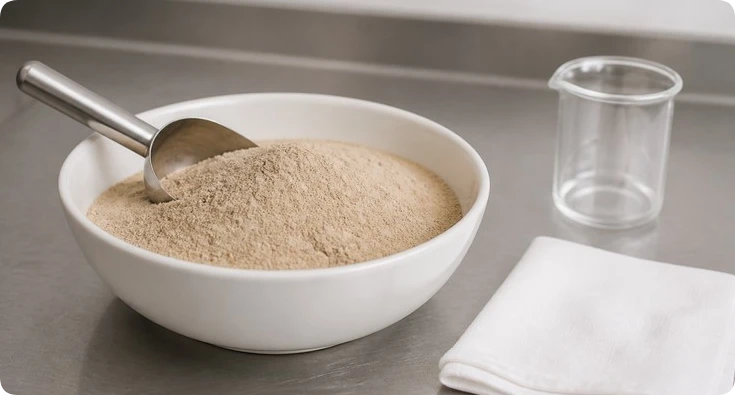
The specification we supply is produced by controlled autolysis of Saccharomyces cerevisiae, and the material we list as yeast extract powder is described on our product page as a yellowish-white to light brown fine powder with a characteristic yeasty odour, soluble in cold water, with a 2% solution pH of 6.5 to 7.5 at 25 degrees Celsius, and listed with a purity of 99% or above.

The US legal limits: what 21 CFR 184.1983 actually specifies
The regulation that affirms this ingredient as GRAS also fixes numeric limits that most supplier specifications show only in part, and a buyer can use the full table as a checklist.
| Parameter | Legal limit under 21 CFR 184.1983 | Basis |
|---|---|---|
| Arsenic | Less than 0.4 ppm | Dry weight |
| Cadmium | 0.13 ppm | Dry weight |
| Lead | 0.2 ppm | Dry weight |
| Mercury | 0.05 ppm | Dry weight |
| Selenium | 0.09 ppm | Dry weight |
| Zinc | 10 ppm | Dry weight |
| Aerobic plate count | Less than 10,000 organisms per gram | Finished ingredient, concentrate or dry material |
| Yeasts and moulds | Less than 10 per gram | Finished ingredient |
| Pathogens | Negative for Salmonella, E. coli, coagulase positive Staphylococci, Clostridium perfringens, Clostridium botulinum or any other recognised microbial pathogen or harmful microbial toxin | Finished ingredient |
All of the above are taken from 21 CFR 184.1983(b) and (c). Our own published figures cover arsenic at below 0.4 ppm and lead at below 0.2 ppm, aerobic plate count below 10,000 CFU/g and yeasts and moulds below 10 CFU/g, with the material free from viable yeast cells, all stated on our product page. The remaining lines in the table above are the ones worth requesting explicitly on a certificate of analysis, because a supplier specification that shows only two heavy metals does not cover the six the regulation names.
The 5% ceiling and the 0.5–2% working range
There are two different numbers a formulator needs, and confusing them creates either a compliance problem or an over-dosed product.
The ceiling is legal: under 21 CFR 184.1983(d) the ingredient may be used at a level not exceeding 5 percent in food. 21 CFR 184.1983(d) The working range is practical: in finished foods the typical dose of yeast extract is 0.5–2 percent.
The gap between those two figures is one of the useful facts about this ingredient. It is a flavour ingredient used in small amounts rather than a bulk nutrient, and the association representing European producers notes a specific benefit at those levels: it makes the taste of low-salt and vegetarian products more attractive, which is why it appears in reduced-sodium reformulation work.
Free glutamic acid: the number that decides your label
Free glutamic acid content is the single most consequential specification line for this ingredient, because it determines both what the pack may claim and, at the top of the range, whether the material may be called yeast extract at all.
The US position is unambiguous. FDA requires that foods containing added MSG list it in the ingredient panel as "monosodium glutamate", and it also states that free glutamate and sodium occur together naturally in hydrolyzed vegetable protein, autolyzed yeast, hydrolyzed yeast, yeast extract, soy extracts and protein isolate, as well as in tomatoes and cheeses. Those ingredients must be listed on the ingredient panel, but the label does not have to specify that they naturally contain glutamate.
That leads to the operative rule: foods with ingredients naturally containing free glutamate, including autolyzed yeast and yeast extract, cannot claim "No MSG" or "No added MSG" on their packaging. The same FDA page adds that MSG cannot be listed as "spices and flavoring", and that other glutamate salts such as monopotassium glutamate and monoammonium glutamate must likewise be specifically declared.
For scale, FDA puts average adult intake of glutamate from food protein at approximately 13 grams per day, against an estimated 0.55 grams per day from added MSG.
The upper end of the specification range carries its own constraint. Traditional yeast extracts contain free glutamic acid naturally at between 2% and 12% by weight, with a typical concentration of 4.8%, a figure confirmed by analysing 48 samples of standard traditional yeast extracts taken from member companies and tested by an external laboratory. Yeast-based products with a glutamic acid content above 12% are treated by the association as not representative of traditional yeast extract and, in its view, should not be labelled as yeast extract; such products are assessed case by case to determine their technological function and regulatory status.
Two practical consequences follow for a purchase file. Request the measured free glutamic acid figure rather than accepting a generic taste description. And treat the 12% line as a labelling threshold rather than a quality ranking, because a high-glutamate material may be the right tool for a flavour brief and the wrong material to call yeast extract on a pack.
How yeast extract is declared on the ingredient list
The declaration route depends on why the ingredient is in the formula, not on what it is, and the same material can take two different names in the European Union as a result.
| Function in the finished product | United States | European Union |
|---|---|---|
| Added to impart odour or taste | Listed in the ingredient panel; the label does not have to state that the ingredient naturally contains glutamate | Falls within (EC) No 1334/2008 and meets the definition of a flavouring preparation; may be declared as "natural flavouring" or, as a more specific name, "yeast extract" |
| Added as an ingredient | Listed in the ingredient panel under its common name | Declared under (EU) No 1169/2011, in which "yeast extract" is a generally accepted customary name |
| Finished product carries a "No MSG" or "No added MSG" style claim | Not permitted where the formula contains yeast extract or autolyzed yeast | Not verified in this article; confirm the position with the competent authority in the target market before writing the claim |
The US column reflects FDA guidance on MSG, and the EU column reflects the EURaSYP position paper, which sets out both the flavouring route under (EC) No 1334/2008 and the ingredient route under (EU) No 1169/2011. The third row is marked as unverified deliberately: the flavouring and ingredient routes are documented by the sources cited here, while the claim restriction is confirmed only on the US side.
One practical note for formulators: because the declaration follows function, the same purchased lot can appear as "natural flavouring" in one product and "yeast extract" in another. The decision belongs to the finished product's development team rather than to the ingredient supplier, and it is worth settling before artwork is approved rather than after.
What to ask a bulk yeast extract powder supplier for
A specification sheet and a certificate of analysis do different jobs, and a buyer should ask for both plus the three documents that decide whether a launch date holds.
The specification should state the breakdown route, the form, the solubility, the pH of a 2% solution, the microbiological limits and the full heavy metals panel against the six elements named in 21 CFR 184.1983. The certificate of analysis should carry the measured values for the lot being shipped rather than the specification targets, together with the measured free glutamic acid content, because that number determines the declaration options covered above.
The three documents that most often delay a launch are the allergen declaration, the technical data sheet with processing guidance, and the target-market regulatory file. Our published document list covers a certificate of analysis, an MSDS, a technical data sheet, an allergen declaration and a GMP statement, with Kosher, Halal and gluten-free certificates and a target-country regulatory dossier available on request.
Certification is the area where a quotation most often overstates reality, so it is worth being precise about wording. Our page lists Kosher (OU or OK), Halal, GFCO Gluten-Free, Non-GMO Project Verified and Vegan as options that can be supplied, and asks buyers to specify certification requirements at the time of ordering. That is a statement about what can be arranged for an order, not a statement that every certificate is held by default, and a buyer should confirm the exact scheme and certificate holder before relying on it in artwork.
On commercial terms, our published minimum order quantity is 25 kg in a fibre drum with samples of 100–500 g available for testing, lead time for commercial orders is typically 2–3 weeks after confirmation, and OEM packaging is offered at 1 kg, 5 kg, 10 kg and 25 kg with private labelling in multiple languages. Custom blends combining yeast extract with other actives can also be arranged. Storage is stated at 2–8 degrees Celsius, protected from light and moisture, with a 24-month shelf life in the unopened container; the powder is hygroscopic, so once a drum is opened it should be resealed promptly.
Frequently asked questions
Q: Is Autolyzed Yeast Extract The Same Thing As MSG?
A: No, but it contains the same molecule in a different form. MSG is the sodium salt of glutamic acid, added as a purified ingredient; yeast extract contains free glutamate and sodium that occur together naturally, which is why US labelling rules treat it the same way for claim purposes. FDA states that free glutamate and sodium occur together naturally in yeast extract and autolyzed yeast.
Q: Can A Food Containing Yeast Extract Be Labelled "No MSG"?
A: No. FDA states that foods with ingredients naturally containing free glutamate - including hydrolyzed vegetable protein, autolyzed yeast, hydrolyzed yeast, yeast extract, soy extracts and protein isolate - cannot claim "No MSG" or "No added MSG" on their packaging. A formulator planning that claim needs to change the claim or change the formula.
Q: How Is Yeast Extract Declared In An EU Ingredient List?
A: It depends on function. If it is added to impart odour or taste it falls under (EC) No 1334/2008 as a flavouring preparation and may be declared as "natural flavouring" or more specifically as "yeast extract". If it is used as an ingredient, it is declared under (EU) No 1169/2011, where "yeast extract" is a generally accepted customary name.
Q: What Heavy Metal Limits Apply To Bakers Yeast Extract In The United States?
A: 21 CFR 184.1983 sets six limits on a dry weight basis: arsenic below 0.4 ppm, cadmium 0.13 ppm, lead 0.2 ppm, mercury 0.05 ppm, selenium 0.09 ppm and zinc 10 ppm. It also sets a microbiological standard, including an aerobic plate count below 10,000 organisms per gram and yeasts and moulds below 10 per gram.
Q: How Much Yeast Extract Can Be Used In Food In The United States?
A: The legal ceiling is 5 percent of the food, set by 21 CFR 184.1983(d) for use as a flavouring agent and adjuvant. The practical range is far lower: the typical dose in finished foods is 0.5–2 percent, according to the industry association representing European producers, and it is used at those levels partly to improve the taste of low-salt and vegetarian products.
Q: What Is The Difference Between Autolyzed And Hydrolyzed Yeast Extract?
A: Autolyzed material is broken down by the yeast's own endogenous enzymes, while hydrolyzed material uses added enzymes; the finished compositions are described as broadly similar, with autolyzed versions typically carrying a richer peptide profile. Our material is produced by controlled autolysis, and the specification sheet should always state which route was used.
Next step: fix the declaration route before the quotation
Two questions decide whether a yeast extract purchase runs smoothly, and both belong in the first exchange with a supplier. The first is the breakdown route and the measured free glutamic acid figure, because together they determine what the material may be called on a pack. The second is the certificate of analysis against the full six-element heavy metals panel and the microbiological standard in 21 CFR 184.1983, because a two-element specification leaves four legal limits unchecked.
You can request a current-lot certificate of analysis, an allergen declaration and a sample through our inquiry form, or reach the documentation team through the contact page. Bulk yeast extract powder specifications, packaging options and OEM labelling terms are listed on the yeast extract powder product page, and buyers assembling a wider savoury or nutritional range can start from our supplement ingredients selection.
This article is written for food and supplement formulation, procurement and regulatory professionals. It is not consumer product advice, and nothing here is intended to diagnose, treat, cure or prevent any disease.
Sources
- US Food and Drug Administration. 21 CFR 184.1983 - Bakers yeast extract. Electronic Code of Federal Regulations. https://www.ecfr.gov/current/title-21/chapter-I/subchapter-B/part-184/subpart-B/section-184.1983
- US Food and Drug Administration. Questions and Answers on Monosodium glutamate (MSG). 19 November 2012. https://www.fda.gov/food/food-additives-petitions/questions-and-answers-monosodium-glutamate-msg
- EURaSYP. EURaSYP Position on the status of Yeast Extract, EWGL-20-06. https://www.yeastextract.info/wp-content/uploads/2022/10/EURASYPStatus-Yeast-extract-new.pdf
- Persistence Market Research. Yeast Extract Market Size & Sales Statistics, 2026–2033. https://www.persistencemarketresearch.com/market-research/yeast-extract-market.asp
- MarketDataForecast. Europe Savory Ingredients Market. https://www.marketdataforecast.com/market-reports/europe-savory-ingredients-market