

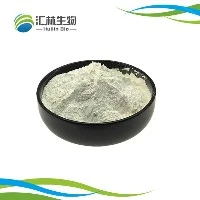


Xi'an Huilin Bio-Tech Co., Ltd. is one of the leading manufacturers and suppliers of cinnamic acid powder in China. With abundant experience, we are committed to providing high quality natural products with competitive price. Please feel free to wholesale bulk pure cinnamic acid powder for sale here from our factory.
Cinnamic acid powder arrives as white to light yellow crystals with a faint balsamic smell - 148.16 g/mol, CAS 140-10-3, released at 98.0 % minimum by HPLC.
What the material does in a formulation is decided less by that percentage than by two other things: which of the two geometric isomers is in the bag, and whether the acid has been neutralised before anyone expects it to dissolve. Both are covered below, along with the numbers that make each one checkable.
The page is written for people who have to release a lot, dissolve it, or explain to a customer why two certificates for the same product disagree.
Two Solids Under One Name
The reason this material is a crystal at all is a structural detail: the double bond between the ring and the carboxyl group sits in the trans configuration, and that flat, regular shape packs tightly enough to melt at 133 °C. The cis form of the same molecule, CAS 102-94-3, melts at 66 to 68 °C. Same formula, C9H8O2, same mass, 148.16, and a gap of 65 °C between the two solids.
On the certificate this becomes the most useful line in the document. This grade is released on a melting range of 132.0 to 135.0 °C. A lot that melts near 120 °C, or that begins at 118 and finishes at 133, is carrying either the cis isomer or residual benzaldehyde from the synthesis - and neither of those shows up as a lower assay figure. The assay can read 98 % on a lot that fails the melt.
Three registry numbers circulate for the same drum. 140-10-3 designates the trans acid and is the number used on this page. 621-82-9 is the older generic entry, with no stereochemistry specified: its InChIKey ends UHFFFAOYSA, the non-stereospecific form, against VOTSOKGWSA for the trans acid. 102-94-3 is the cis acid. Chinese listings use 140-10-3 and 621-82-9 interchangeably for the same material, so a certificate should be matched to the label by melting range rather than by number alone.
Why It Hardly Dissolves
Solubility in water is 0.4 g/L at 20 °C. Divided by 148.16, that is 2.7 mmol/L - a saturated solution is about three thousandths molar, which is not a solution anyone can titrate comfortably or pump through a line.
The pKa is 4.44, so most of what does dissolve stays undissociated. At 2.7 mmol/L the hydrogen ion concentration works out to about 3 × 10⁻⁴ mol/L, which is pH 3.5, and a 0.4 g/L solution measures between pH 3 and 4. The solubility, the pKa and the measured pH agree with one another, which is what makes all three usable.
Getting the acid into water is therefore a neutralisation rather than a dissolution. 100 g of the acid is 0.675 mol and takes 27 g of sodium hydroxide to convert completely; the sodium salt at 170.14 g/mol is what actually enters solution, 114.9 g from that 100 g. Half-neutralising instead leaves a buffer at pH 4.4 with part of the material still solid, which is the usual reason a trial batch goes cloudy.
Where no base is wanted, the acid goes into ethanol, methanol, acetone, ether or glacial acetic acid first. It is slightly soluble in hot water and much more soluble in the organic solvents, so recrystallisation from hot water is the standard purification and also the standard way to lose yield.
What the 98.0 % Is Calculated On
The assay runs by HPLC with UV detection at 273 nm, the absorption maximum of the conjugated ring, double bond and carbonyl in methanol. No derivatisation, no evaporative light scattering: the chromophore is built into the molecule. The same chromophore is why the cinnamate esters are used as UVB absorbers in sunscreens - one structural feature serving two industries.
Two conventions sit behind a figure like 98.0. A result can be calculated on the material as received, or on the dried basis. What separates them is water, and this grade carries a limit of 0.5 %. A lot at 98.0 % as received with 0.5 % water is 98.49 % on the dried basis, from 98.0 ÷ 0.995. Neither figure is wrong; they answer different questions, and a specification that does not say which one is being stated is not yet a specification. Our certificate states both, and names the basis used for the release.
What separates a 98 % lot from a 99 % lot is usually water and residual benzaldehyde rather than a different synthesis. Both are visible on the certificate: water as a number, benzaldehyde as the reason a melting range sits at the bottom of its window.
An area percentage read off the chromatogram and an assay against an external standard are also not the same number. The certificate names the route, and the two should not be compared without checking which was used.
Specification and Release Basis
The table below is the release specification for this grade. Every row is tested per batch; the results belong to the lot and travel on its certificate, not on this page.
| Item | Specification | Test Method |
| Appearance | White to light yellow crystalline powder | Visual |
| Odour | Faint balsamic, cinnamon-like | Organoleptic |
| Assay (C9H8O2) | ≥ 98.0 % | HPLC, UV 273 nm |
| Melting range | 132.0–135.0 °C | Capillary method |
| Water content | ≤ 0.5 % | Karl Fischer |
| Residue on ignition | ≤ 0.1 % | Gravimetric |
| Heavy metals (as Pb) | ≤ 10 mg/kg | ICP-MS |
| Arsenic | ≤ 2 mg/kg | ICP-MS |
| Total aerobic count | ≤ 1,000 CFU/g | Plate count, 35 °C |
| Yeast and mould | ≤ 100 CFU/g | Plate count, 25 °C |
| E. coli | Absent in 1 g | Culture |
| Salmonella | Absent in 25 g | Culture |
These are release limits, not a description of the best lot the plant can produce. Where a tighter limit or an additional test is required - a lower benzaldehyde figure, a narrower melting range, a residual solvent screen - that is written as a separate specification and released against it.
Where the Carbon Skeleton Comes From
The commercial route is the Perkin condensation. Benzaldehyde and acetic anhydride are heated with anhydrous sodium acetate at about 180 °C for eight hours; unreacted aldehyde is removed by steam distillation; the solution is acidified and the acid crystallises on cooling. The yield reported for the process is around 58 %.
Two consequences follow. The first is that this is a synthetic material, not a cinnamon extract. The carbon skeleton is assembled from petrochemical benzaldehyde, and the natural-grade article - extracted, sold under a different designation, and carrying its own documentation trail - is a separate product. A flavour house working to a natural-origin rule cannot substitute one for the other, and the earlier that is established, the fewer samples are wasted on both sides.
The second follows from the first. What the route can leave behind is unreacted benzaldehyde, and the steam distillation exists to remove it. A lot that skipped or shortened that step smells sharper and melts lower, which is why the two release tests on this page are the assay and the melt rather than the assay alone.
Nothing in the route introduces a plant-source variable: no crop year, no pesticide residue profile, no species question. That is worth stating plainly, because a catalogue page for a botanical extract would need three paragraphs on exactly those points.
Light, Heat and the Double Bond
The trans double bond is the part of the molecule that reacts. Ultraviolet light isomerises it towards the cis form, which is why the stability note names light before anything else and why the material is packed to keep it out.
Isomerisation is slow and partial, and it reaches the melting range before it reaches anything else. A drum stored against a window for a season can fail the melt while the assay still reads 98 %. That is the second reason the melting range is the release test and the assay is not.
Dry heat is less of a problem than light. The acid melts at 133 °C and boils at 300 °C; beyond that it loses carbon dioxide and becomes styrene, a decarboxylation rather than a breakdown, which is why the material should not be held molten in an open vessel.
Storage is sealed, dry, at ambient temperature, away from light. The 2 to 8 °C on a reagent bottle is a laboratory instruction for a 5 g pack; a 25 kg bag in a warehouse is stored dry and dark, not refrigerated.
What It Is Not
The substance substituted for cinnamic acid most often is hydrocinnamic acid, because the names differ by one word and the molecules differ by one double bond. Two measurements separate them without ambiguity: the melting point, 133 °C against 47 to 48 °C, and the ultraviolet spectrum, which hydrocinnamic acid does not have in the same region because the conjugation is gone.
Cinnamaldehyde is the other confusion, usually at the ordering stage rather than at the bench. It is a liquid at room temperature, melting at −7.5 °C, with a much stronger odour, and it is one oxidation step away from the acid.
| Substance | CAS | Key figures | Practical difference |
| Cinnamic acid, trans | 140-10-3 | C9H8O2, 148.16, mp 133 °C | Solid acid; 0.4 g/L in water; absorbs at 273 nm |
| Cinnamic acid, cis | 102-94-3 | C9H8O2, 148.16, mp 66–68 °C | Same mass, different crystal; depresses the melt when present |
| Cinnamaldehyde | 104-55-2 | C9H8O, 132.16, mp −7.5 °C | Liquid; aldehyde; one oxygen less |
| Hydrocinnamic acid | 501-52-0 | C9H10O2, 150.17, mp 47–48 °C | Saturated; no 273 nm band; different melting |
| Methyl and ethyl cinnamate | - | esters of this acid | Separate articles with their own specifications |
Ferulic acid and p-coumaric acid share the skeleton with a substituted ring. The extra hydroxyl and methoxy groups change solubility and reactivity enough that nothing transfers by mass, and the product names give no hint of which one is in the drum.
Where It Is Used
Flavour and fragrance. A fixative and blender rather than a top note: it softens spicy, cinnamon, cherry and honey accords and holds them in the compound. Its own odour is mild beside the aldehyde's.
Ester manufacture. Methyl, ethyl and benzyl cinnamate are made from this acid by esterification and are sold as flavour materials in their own right.
Photosensitive resins. Polyvinyl cinnamate is the classic negative photoresist, and the cinnamoyl group is what makes it light-sensitive. The same reactivity that puts a shelf life on the powder is the working mechanism in the coating.
Corrosion inhibition and surface finishing. Galvanised steel, electroplating baths and PVC heat stabilisation all use the acid or its salts as an additive.
Pharmaceutical intermediates. Baclofen and cinnarizine are built from it, and an enzymatic route to L-phenylalanine starts here.
Analytical reagent. Determination of uranium and vanadium, and separation of thorium.
Regulatory Position
In the United States, cinnamic acid is named in the list of synthetic flavouring substances and adjuvants permitted under 21 CFR 172.515, and it carries FEMA number 2288. In China it is listed in GB 2760 as a food flavouring. In the European Union, flavouring use falls under Regulation (EC) No 1334/2008 and its Union list; documentation for that route is prepared on request. In cosmetic use it is a fragrance ingredient.
The hazard profile is mild but not empty: eye irritant category 2 under GHS, H319, and the older R36/37/38 phrasing on some safety data sheets. Oral LD50 in the rabbit is 2500 mg/kg and dermal LD50 above 5000 mg/kg. The safety data sheet that travels with the drum carries the full set.
This grade is released against the specification above. Where a market requires a food-grade release, that release is issued separately and is not implied by this page.
Questions Buyers Ask Before the First Order
Q: Is cinnamic acid the same as cinnamaldehyde?
A: No. The aldehyde is C9H8O at 132.16, liquid at room temperature with a melting point of −7.5 °C. The acid is C9H8O2 at 148.16, melting at 133 °C. One oxygen separates them, and with it the physical form, the odour strength and the CAS number.
Q: What is the difference between 140-10-3 and 621-82-9?
A: 140-10-3 is the trans acid; 621-82-9 is the older entry with no stereochemistry specified. Both appear on commercial documents for the same drum. The melting range, 132.0 to 135.0 °C, is what tells you which solid is in the bag.
Q: My lot melted at about 120 °C. What does that mean?
A: Either cis isomer or residual benzaldehyde - both depress and broaden the melt. It is a purification or storage signal, and the certificate alone will not show it, because the assay can still read 98 % on that lot.
Q: Is this natural or synthetic?
A: Synthetic, by the Perkin condensation from benzaldehyde and acetic anhydride. It is not a cinnamon extract and carries no natural-origin designation; the natural article is a separate product.
Q: How do I get 100 g into a litre of water?
A: Not by stirring. Neutralise it: 100 g is 0.675 mol and takes 27 g of sodium hydroxide, giving 114.9 g of sodium cinnamate, which dissolves. Half-neutralising leaves a pH 4.4 buffer with part of the acid still solid.
Q: Which grade goes into flavour compounds?
A: Flavour work usually specifies 99.0 % minimum with a melting range of 132 to 135 °C, because the aldehyde and the cis isomer both carry odour. This page covers the 98.0 % grade; a 99.0 % release is a separate specification.
Q: What does the certificate test?
A: Appearance, odour, assay by HPLC at 273 nm, melting range, water, residue on ignition, heavy metals, arsenic and the microbiological set in the table. Results are per batch, and the water figure is what converts an as-received assay to a dried basis.
Q: Is it the same as hydrocinnamic acid?
A: No - one double bond less, C9H10O2 at 150.17, melting at 47 to 48 °C, and no absorption at 273 nm. The names differ by one word; the melting point settles it.
Supplier
Xi'an Huilin Bio-tech Co., Ltd. supplies cinnamic acid powder at 98.0 % minimum by HPLC, alongside cinnamaldehyde, ethylhexyl methoxycinnamate, vanillin and ferulic acid, from Shaanxi. Material is bought against a written specification rather than a catalogue entry, and each batch leaves with the certificate that carries the figures shown above. Documentation to support import requirements in the destination market is available on request.
Sealed, dry and away from light, the powder holds its specification for 24 months in unopened packaging.
This page describes a raw material supplied to laboratories and to manufacturers for research and industrial use. It is not a finished product and it is not a medicinal product. Final application and the regulatory determination in the destination market belong to the manufacturer of the finished product.
Hot Tags: cinnamic acid powder, China, suppliers, manufacturers, factory, wholesale, buy, price, bulk, pure, natural, high quality, in stock, for sale, Cosmetic Raw Material, Laurocapram Azone Powder, Puer Snow White Powder, Pure Retinol Powder, Superoxide Dismutase Powder, Tetrahydrocurcumin Powder


