



A bag of konjac gum glucomannan carries two numbers on the same panel: at least 95%, and at least 3,000 mPa·s. They answer different questions. The first says how much of the powder is the polysaccharide. The second says how thick it gets once it meets water, and that is the one that decides whether your formula works. Our konjac gum powder states both.
1. Three Names, One Powder
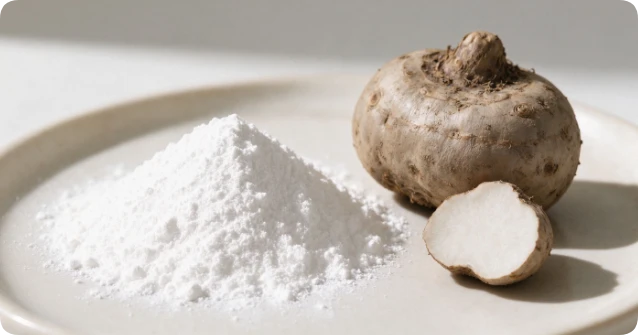
Konjac gum, glucomannan, KGM and E425 send people looking for four different products, and they describe one. Amorphophallus konjac is the plant. Glucomannan is the polysaccharide pulled from its tuber, and KGM is the abbreviation you will see in technical documents. Konjac gum is that polysaccharide sold as a food ingredient, and E425 is the number the European Union uses for it on an ingredient list.
| Name | What it names | Who uses the term |
| Amorphophallus konjac | The plant species | Growers, importers, botanists |
| Glucomannan (KGM) | The polysaccharide itself | Technologists, specification sheets, literature |
| Konjac gum | The ingredient as traded | Buyers, formulators, purchasing |
| E425 | The EU additive number | Regulatory affairs, label writers |
The confusion has a practical cost. A specification written for glucomannan and a specification written for konjac gum can describe the same drum with different test methods and different limits, and a buyer comparing the two documents may conclude they are looking at different grades. They usually are not. They are looking at the same material through two naming conventions.
2. What ≥95% Actually Counts
The 95% figure on a konjac gum powder certificate is the glucomannan content measured on a dry basis, which means the water has been taken out of the calculation before the percentage is struck. That single word changes what the number means. A powder at 95% dry basis with 10% moisture is not 95% glucomannan as it sits in the bag; it is about 85.5% of the material you scoop, and the rest is water.
This is why a konjac gum specification carries several upper limits alongside the headline figure. Each one is subtracting something different, and together they describe what the 95% is not.
| Line | Limit on this specification | What it is subtracting |
| Moisture | 12% maximum at 105 °C for 5 hours | Water, and the reason the assay is quoted dry |
| Protein | 3% maximum | Tuber protein carried through the extraction |
| Total ash | 5% maximum at 800 °C | Mineral matter, including soil from the field |
| Starch | 3% maximum | Residual tuber starch not converted to gum |
The moisture line is worth dwelling on because it moves the arithmetic. If you need a stated amount of glucomannan in a serving, you are weighing out more powder than the label suggests, and the gap widens as moisture rises toward the limit. At 12% moisture the same 95% dry-basis powder delivers about 83.6% of its mass as glucomannan.
3. The Number That Decides Your Formula
Two lots of konjac gum glucomannan can both read 95% and behave nothing alike, because the percentage counts how much polysaccharide is present, not how long the chains are. Chain length is what viscosity measures. The specification for this konjac gum powder quotes at least 3,000 mPa·s for a 1% solution at 25 °C, and that reading is taken under fixed conditions precisely so two suppliers can be compared.
Viscosity does not fall in proportion to concentration. Halve the amount of gum and the reading drops by much more than half, so the instinct to use a little less and hope for a thinner sauce usually produces a product with no body at all. This is the single most common formulation surprise with this ingredient, and it is the reason the viscosity figure matters more than the assay figure for anyone working with texture.
| What you are making | What the gum is doing | What goes wrong first |
| Sauce or dressing | Holding body without adding oil | Over-thickening and a slimy mouthfeel |
| Konjac noodle | Forming a heat-stable gel with alkali | Gel that is too firm, or alkali taste left behind |
| Instant drink | Adding body at low use level | Clumping before it hydrates; gel slug in the cup |
| Capsule or sachet | Delivering fiber with no texture role | Too much viscosity, and swelling in the throat |
Compare that with a material where no such measurement exists. A ratio extract such as pumpkin seed extract powder is sold on how much raw herb went in, and no reading taken on the powder confirms it. Konjac gum sits at the opposite end: one number, one method, one temperature, and the argument about whether two quotes are comparable becomes a short one.
4. Why It Swallows Water
The glucomannan in konjac gum glucomannan is a long chain of mannose and glucose units with hydroxyl groups along its length. Those groups bond to water, the chain uncoils, and the result is a network that holds water in place rather than dissolving into a thin solution. The published figure for this material is 80 to 100 times its own weight in water, which is why a small scoop turns a pot of liquid into something that will not pour.
Heat and shear both speed that up. The powder disperses in cold water but hydrates slowly, and the lumps that form when it is dumped into liquid are powder that wetted on the outside and stayed dry inside. Adding it under agitation, or pre-blending it with another powder before it meets water, is the usual fix, and it is a mechanical problem rather than a chemical one.
The alkaline step is what makes this gum different from most thickeners. Add an alkali and the deacetylated chains associate into a gel that holds its shape when heated, which is the chemistry behind konjac noodles and konjac blocks. No other common hydrocolloid does this in the same way, and it is the reason the ingredient appears in two completely separate product categories: a thickener in one, a structural material in the other.
5. Two Claims, Two Sets of Conditions
The European Union authorises two health claims for glucomannan, and they do not share a dose. Both appear in the annex to Commission Regulation (EU) No 432/2012, and both attach conditions that a label writer has to meet before the wording can be used at all.
| Permitted claim | Intake the food must provide | Conditions attached | Warning required |
| Maintenance of normal blood cholesterol levels | 4 g glucomannan per day | Consumer must be told the effect needs 4 g daily | Choking, for people with swallowing difficulties or low fluid intake |
| Weight loss in the context of an energy-restricted diet | 3 g per day in three doses of 1 g | 1 g per quantified portion, 1 to 2 glasses of water, before meals, energy-restricted diet | Choking, on the same terms |
Two claims, 4 g and 3 g, and only one of them carries the diet condition. Check which of the two your intended serving size can actually deliver before you choose the wording. That gap is why label text cannot be copied from another product: at 95% dry basis and 12% moisture, 4 g of glucomannan means weighing about 4.78 g of powder, while a 1 g portion means about 1.20 g.
6. Frequently Asked Questions
Q: Is konjac gum the same as glucomannan?
A: Yes, at the level that matters for buying. Konjac gum is the traded name, glucomannan is the polysaccharide it consists of, and E425 is the European additive number. The three appear in different documents rather than describing different materials, which is why a specification can look unfamiliar without being a different grade.
Q: What does 95% glucomannan mean on a specification?
A: It means 95% of the dry matter is glucomannan, measured with the water removed first. It is not a purity figure for the powder in the bag. At the 12% moisture limit, the same material delivers about 83.6% of its mass as glucomannan, and any dose you calculate has to use that number rather than 95%.
Q: Why does viscosity matter more than the percentage?
A: Because two powders at the same percentage can build completely different textures. The percentage counts how much polysaccharide is present; viscosity reflects how long the chains are and how much water they hold. A specification states viscosity at a fixed concentration and temperature so that two suppliers can be compared on the same footing.
Q: Can I put a cholesterol claim on my label?
A: Only if the food provides 4 g of glucomannan per day and you tell the consumer that this intake is what produces the effect. The claim also requires a choking warning for people with swallowing difficulties or low fluid intake. At 95% dry basis and 12% moisture, 4 g of glucomannan means about 4.78 g of powder.
Q: Does konjac gum need heat to thicken?
A: No. It disperses in cold water and thickens as it hydrates, which is why it works in instant and cold-processed products. Heat and mechanical agitation speed the hydration up rather than trigger it. The step that does need alkali is gel formation for noodles and blocks, and that is a separate use of the same powder.
Q: Why does the label require a choking warning?
A: Because the material swells in contact with liquid, and a dry dose taken with too little water can swell in the throat. The warning is part of the authorized claim text rather than a marketing choice, and it has to appear wherever the claim appears. Taking the dose with one to two glasses of water is the measure the regulation specifies.
Xi'an Huilin Bio-tech Co., Ltd. supplies konjac gum powder extracted from Amorphophallus konjac tuber, with glucomannan content stated on a dry basis and viscosity stated at 1% and 25 °C on every certificate. Tell us the texture you are building and the daily glucomannan figure your label needs, and we will quote the grade that reaches it. Send your target specification and we will answer line by line.
Sources
-
1. Xi'an Huilin Bio-tech Co., Ltd. Konjac Gum Powder, product specification including glucomannan content, viscosity and moisture limits. product page
-
2. Commission Regulation (EU) No 432/2012 of 16 May 2012 establishing a list of permitted health claims made on foods. Annex, entries for glucomannan (konjac mannan). EUR-Lex 32012R0432
-
3. Xi'an Huilin Bio-tech Co., Ltd. Natural Ingredients category, for the range this product sits in. category page