


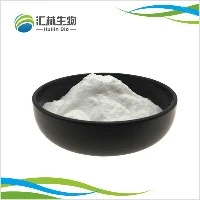


Alpha GPC powder has one ingredient, not a list: L-alpha-glycerylphosphorylcholine, CAS 28319-77-9, at 98 to 99.5% by HPLC. There is no carrier, no caffeine and no second active in that grade. What confuses buyers is the other grade, sold as 50% powder: the same molecule cut with a carrier, priced per kilo rather than per milligram of alpha GPC powder.

1. The Molecule, and Everything It Is
The compound inside alpha GPC powder is a glycerol backbone esterified to phosphoric acid and to choline, which is why it is also written choline glycerophosphate or choline alfoscerate. One molecule, one CAS number, one assay. Anything else on a certificate is a limit, a residue or water, not an ingredient.
| Property | Value | Why a buyer cares |
| CAS | 28319-77-9 | Identifies the L-alpha form, not a racemate |
| Formula / MW | C8H20NO6P / 257.22 | Sets the choline fraction |
| Choline content | 40–41% by weight | The number a dose calculation starts from |
| Assay | 98.0–99.5% HPLC | Our standard grade |
| Appearance | White crystalline powder | A 50% blend usually reads off-white |
| Melting point | 130–134 °C | Identity check that costs nothing |
| Solubility | 500 mg per mL water | Dissolves without a dispersion step |
The choline figure is the one worth memorising, and it is the same arithmetic whether the certificate calls the material alpha GPC powder or choline glycerophosphate. Every milligram of the powder carries 0.405 mg of choline and nothing else active, so a 600 mg dose is a 243 mg choline dose, which is 44% of the 550 mg adequate intake for an adult man. A label that promises 600 mg of choline needs 1,481 mg of this powder to keep that promise.
2. Two Grades, One Molecule, Two Prices
The 50% grade is the same molecule diluted onto a carrier so it can be weighed and blended without a glove box. It is not a lower purity of the same thing; it is a different product with a different assay basis, and the two are quoted on units that cannot be compared.
| Grade | What the powder contains | Powder needed for 600 mg active | Where it fits |
| 98–99.5% | The molecule and water, no carrier | 612 mg | Capsules, stick packs, precise dosing |
| 50% | Half the molecule, half a carrier | 1,200 mg | Powder blends, sachets, high-speed filling |
The practical consequence is on the label, not in the drum. A 1,000 mg scoop of a 50% powder delivers 500 mg of active, and a formulator who assumes otherwise under-doses by half. It also explains a price gap that looks irrational until you divide by active: the 50% grade is often cheaper per kilogram and more expensive per milligram.
There is a second reason buyers choose the diluted grade: hygroscopicity. The pure crystal takes moisture from the air quickly, so a filling line in a humid room needs low humidity, a desiccant and a short open time. A 50% choline glycerophosphate blend is easier to handle for exactly the reason it is less potent, and a plant that cannot control humidity should say so before choosing the grade rather than after the first caked drum.
Capsule maths follows from the same table. Six hundred milligrams of active is 612 mg of the 98% grade, which fills one size 00 capsule at a normal tamping density; the 50% grade needs 1,200 mg and therefore two. A formulator who sizes the capsule from the active figure and then buys the diluted grade has to redesign the dosage form, and that is a cost that never appears in a quotation.
3. What Is Not in the Powder
Three things are commonly assumed to be in alpha GPC powder and are not. There is no caffeine and no stimulant of any kind, so the focus story is not a stimulant story. There is no sweetener, flavour or colour in the standard grade. And there is no second choline source: a product that lists both alpha GPC and choline bitartrate is a blend somebody built, not a specification we ship.
Source is the other question a certificate should answer. Ask whether the lot is derived from soya or sunflower lecithin, because a soy-derived choline glycerophosphate triggers allergen declaration in both the US and the EU, and a buyer who assumes "no allergens" because the ingredient list is one line can be wrong on the label rather than in the drum.
Microcrystalline cellulose belongs to the 50% conversation, not the 98% one. If a supplier says the ingredient list is "alpha GPC and MCC", they are describing a diluted grade, and the question that follows is what percentage of the powder is active and what the carrier is. Neither answer is on the front of the tub.
4. The Four Lines That Decide a Lot
Assay alone will not tell you whether a lot of alpha GPC powder is usable. Four figures do, and two of them are routinely left off the certificate a buyer is sent.
Specific optical rotation of −2.7 to −2.8 degrees at 25 °C in water confirms the L-alpha configuration; a racemic lot assays correctly and is still the wrong molecule. Water content matters because the crystal is hygroscopic and an open drum gains weight that dilutes every subsequent calculation. Choline content should be stated so the dose arithmetic can be checked without a molecular weight. Heavy metals and microbial limits complete the set.
5. Why "50% Pure" Is the Wrong Sentence
Purity and concentration are different words, and alpha GPC powder is where the market mixes them hardest. A 50% powder is not half pure; it is half active and half excipient, and each half is what it says it is. A 99.5% powder is 99.5% the molecule with 0.5% water, related substances and residue.
A worked example makes the conversion concrete. If one quote is 40 per kilogram for a 50% blend and another is 70 per kilogram for the 98% grade, the first looks cheaper by 43%. Per gram of active it is 80 against 71, so the "expensive" alpha GPC powder is the cheaper source of choline glycerophosphate, and the gap widens once freight and the extra capsule shell are counted.
That distinction matters when a customer compares two quotes and concludes one supplier is cheating. Usually nobody is: one quote is per kilogram of blend and the other is per kilogram of active. Convert both to cost per milligram of alpha GPC before the argument starts, and the ranking often reverses.
6. Frequently Asked Questions
Q: What are the ingredients in alpha GPC powder?
A: One active: L-alpha-glycerylphosphorylcholine, CAS 28319-77-9, at 98 to 99.5% by HPLC. The remainder is water and trace related substances. The 50% grade adds a carrier, so it has two ingredients, and the carrier should be named on the certificate. That is the whole list.
Q: Is alpha GPC powder pure choline?
A: No. It is a choline ester that is 40 to 41% choline by weight. A 600 mg dose delivers about 243 mg of choline, and a label claiming 600 mg of choline needs 1,481 mg of the powder to support it.
Q: Does it contain caffeine or stimulants?
A: Not in the standard grade of alpha GPC powder. Alpha GPC is a phospholipid metabolite, not a stimulant, and any caffeine in a pre-workout comes from the caffeine the brand added. A certificate that lists only the assay and no other actives is consistent with that.
Q: Why is a 50% grade cheaper per kilogram?
A: Because half the kilogram is carrier. Compare cost per milligram of active rather than per kilogram: 600 mg of active needs 612 mg of the 98% grade and 1,200 mg of the 50% grade, so the cheaper drum can be the dearer dose.
Q: What carrier is used in the 50% grade?
A: It varies by manufacturer of the alpha GPC powder and it should never be a guess. Ask for the carrier name, its percentage, and whether it is declared on your finished label. Microcrystalline cellulose and silicon dioxide are common; neither belongs in the 98% grade.
Q: How should the powder be stored?
A: Sealed, dry and cool, with a desiccant. The crystal is very hygroscopic and soluble at 500 mg per mL, so moisture pickup is fast in an open filling room. Our material ships from 1 kg with a 24 month shelf life and is stored at 4 °C under nitrogen before dispatch.
Xi'an Huilin Bio-tech Co., Ltd. supplies alpha GPC powder at 98.0 to 99.5% HPLC, CAS 28319-77-9, with choline content and specific optical rotation stated on every certificate, and citicoline for formulators comparing the two choline sources. Tell us the grade you need and the carrier you can declare, and we will quote both on the same basis.
Sources
-
1. Institute of Medicine, Food and Nutrition Board. Dietary Reference Intakes for Thiamin, Riboflavin, Niacin, Vitamin B6, Folate, Vitamin B12, Pantothenic Acid, Biotin, and Choline. National Academies Press; 1998. NAP
-
2. Zeisel SH. Choline: an essential nutrient for public health. Nutrition Reviews. 2013;71(10):615-623. doi:10.1111/nure.12053. PubMed
-
3. EFSA Panel on Nutrition, Novel Foods and Food Allergens. Safety of L-alpha-glycerylphosphorylcholine (L-alpha-GPC) from soya phospholipids (lecithin) as a novel food pursuant to Regulation (EU) 2015/2283. EFSA Journal. 2026;24(5):e10008. doi:10.2903/j.efsa.2026.10008. EFSA
-
4. Regulation (EU) 2015/2283 on novel foods. EUR-Lex
-
5. US Food and Drug Administration. Structure/Function Claims. fda.gov
-
6. Regulation (EC) No 1924/2006 on nutrition and health claims made on foods. EUR-Lex