


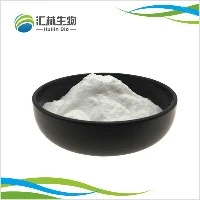


Alpha-ketoglutarate is the free diacid. Calcium alpha-ketoglutarate is its calcium salt, and for a buyer the difference is 21.76 g of calcium in every 100 g, a near-neutral solution, and a second CAS number. Both carry the same metabolite, so the choice is about formulation rather than potency.
1. The Short Answer
Neither form is stronger. The calcium salt exists because the free acid is a diacid, and a diacid is inconvenient in a capsule, a tablet or a beverage.
› Same metabolite, different salts: the free acid is C5H6O5, the calcium salt is C5H4CaO5
› The salt carries 79.3% alpha-ketoglutarate by weight, so 1 g of salt is not 1 g of the acid
› Dosing, calcium declaration and aqueous stability are the three decisions the choice actually moves
Everything else in this article is the evidence behind those three lines. The chemistry of the two molecules is covered in a separate explainer on AKG versus calcium AKG; this page is written for the person who has to put a number on a purchase order.
2. The Two Molecules, Field by Field
The identity fields differ on everything except the parent metabolite, and two of them decide whether your label declaration is correct. PubChem lists 2-oxoglutaric acid as CID 51 and calcium 2-oxoglutarate as CID 3018235, which is where the CAS numbers below come from.
| Field | Alpha-ketoglutarate (free acid) | Calcium alpha-ketoglutarate (salt) |
| Chemical name | 2-oxopentanedioic acid | calcium 2-oxopentanedioate |
| CAS | 328-50-7 | 71686-01-6 |
| Formula | C5H6O5 | C5H4CaO5 |
| Molecular weight | 146.10 | 184.16 |
| Alpha-ketoglutarate share | 100% | 79.3% |
| Calcium content | none | 21.76% (calculated) |
| Other identifiers | - | EINECS 275-843-2; UNII 95PE00B13W |
The 21.76% figure is arithmetic, not a claim: 40.078 divided by 184.16. It is also the number most often wrong on a specification, because a supplier quoting a monohydrate basis lands on 19.82% and a supplier reusing a hydrate formula lands somewhere else again. Put the basis on the certificate.
3. What the Calcium Changes: Acidity, Not Potency
The salt changes the pH of the powder in solution; it does not change what the metabolite does. Alpha-ketoglutarate is a two-carboxyl diacid, so a solution of the free acid is acidic, while the calcium salt has both carboxyl groups neutralised by one calcium ion.
That is the whole functional case for the salt in a solid dosage form: no free acid load in the blend, no acid spike in the stomach, and a calcium ion that has to be declared separately anyway. What it is not is a more potent material. Per gram of alpha-ketoglutarate delivered, the salt is the weaker of the two by exactly the 79.3% factor in the table above.
Be careful with the solubility story, because it is repeated everywhere and it is not supported. No source we located shows the calcium salt dissolving better than the free acid, and our own specification for the salt states 12 g per 100 mL of water at 20 °C, which is moderate rather than exceptional. If a supplier tells you the salt is chosen for superior solubility, ask for the comparative data.
4. What It Changes in an Aqueous System
Aqueous processing is where the free acid becomes the harder material, and the constraint is pH rather than concentration. Alpha-ketoglutarate degrades in aqueous solution above pH 7.0, which is the handling note on our own free-acid specification and the reason that grade is sold for dry blends and capsules.
Neutralising the acid does not make the molecule immune to water. It changes the pH window in which the solution sits, and a buffered system can still sit inside a range where the metabolite is not indefinitely stable. The practical conclusion for a formulator is the same either way: dry systems are the low-risk route, and any aqueous format needs its own accelerated stability data rather than an inference from the salt form.
The one human trial that used this material clinically did not use a beverage. The ABLE trial gave 1 g of sustained-release calcium alpha-ketoglutarate daily for six months, which tells you the dose and the delivery format that regulators and investigators accepted, not that a ready-to-drink format works.
5. The Calcium Is Declarable, So Do the Arithmetic
Calcium is not a filler in this salt, but it is a label constraint, and it is the item buyers most often forget to model. At 21.76% by weight, the salt puts a meaningful calcium load into any realistic dose.
| Daily dose of the salt | Calcium delivered | Share of the 800 mg EU reference intake |
| 1 g (the ABLE dose) | 218 mg | 27% |
| 2 g | 436 mg | 55% |
| 5 g | 1,088 mg | 136% |
Two consequences follow. If the finished product also carries calcium carbonate or citrate, the salt contributes to the same declaration and the percentages add. And if the label declares alpha-ketoglutarate rather than the salt, the declared mass has to be divided by 0.793 to get the powder weight, which is 1.26 g of salt for every 1 g of metabolite claimed.
6. What the Human Data Actually Covers
No human study we could locate compares the free acid against the calcium salt, so any claim that one absorbs better is unsupported at the human level. The record is thinner than the marketing suggests and worth stating precisely.
› The longest-lived animal data are mouse and worm studies, not human trials
› The one human randomized trial published so far reports recruitment feasibility, not an efficacy endpoint
› Lifespan findings in animals do not transfer to a supplement claim in either market
The mouse study behind most of the interest is Asadi Shahmirzadi and colleagues in Cell Metabolism in 2020, and the invertebrate work is Chin and colleagues in Nature in 2014. The human trial is ABLE, whose 2025 publication in Experimental Gerontology reports 467 enquiries, 120 enrolled over 223 working days, and an 80.3% pre-screening eligibility rate. Those are recruitment metrics. Any product claim about biological age has to wait for the outcome paper.
7. Which Grade to Specify
Choose by the physical system you are building, not by which form sounds more advanced. The table below is a starting position that still needs your own stability and compatibility work.
| Application | Free acid | Calcium salt | Why |
| Dry capsule or stick pack | Workable | Preferred | No free acid in the blend; moisture control is the shared requirement |
| Aqueous beverage | Constrained | Constrained | Neither form removes the need for accelerated stability data |
| Calcium-fortified positioning | Not applicable | Preferred | The calcium is declarable nutrition, not an impurity |
| Laboratory and cell culture | Standard | Special case | Media are formulated around the free acid and its sodium salt |
There is a third option that buyers ask about in the same breath, and it belongs in the comparison: arginine alpha-ketoglutarate, usually written AAKG, is the same acid with arginine instead of calcium. It carries a different nitrogen load and a different marketing story, and it is a separate AAKG grade rather than a substitute for either form above.
8. What Goes on the Purchase Order
Specify the assay basis before anything else, because two certificates can both read 99% and describe different powders. Then fix the identity fields, because that is where the two forms get confused even by people who know the chemistry.
› Assay and its basis: dried or anhydrous, stated explicitly on the certificate
› CAS and molecular formula, which for the salt are 71686-01-6 and C5H4CaO5
› Water content or loss on drying, since the hydrate basis moves the calcium percentage
› Calcium content measured, not only calculated, on at least the first three lots
› Heavy metals, microbiological limits and particle size against your process
Both grades are packed from 1 kg with a 24-month shelf life in the unopened container, and both are hygroscopic enough that a desiccant in the sample bag is worth asking for. The free-acid grade is specified at 99% by titration and the calcium salt at 99% by HPLC, so the two assays are not interchangeable and should never be compared as if they were.
9. Frequently Asked Questions
Q: Is calcium alpha-ketoglutarate the same thing as alpha-ketoglutarate?
A: No. Alpha-ketoglutarate is the free diacid, C5H6O5, CAS 328-50-7. Calcium alpha-ketoglutarate is its calcium salt, C5H4CaO5, CAS 71686-01-6, with a molecular weight of 184.16. They deliver the same metabolite, but they are different materials with different weights and different handling. Neither is a diluted version of the other.
Q: How much calcium does calcium alpha-ketoglutarate contain?
A: 21.76% by weight on the anhydrous salt, which is 40.078 divided by 184.16. A 1 g dose therefore delivers 218 mg of calcium, or 27% of the 800 mg EU reference intake. A monohydrate basis lowers the figure to 19.82%, so the basis has to be stated.
Q: Does the calcium salt absorb better than the free acid?
A: No human study we could locate compares the two, so the comparison is unproven rather than true. The salt is chosen for what it does to pH in the blend and in solution, and for the calcium it adds. Absorption claims need a human comparison that nobody has published.
Q: Can either form go into a ready-to-drink beverage?
A: Neither is easy in water. The free acid degrades in aqueous solution above pH 7.0, which is why it is sold for dry blends and capsules, and neutralising it does not remove the need for stability data. Dry formats are the low-risk route for both forms.
Q: Why is the salt more common in supplements?
A: Because a diacid is awkward in a solid dosage form. The salt removes the free acid load from the blend, sits near neutral in solution, and contributes declarable calcium instead of an acidity problem. None of that makes it more potent, and per gram of metabolite it contains less.
Q: What should a specification state for either grade?
A: Assay with its basis, CAS and molecular formula, water content or loss on drying, calcium content for the salt, plus heavy metals, microbiological limits and particle size. Ask for the assay basis in writing, because 99% dried and 99% as-is are not the same powder.
Xi'an Huilin Bio-tech Co., Ltd. supplies calcium alpha-ketoglutarate at 99% by HPLC, CAS 71686-01-6 and the free acid at 99% by titration, both from 1 kg with a 24-month shelf life. Send the application, the assay basis you need and the calcium figure your label will carry, and we will quote each grade against its own certificate of analysis.
Sources
-
1. PubChem, National Library of Medicine. 2-Oxoglutaric acid, CID 51, C5H6O5, molecular weight 146.10. CID 51
-
2. PubChem, National Library of Medicine. Calcium 2-oxoglutarate, CID 3018235, C5H4CaO5, molecular weight 184.16; CAS 71686-01-6, EINECS 275-843-2, UNII 95PE00B13W. CID 3018235
-
3. Asadi Shahmirzadi A, Edgar D, Liao CY, et al. Alpha-ketoglutarate, an endogenous metabolite, extends lifespan and compresses morbidity in aging mice. Cell Metab. 2020;32(3):447-456.e6. doi
-
4. Chin RM, Fu X, Pai MY, et al. The metabolite alpha-ketoglutarate extends lifespan by inhibiting ATP synthase and TOR. Nature. 2014;510(7505):397-401. doi
-
5. Lim ZM, Chew YE, Guan L, et al. Recruitment evaluation of a gerotherapeutic randomized controlled trial testing alpha-ketoglutarate in biological ageing (ABLE). Exp Gerontol. 2025;209:112867. doi
-
6. Xi'an Huilin Bio-tech Co., Ltd. Product specifications for calcium alpha-ketoglutarate and alpha-ketoglutarate powder, including assay method, solubility of 12 g per 100 mL at 20 °C for the calcium salt, and the pH 7.0 aqueous stability note for the free acid. Company product pages.