

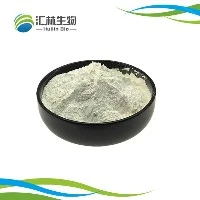


Xi'an Huilin Bio-Tech Co., Ltd. is one of the leading manufacturers and suppliers of acetyl-l-carnitine hcl powder in China. With abundant experience, we are committed to providing high quality natural products with competitive price. Please feel free to wholesale bulk pure acetyl-l-carnitine hcl powder for sale here from our factory.
Two Grades, One Molecule
Acetyl-L-carnitine HCl powder (CAS 5080-50-2, C9H18ClNO4, 239.69 g/mol) is supplied in two release tiers that differ by one percentage point of assay and by nothing else. The 98 % tier is the working grade for most formulations; the 99 % tier exists because some buyers write 99 % into their incoming specification and will not open it.
Both tiers are released on the same basis, and the basis is the part worth reading twice:
| Released as | 98 % tier | 99 % tier |
| Acetyl-L-carnitine hydrochloride, dried basis | ≥ 98.0 % | ≥ 99.0 % |
| Acetyl-L-carnitine as the free molecule | ≥ 83.1 % | ≥ 83.9 % |
The free molecule is 84.8 % of the salt - 203.24 ÷ 239.69 - so a percentage point of salt buys about 0.85 points of active. Which means the useful comparison between suppliers is never the headline figure alone. A 98 % salt quoted against a 98 % "free-base equivalent" is not the same purchase, and the difference is fifteen points, not one.
Release Data
| Item | Specification | Method |
| Assay, as acetyl-L-carnitine hydrochloride, dried basis | ≥ 98.0 % standard; ≥ 99.0 % premium | HPLC, ALCAR reference standard |
| Acetyl-L-carnitine equivalent, calculated | ≥ 83.1 % standard; ≥ 83.9 % premium | 203.24 ÷ 239.69 × assay |
| Chloride, calculated | 15.2 % | 36.45 ÷ 239.69 |
| Appearance | White crystalline powder | Visual |
| Identification | Retention time concordant with reference | HPLC |
| Loss on drying | Reported per batch | Gravimetric, 105 °C |
| Related substances, L-carnitine and crotonobetaine | Reported per batch | HPLC |
| Heavy metals, as Pb | ≤ 10 mg/kg | ICP-MS |
| Arsenic | ≤ 2 mg/kg | ICP-MS |
| Total plate count | Reported per batch | Plate count |
| Conclusion | Conforms when tested by the stated methods | / |
Assay, moisture and the related-substance profile are released together on every certificate, because a single assay figure cannot tell you whether you are buying the salt or the active. Batch number, production date, report number and signature travel with the shipment.
What "Acetyl" Changes in the Specification
Acetylation is a structural change, and on this page it is treated as a specification issue rather than a benefit.
Adding the acetyl group moves the molecule and its molecular weight, which is why this material and L-carnitine are not interchangeable by weight in a formulation. A blend written around one cannot absorb the other at the same inclusion without redoing the arithmetic, and the two do not share a regulatory identity either - L-carnitine has a Chinese fortification standard, and this salt does not.
The salt form carries its own handling consequence. Acetyl-L-carnitine hydrochloride is hygroscopic: an opened drum left in a humid room gains weight, and that weight turns into a low assay on the next certificate. Sealed storage is not a formality on this product.
Regulatory Position by Market
Three markets, three different answers, and the differences are not small.
China. L-carnitine is permitted as a nutritional fortifier and has a food additive standard of its own. Acetyl-L-carnitine is neither. It is absent from the permitted compound sources under the fortification standard and has no food additive monograph, so no "food grade" status exists for it in China. Suppliers who label it as a food raw material are describing something without a standard behind it.
European Union. There is no EU-wide food authorisation for carnitine, and the acetylated form is treated more strictly than the parent compound: in Italy, acetyl-L-carnitine is a prescription medicine, and the product is imported into the UK under special-order arrangements rather than sold as a food supplement. A page that implies free sale across the EU would be wrong.
United States. Acetyl-L-carnitine is sold as a dietary supplement ingredient and is widely used in that market. For a finished product, whether the ingredient qualifies as a pre-1994 dietary ingredient is the brand's determination, not a general permission.
Elsewhere. Requirements differ by market and change. We supply specification, certificate and compositional statement; permitted use is your regulatory team's call.
Impurity Profile
The two substances worth naming on this product are the ones the acetylation reaction leaves behind.
L-carnitine, unreacted or partially hydrolysed, is the first: it is the starting material, it separates cleanly enough to be quantified, and its level is a direct read on how completely the reaction ran. Crotonobetaine is the second, a dehydration product that appears when the acetyl group is lost under the wrong conditions.
Both are reported per batch on the certificate. A supplier who can only offer "98 % by HPLC" without a related-substance table has told you nothing about either.
Where It Is Used
Capsule and tablet blends. Supplied as a raw material to manufacturers whose formula already specifies the salt. The finished-product claim and its substantiation belong to the brand.
Powder blends. Where an acetylated carnitine is the intended input and the hygroscopicity can be managed in packing.
Formulation trials. Small quantities for bench work before the specification is fixed - the right moment to settle whether the formula is written on salt weight or on active weight.
This material is not offered as a food additive in China and we do not characterise it as authorised for food use in the European Union.
Questions Buyers Ask
Q: Does 98 % refer to the salt or to acetyl-L-carnitine itself?
A: The salt, on a dried basis. The free molecule is 84.8 % of the salt, so 98 % assay equals 83.1 % acetyl-L-carnitine - and 99 % equals 83.9 %.
Q: Is there a monohydrate version I should specify instead?
A: No. CAS 5080-50-2 is the anhydrous hydrochloride, molecular weight 239.69. Unlike some alkaloid salts, this product is not traded in a hydrated form, so moisture is a storage question rather than a specification choice.
Q: How do the two tiers differ in practice?
A: By one point of assay and by the price of that point. Both are released by the same HPLC method on the same basis, so switching tiers does not change your analytical workflow.
Q: Can this replace L-carnitine in an existing blend?
A: Not at the same inclusion. The acetylated molecule has a different molecular weight, and the two materials have different regulatory status - L-carnitine has a Chinese fortification standard, this salt has none. The formula has to be rewritten, not substituted.
Q: Which documents arrive with a batch?
A: Certificate of analysis covering assay, chloride by calculation, moisture, related substances, heavy metals and arsenic; a signed specification sheet; the safety data sheet; and a compositional statement for filing.
Q: Is the material hygroscopic?
A: Yes. It is a hydrochloride salt and it takes up moisture from air, so drums must be resealed and stored dry. Moisture is reported per batch precisely because storage conditions show up in it.
Supplier
Acetyl-L-Carnitine HCl Powder is supplied by Xi'an Huilin Bio-Tech Co., Ltd. with per-batch certificates stating assay basis, moisture and related-substance profile. The unacetylated L-carnitine grade is available from the same source, so a buyer running both forms reconciles one set of documents.
Lead time and freight terms are quoted with the order; FOB, CIF and DDP are workable by destination.
This page describes a raw material for manufacturing use. It is not a finished consumer product, and nothing here is a statement about the effect of any product on any person. Regulatory status differs by market and is the buyer's determination; we supply the documentation a filing requires.
Hot Tags: acetyl-l-carnitine hcl powder, China, suppliers, manufacturers, factory, wholesale, buy, price, bulk, pure, natural, high quality, in stock, for sale


