


Sinapic acid is a hydroxycinnamic acid - 4-hydroxy-3,5-dimethoxycinnamic acid, CAS 530-59-6 - and sinapic acid uses divide into three groups a specification has to keep apart: an analytical reference standard, a synthesis building block, and a flavoring substance listed in the European Union.
Sinapic Acid Structure: Why the Two Methoxy Groups Matter
Sinapic acid structure is a C6–C3 phenylpropanoid: a cinnamic acid backbone carrying 3,5-dimethoxy and 4-hydroxy substitution on the ring, formula C11H12O5, molecular weight 224.21 g/mol. The second methoxy group is the entire difference between sinapic acid and ferulic acid.
-
How sinapic acid structure differs from ferulic acid
Sinapic acid structure also settles the physical behavior. All four common hydroxycinnamic acids share a nine-carbon skeleton and differ only in ring substitution: p-coumaric acid carries one hydroxyl, caffeic acid two adjacent hydroxyls, ferulic acid one methoxy and one hydroxyl, and the fourth carries two methoxy groups flanking a hydroxyl. The closest commercial comparator is 98% ferulic acid powder. PubChem records the pattern in the IUPAC name, 3-(4-hydroxy-3,5-dimethoxyphenyl)prop-2-enoic acid, with a calculated partition coefficient of 1.5.
-
Where it sits in the phenylpropanoid pathway
In the plant, the acid is not an endpoint. A tracer study with stable-isotope labeling at both methoxy groups, published in the Journal of Agricultural and Food Chemistry, found that it is converted to sinapyl alcohol through sinapoyl-CoA during lignin biosynthesis. Sinapyl alcohol is one of the three monolignols and supplies the syringyl units of lignin in flowering plants.
-
Four hydroxycinnamic acids compared
The last two rows are the pair to watch, and the European Union keeps them adjacent: flavoring substance FL 08.088 is 4-Hydroxy-3,5-dimethoxycinnamic acid and FL 08.089 directly below it is 4-Hydroxy-3-methoxycinnamic acid.
| Acid | Ring substitution | Formula | Molecular weight | PubChem CID |
| p-Coumaric acid | 4-hydroxy | C9H8O3 | 164.16 g/mol | 637542 |
| Caffeic acid | 3,4-dihydroxy | C9H8O4 | 180.16 g/mol | 689043 |
| Ferulic acid | 3-methoxy, 4-hydroxy | C10H10O4 | 194.18 g/mol | 445858 |
| Sinapic acid | 3,5-dimethoxy, 4-hydroxy | C11H12O5 | 224.21 g/mol | 10743 |
Sinapic Acid Uses: Four Places the Molecule Earns Its Keep
Sinapic acid uses cluster in four places: an analytical matrix and reference standard, a synthesis building block, a flavoring substance, and a cosmetic or supplement pre-formulation input. The first two carry most of the commercial volume.
-
MALDI matrix and analytical reference work
The PubChem record describes the compound as a matrix for matrix-assisted laser desorption, the MALDI technique used to determine protein molecular weights, and as a constituent of propolis. In the laboratory it is bought as a high-purity reference standard for quantifying phenolic content in plant extracts. That use drives small-pack orders, where purity matters more than price per kilo.
-
A synthesis platform for UV absorbers and bisphenol A substitutes
A 2022 review in Separation and Purification Reviews documents it as a platform molecule for several syntheses: sinapoyl malate and its analogs as ultraviolet-absorbing agents, syringaresinol as an antiradical additive, bisphenol A substitutes for polymer and resin production, the roasted-seed phenol canolol, and norbornene dihydrosinapate as a pre-polymer substrate. This group works from a synthesis route and needs batch consistency.
-
Flavoring, cosmetic and supplement pre-formulation work
For a sinapic acid supplement or cosmetic project, the material enters as an input to somebody else's formulation rather than as a finished product. Formulators use it alongside caffeic acid powder, rosmarinic acid powder and what ferulic acid powder is used for. The formulation problem is almost always water solubility: the working route is a stock solution in ethanol or dimethyl sulfoxide. Choose the supplement ingredients grade where the endpoint is a capsule or powder blend rather than a serum.
-
What each use asks of the specification
The four sinapic acid uses do not want the same document, so set the required lines against the intended use.
| Use | What the specification has to fix | Who buys on it |
| Analytical reference standard | Assay by HPLC, chromatographic identity, water content | Analytical laboratories, extract quality control |
| Synthesis building block | Isomeric composition, residual solvents, batch consistency | Specialty chemical and polymer groups |
| Flavoring substance | Purity floor, identity against the listing, declaration route | Flavor houses, food and beverage manufacturers |
| Cosmetic or supplement pre-formulation | Solubility route, heavy metals, residual solvents | Cosmetic formulators, supplement developers |
Sinapic Acid Foods: What Rapeseed and Mustard Seed Actually Contain
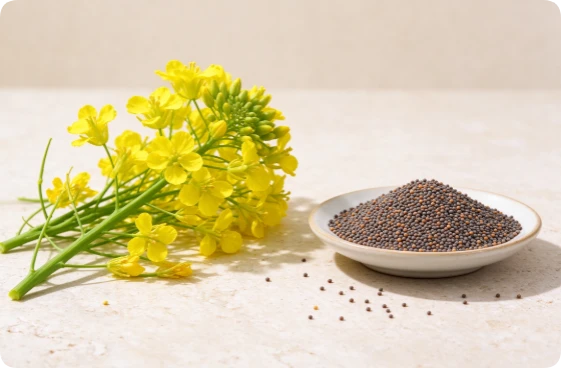
Sinapic acid foods come from one plant family, and almost all the sinapic acid found in them is esterified rather than free. The Brassicaceae oilseeds - rapeseed (Brassica napus), brown and oriental mustard (Brassica juncea) and white mustard (Sinapis alba) - are the concentrated sources.
-
Sinapine is the form you actually find in the seed
Sinapic acid foods work starts with the ester, not the free acid. Sinapine, the choline ester of the acid, accounts for 62% to 94% by weight of the derivative total in B. napus, and 90% to 94% in B. juncea and S. alba. In processed seed it runs 5 to 35 mg/g of dry matter, so the sinapic acid found in the seed is overwhelmingly this ester rather than the compound named on the label. Sinapine also tastes bitter, which caps rapeseed meal in feed.
-
Free sinapic acid is a small fraction
Free sinapic acid found in processed rapeseed and mustard seed runs 0.1 to 5 mg/g of dry matter, against 5 to 35 mg/g for sinapine. The gap is commercial rather than academic: producing the free acid from seed by-product means running a hydrolysis step against an ester, which is why extraction research concentrates on releasing rather than washing it out.
-
What roasting does
Heat changes the picture. Roasting rapeseed decarboxylates part of the sinapic acid found in the seed into canolol, also called 4-vinylsyringol, a phenol that raises the oxidative stability of crude rapeseed oil. Canolol is a pathway ending in a food-technology function rather than a claim.
-
How the fractions compare
Read as a sinapic acid foods list, the family is narrow: the sinapic acid found in the oil and seed arrives mostly as sinapine rather than the free crystalline compound. The 2022 review records 2019 world production of 70.5 million tonnes of rapeseed and 654,000 tonnes of mustard; the derivatives are sensitive to heat, oxygen and pH.
| Form | Content in processed seed | Basis |
| Sinapine (choline ester) | 5 to 35 mg/g | Dry matter, rapeseed and mustard |
| Sinapine share of derivatives | 62% to 94% | Weight by weight, B. napus |
| Free sinapic acid | 0.1 to 5 mg/g | Dry matter, processed seed |
| All derivatives | 0.5% to 3.5% | Weight by weight of dry matter |
Sinapic Acid CAS Number and the Identifiers a Specification Needs
The sinapic acid CAS number is 530-59-6, and a search for the sinapic acid CAS no returns a second registry number on the same PubChem record. Putting both on the specification closes an identity dispute before it opens.
-
Sinapic acid and sinapinic acid are one CAS number
The two names are synonyms for one substance, not two products. Sigma-Aldrich lists sinapinic acid among the synonyms of CAS 530-59-6, and the mass-spectrometry literature uses that spelling for the same compound. A purchase order naming one and a certificate naming the other describes the same material, but treating them as alternatives invites the question of which was shipped.
-
Identifiers to copy onto the specification
Each line can be checked against a public record without contacting the supplier. Sinapic acid structure tells the analyst what to look for; the registry numbers tell the buyer which record to check against.
| Identifier | Value | Where to verify |
| CAS registry number | 530-59-6 | PubChem CID 10743 |
| Second registry number | 7362-37-0 | same record |
| EC (EINECS) number | 208-487-3 | PubChem CID 10743 |
| KEGG compound ID | C00482 | PubChem CID 10743 |
| InChIKey | PCMORTLOPMLEFB-UHFFFAOYSA-N | PubChem CID 10743 |
| UNII | P0I60993EC | PubChem CID 10743 |
Sinapic Acid Supplement and Cosmetic Supply: What the Listings Allow
Sinapic acid supplement and cosmetic supply runs on a different document set from analytical supply, The European Union lists the substance as a flavoring; the United States carries no equivalent entry.
-
The European Union lists it as flavoring substance FL 08.088
Annex Part A, Table 1 of Commission Implementing Regulation (EU) No 872/2012 carries the entry: FL number 08.088, chemical name 4-Hydroxy-3,5-dimethoxycinnamic acid (mixture of isomers), CAS 530-59-6, with EFSA as the evaluating body and no JECFA number. Two columns are blank, and the table heading fixes what blank means: purity at least 95% unless otherwise specified, and use permitted in accordance with good manufacturing practices unless a restriction is given.
-
The United States has no equivalent listing
On the US side the record is empty. The FDA inventory Substances Added to Food, the agency's own list of substances added to food, returns no entry under the substance name or either registry number, and 21 CFR 172.515 does not contain it. For a sinapic acid supplement project in the United States, the EU route is not there.

-
The EU entry says "mixture of isomers"
The entry covers the mixture of isomers at CAS 530-59-6, not a single geometric form. A specification written on one isomer is not wrong on its own terms, but it is not the same statement as the listing, so a buyer relying on FL 08.088 should align the isomeric composition line with the entry - easier before the batch is made than after.
-
Two listings, side by side
Searches for sinapic acid benefits usually expect a health claim, and the documents below do not supply one in either market. What they support is a technical benefit: a defined identity, a listed flavor function in one jurisdiction, and a synthesis role in the other.
| Market | Status | Written where | What it permits |
| European Union | Listed flavoring, FL 08.088 | Regulation (EU) No 872/2012, Annex Part A | Flavor use, no restriction, 95% purity default |
| United States | No entry found | FDA Substances Added to Food; 21 CFR 172.515 | No flavoring listing on this route |
| Canada, Australia, New Zealand, Japan, Korea | Not assessed here | Destination rules | Confirm with the destination authority |
Sinapic Acid Side Effects and Safe Handling
Sinapic acid side effects, in the occupational rather than the clinical sense, are irritation at the point of contact. Every classification and notification of the substance puts it under a Warning signal word with skin, eye and respiratory endpoints.
-
GHS classification and what it means on a label
The harmonized classification is skin irritation category 2 (H315), serious eye irritation category 2A (H319) and single-exposure respiratory toxicity category 3 (H335), with the GHS07 pictogram and the signal word Warning. No other sinapic acid side effects appear on the sheet. The ECHA classification and labelling inventory, as reproduced by PubChem, records skin irritation in 99.5% of notifications, eye irritation in 99.5% and respiratory toxicity in 99%, from 200 reports. One vocabulary note: the older irritant symbol with the letter X is withdrawn, and a document still using it is out of date.
-
Storage and incompatibilities
The safety data sheet adds the handling lines the classification does not carry: keep the receptacle tightly sealed; carbon dioxide and carbon monoxide are among the decomposition products; and regard the material as mildly hazardous to water on the supplier's self-assessment. It is not listed as a SARA extremely hazardous or toxic chemical or as a hazardous air pollutant. Solutions are prepared in dimethylformamide or dimethyl sulfoxide at 10 mg/mL. Our own storage specification is sealed, light-proof, 2 to 8 °C.
-
Two values to pin to the certificate
The melting point is recorded on that sheet as undetermined and the density as not determined, so neither should be copied onto a specification from a marketing page. Pin both to the certificate for the batch in front of you. None of the sinapic acid side effects above is a food-safety finding; they are handling classifications.
How to Write a Sinapic Acid Specification
A specification that tries to fit all sinapic acid uses at once ends up fitting none of them, so start from the endpoint and work back.
-
Identity and technical lines
Identity first: CAS 530-59-6, the second registry number, the EC number and the InChIKey. Assay follows, at 98% or above by HPLC for the material in our catalogue. Then isomeric composition, written to match the listing you rely on, then appearance, solubility route and storage. The heavy metals and residual solvent lines change with the destination market and should never be copied between them.
-
Commercial lines
Sample size, pack sizes, lead time and minimum order close the document. Our minimum order quantity is 100 g, with payment by letter of credit or telegraphic transfer. Fix the sample size in writing, because a 5 g sample and a 100 g sample answer different questions. A sinapic acid supplement customer will normally ask for the safety data sheet and a batch certificate, so quote those into the offer, not at the order.
Frequently Asked Questions
Q: What Are The Main Sinapic Acid Uses?
A: The four are an analytical reference standard and MALDI matrix, a synthesis building block, a flavoring substance listed in the European Union, and a cosmetic or supplement pre-formulation input. The first two carry the most commercial volume; the third depends on the destination market.
Q: Which Foods Contain Sinapic Acid?
A: Sinapic acid foods are the Brassicaceae oilseeds: rapeseed, brown and oriental mustard and white mustard. In processed seed it is present mainly as sinapine at 5 to 35 mg/g of dry matter, with the free acid at only 0.1 to 5 mg/g. Roasting converts part of it to canolol.
Q: What Is The CAS Number Of Sinapic Acid?
A: The registry number is 530-59-6, with a second number of 7362-37-0 on the same PubChem record, CID 10743. The EC number is 208-487-3 and the KEGG compound ID is C00482. Ask for both registry numbers to be stated on the certificate of analysis.
Q: Is Sinapic Acid The Same As Sinapinic Acid?
A: Yes - they are two names for one substance at CAS 530-59-6. Sigma-Aldrich lists sinapinic acid among the synonyms, and the mass-spectrometry literature uses that spelling for the same compound. Naming both on the purchase order removes any ambiguity before the batch ships.
Q: Is It Allowed As A Food Ingredient?
A: It depends on the market. The European Union lists it as flavoring substance FL 08.088 with no restriction on use and a default purity floor of 95%. In the United States no entry was found in the FDA inventory Substances Added to Food, and 21 CFR 172.515 does not contain it, so the EU route has no US equivalent.
Q: What Sinapic Acid Side Effects Should A Buyer Plan For?
A: Plan for irritation: skin irritation category 2, serious eye irritation category 2A and single-exposure respiratory toxicity category 3, under a Warning signal word and the GHS07 pictogram. Handle the powder with gloves and eye protection and keep the container sealed. Expect the melting point and density to be undetermined and fix both on the batch certificate instead.
Sources
- PubChem, Sinapic acid, CID 10743 - https://pubchem.ncbi.nlm.nih.gov/compound/Sinapic-acid
- Regulation (EU) No 872/2012, Annex Part A, Union list of flavouring substances - https://www.legislation.gov.uk/eur/2012/872/annexes/adopted
- 21 CFR 172.515, Synthetic flavoring substances and adjuvants - https://www.ecfr.gov/current/title-21/section-172.515
- FDA, Substances Added to Food inventory - https://www.hfpappexternal.fda.gov/scripts/fdcc/?set=FoodSubstances
- Cayman Chemical, Safety Data Sheet, 3 March 2025 - https://cdn.caymanchem.com/cdn/msds/25457m.pdf
- Reungoat et al., Separation and Purification Reviews 51(4), 2022 - https://agroparistech.hal.science/hal-03517107v1
- Biosynthetic pathway to syringyl lignin, Journal of Agricultural and Food Chemistry, 2002 - https://pubmed.ncbi.nlm.nih.gov/12009990/
- Independent origins of syringyl lignin in vascular plants, PNAS - https://pmc.ncbi.nlm.nih.gov/articles/PMC2409400/
- Effect of Seed Roasting on Canolol, Tocopherol and Phenolic Contents in Rapeseed Oil, Journal of Agricultural and Food Chemistry, 2014 - https://pubs.acs.org/doi/10.1021/jf500549t
- Canola meal utilization in swine nutrition, J. Anim. Sci. Biotechnol. - https://www.ejast.org/archive/view_article?doi=10.1186/s40781-016-0085-5