



"Soy protein" names a family, and the two grades that carry most of the trade differ by roughly twenty points of protein. That single difference decides how much powder a serving needs, what the label can claim, and whether the isolate premium is justified. The published isolate specification is the reference throughout.
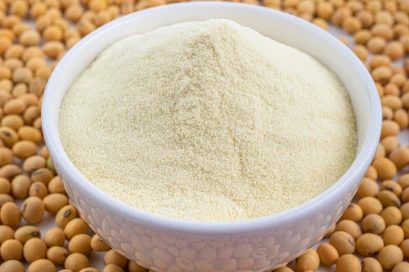
1. A Quotation That Says Only Soy Protein Has Not Named a Grade
A line that reads "soy protein" fixes the source and nothing else, and the grade is the part that changes the formulation. Two quotations can carry the same words and differ by twenty points of protein, so the first job is to make the quotation name a grade.
| The line on the quote | What it fixes | What it leaves open |
| Soy protein | The protein source | Grade, protein content, basis |
| Soy protein, 90% | A dry-basis target | Moisture, as-is protein, method |
| Soy protein isolate, 90% dry basis | Grade and basis | Moisture limit, functional metrics |
Once the grade and the basis are on the page, the arithmetic in the rest of this guide becomes available: grams of powder per serving, cost per gram of protein, and the claim the finished label can carry. Without them none of those questions has an answer, which is why the grade belongs in the enquiry rather than in the confirmation.
It is worth asking for the grade in writing even when the sample already looks right, because sample and commercial batch are only guaranteed to match when both are made to the same written specification.
2. The Two Commercial Grades Differ by One Number
Soy protein concentrate and soy protein isolate are the same starting material taken to different degrees of refinement, and the difference in protein content is the one figure that moves every other decision, from fill weight to claim.
| Property | Concentrate | Isolate |
| Protein, dry basis | 65% to 70% | 90% or more |
| What is removed | Soluble sugars, part of the fibre | Most non-protein solids |
| Route | Non-protein components partially removed | Alkaline extraction, precipitation, spray drying |
| Bulk price per kilo | Lower | Higher |
| Where it usually lands | Bakery, snacks, meat systems | Beverages, high-density powders |
A soy protein concentrate has part of the non-protein fraction removed and lands in the sixties to low seventies on a dry basis. A soy protein isolate goes further: the protein is solubilised under alkaline conditions, separated from the insoluble fibre, precipitated at its isoelectric point, washed and spray dried, which is what puts it at ninety or above.
What the extra refinement buys is space in the bag. Every point of protein is a point that is not moisture, ash, fibre or sugar, and where the serving size is fixed by a sachet or a mould, that space is the constraint rather than the price.
3. That Number Is Measured Against a Basis, and the Basis Is Usually Missing
A protein figure without a basis cannot be compared with anything, and the commonest certificate mixes two bases in one column. The rows below come from one batch of isolate, and as printed they sum to 100.9%.
| Item | As printed | On one basis |
| Protein | 91.2% | 87.3% |
| Moisture | 4.3% | 4.3% |
| Ash | 4.1% | 4.1% |
| Fat | 0.7% | 0.7% |
| Crude fibre | 0.6% | 0.6% |
| Total | 100.9% | 97.0% |
Protein is reported on a dry basis, after the water has been divided out, while moisture, ash, fat and fibre are reported as they are. Convert the protein to the same footing and the rows total 97.0%, with the missing 3.0% being the soluble solids the certificate does not itemise. The conversion is one multiplication: dry-basis protein times one minus the moisture fraction.
Two consequences follow from that. A 90% dry-basis grade carries 84.6% protein as-is at the 6.0% moisture ceiling and 86.1% at the 4.3% the batch actually held. And a buyer who adds the printed rows, reaches 100.9% and concludes the laboratory was careless has misread a correct certificate.
4. Cost per Gram of Protein Sets the Ceiling on the Isolate Premium
Price per kilogram prices water and ash at the same rate as protein, so the only comparable unit between grades is cost per gram of protein, and that unit puts a hard number on the premium the isolate can carry.
| Grade | Protein, dry basis | Protein per tonne | Break-even against concentrate |
| Concentrate | 70% | 700 kg | 1.000 |
| Isolate | 90% | 900 kg | 1.286 |
At seventy and ninety percent the ratio is fixed: nine hundred kilograms of protein per tonne against seven hundred, or 1.286. At equal price per kilogram the isolate is the cheaper protein, and it only becomes the dearer one above 1.286 times the concentrate price. At the sixty-five percent end of the concentrate range the same calculation gives 1.385.
Moisture cancels out of that ratio when both grades sit at the same ceiling, which is why it can be run on dry-basis figures alone. It stops cancelling the moment one supplier reports as-is and the other reports dry, and that is the reason the basis section comes before this one.
5. The Label Claim Is Decided in Energy, Before the Grade Is Chosen
The claim a finished product can carry is set by the share of its energy that protein supplies, not the share of its mass, so the claim has to be settled before the grade is chosen. Regulation (EC) No 1924/2006 puts the two thresholds at 12% and 20% of energy.
| Energy per serving | Protein for 12% of energy | Protein for 20% of energy |
| 150 kcal | 4.5 g | 7.5 g |
| 250 kcal | 7.5 g | 12.5 g |
| 350 kcal | 10.5 g | 17.5 g |
| 450 kcal | 13.5 g | 22.5 g |
Protein carries four kilocalories per gram under the energy conversion factors in Regulation (EU) No 1169/2011, which turns a threshold into a weight. At 250 kilocalories a serving needs 7.5 grams of protein to reach the lower claim and 12.5 grams to reach the upper one; at 450 kilocalories the same two thresholds need 13.5 and 22.5 grams.
The table is worth reading downwards before it is read across, because the same claim gets harder as the serving gets larger, and a bar and a drink with identical protein content can end up on opposite sides of the line.
6. That Claim Sets the Grams of Powder per Serving
Once the claim fixes the protein a serving must carry, the grade fixes the powder that has to be weighed into it, and the gap between the grades grows faster than the difference in protein content suggests.
| Protein target per serving | Isolate powder | Concentrate powder | Difference |
| 10 g | 11.8 g | 15.2 g | 3.4 g |
| 20 g | 23.6 g | 30.4 g | 6.8 g |
| 25 g | 29.6 g | 38.0 g | 8.4 g |
At the moisture ceiling the soy protein isolate delivers 84.6% protein as-is and the soy protein concentrate 65.8%, so twenty grams of protein takes 23.6 grams of isolate powder or 30.4 grams of concentrate. The difference is 6.8 grams per serving, and it repeats at every serving size, which is where a formulation with no room to move discovers which grade it actually needs.
That arithmetic runs before the price is discussed, and it settles a grade dispute faster than a specification sheet does: either the fill weight fits the claim or it does not.
7. What to Test at Intake, and What to Ask For First
A grade is only as good as the tests that confirm it on arrival, so the short list below covers the items that move the formulation when they miss, and the methods the certificate has to name beside each result.
| Test | Method on our certificate | What a miss costs |
| Protein | GB 5009.5 | The fill weight changes with it |
| Moisture | GB 5009.3 | As-is protein falls, caking rises |
| Nitrogen solubility | AOCS Ba 11-65 | Dispersion changes in your line |
| Ash | GB 5009.4 | Space in the bag that is not protein |
| Microbiology | GB 4789 series | Release hold or rejection |
| Aflatoxin B1 | GB 5009.22 | Market access |
Ask for the method with every result, because a number without a method cannot be reproduced in your own laboratory, and ask for the moisture limit alongside the release value, because the two together decide the as-is protein you receive. The same request should name the allergen statement your market requires.
The same arithmetic decides grade selection in the other plant proteins, including pea protein, where the protein basis and the fibre limit move the delivered figure in the same way.
Frequently Asked Questions: Six Answers Before a First Order
Q: Should I Specify The Isolate Or The Concentrate?
A: Start from the protein a serving must carry and the space the serving has, then read the answer off the fill weight. If the serving cannot hold 30 grams of powder, the concentrate is out of the question and the price becomes secondary. If it can hold that much, compare cost per gram of protein before deciding.
Q: What Does The Protein Figure On A Certificate Measure?
A: It measures nitrogen multiplied by a stated factor, reported against a stated basis. Soy protein is normally reported on a dry basis at N × 6.25, which is higher than the as-is figure by exactly the moisture content. Without the factor and the basis, the number cannot be reproduced or compared with another supplier's.
Q: Why Does A 90% Isolate Analyse At 86% On Arrival?
A: Because 90% is a dry-basis figure and the powder still contains water. At 4.3% moisture the same material is 86.1% protein as-is, and at the 6.0% ceiling it is 84.6%. Neither is a short weight; both describe the same batch against a different denominator.
Q: How Should I Compare The Price Of The Two Grades?
A: Divide the price per kilogram by the protein content to get cost per gram of protein, then compare that figure. At 70% and 90% the break-even is a price ratio of 1.286: below it the isolate is the cheaper protein, above it the concentrate is. At a 65% concentrate the ratio becomes 1.385.
Q: How Much Protein Does A Serving Need For A Protein Claim?
A: Under Regulation (EC) No 1924/2006 a serving needs protein to supply 12% of its energy for the lower claim and 20% for the upper one. With protein at four kilocalories per gram, a 250 kilocalorie serving needs 7.5 and 12.5 grams respectively. The thresholds are about energy, not about the percentage in the powder.
Q: What Should The Purchase Order State?
A: The grade, the protein content with its basis, the nitrogen factor, the moisture limit and the release value, in one line, plus the test methods and the allergen statement. A purchase order that names only a percentage leaves the supplier free to choose the denominator, and the denominator is where the disputes come from.
Reviewed and updated 29 October 2026 by the technical team at Xi'an Huilin Bio-tech Co., Ltd., which supplies soy protein isolate against an agreed specification.
Sources
-
1. Regulation (EC) No 1924/2006 of the European Parliament and of the Council of 20 December 2006 on nutrition and health claims made on foods, Annex. OJ L 404, 30.12.2006, p. 9. https://eur-lex.europa.eu/eli/reg/2006/1924/oj
-
2. Regulation (EU) No 1169/2011 of the European Parliament and of the Council of 25 October 2011 on the provision of food information to consumers, Annex XIV. OJ L 304, 22.11.2011, p. 18. https://eur-lex.europa.eu/eli/reg/2011/1169/oj
-
3. Xi'an Huilin Bio-tech Co., Ltd. Soy Protein Isolate Powder: specification and certificate of analysis