


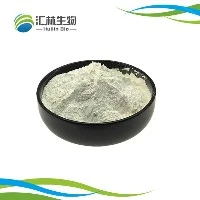
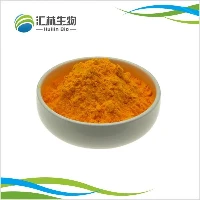

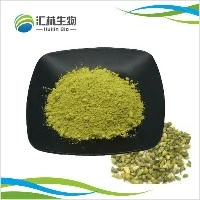
L-theanine powder production runs on three supply chains, and they do not make interchangeable powders. One extracts the molecule from tea leaves, one builds it from chemical intermediates, one ferments it in a bioreactor. All three carry CAS 3081-61-6, and each has its own GRAS notice on file with the US FDA. Our L-theanine powder comes from the first route.
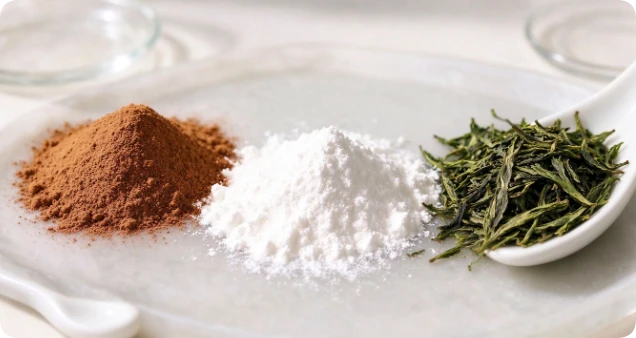
1. One CAS Number, Three Supply Chains
The identity data is identical across every route, which is exactly why the differences stay invisible. PubChem lists L-theanine under CID 439378 as C7H14N2O3, molecular weight 174.20, systematic name (2S)-2-amino-5-(ethylamino)-5-oxopentanoic acid. Any lot that matches that formula and that optical configuration is the same substance on paper. What differs is everything around it.
The FDA's GRAS notice inventory makes the split visible in a way most certificates do not. A search for theanine returns five notices, and they map onto the three routes: tea leaf extraction (GRN 338, closed November 2010), chemical synthesis (GRN 209 in February 2007 and GRN 501 in July 2014, with GRN 1344 still pending), and fermentation (GRN 1311, closed September 2026). Five notices for one molecule is the clearest signal in the public record that the routes are treated as separate products.
| Route | Starting material | Typical commercial assay | GRAS notice on file |
| Extraction | Green tea leaf | 90 to 98% | GRN 338, 2010 |
| Chemical synthesis | Ethylamine plus a glutamate derivative | 98 to 99% | GRN 209, 2007; GRN 501, 2014 |
| Fermentation | Glutamate and ethylamine in a microbial host | 98 to 99% | GRN 1311, 2026 |
Read the table as an explanation of price rather than a ranking of quality, because the L-theanine production route decides what else sits in the drum. The three columns differ by roughly a factor of two at the drum level, and almost none of that gap is about how much L-theanine is in the bag. It is about what else the process puts there and what documentation the supplier can hand you.
2. Route A: Extraction from Tea Leaves
Green tea is the only place L-theanine occurs in commercially useful amounts, and that single fact sets the economics of the whole route. The molecule is made in the root and transported to the leaf, where it sits among a large excess of other water-soluble material. Extraction therefore starts with a dilute stream and has to be purified back to a powder, which is why the route is capital-light at the front end and expensive at the back.
The impurity profile is the part buyers should study. A green tea extract carries caffeine and the catechin family alongside the target, and the ratio depends on leaf grade, harvest season and how the column is run. A specification that states assay but not caffeine is incomplete for this route, because caffeine is the impurity a formulator will notice first in a relaxant product. The same leaf stream also yields tea polyphenols, which is why extractors who run both lines can price the theanine fraction more competitively.
The commercial argument for this route is not purity. It is origin. A tea-derived material supports a natural-origin story that a petrochemical synthesis cannot, and for a brand selling on that story the 90 to 98% band is a feature rather than a limitation. The cost of the story is batch-to-batch variability in the minor peaks, which has to be managed with a specification rather than promised away.
3. Route B: Chemical Synthesis
In L-theanine powder production, the synthetic route builds the molecule from ethylamine and a glutamate derivative, and its central problem is stereochemistry rather than yield. Only the L configuration is the substance people mean by L-theanine, and a chemical route can produce the D form alongside it unless the reaction is designed and controlled to prevent that. Assay by HPLC against a reference standard will not always separate the two, so a certificate showing 99% is not by itself proof of optical purity.
That is why specific optical rotation matters more on this route than on the other two. PubChem records the systematic name with the (2S) descriptor built in, and rotation is the cheapest check that the descriptor is true of the lot in front of you. A specification without a rotation range leaves the single most important structural question unanswered.
The second synthetic marker is solvent residue. A multi-step organic route uses solvents that a tea extract never touches, and the specification should name which ones are controlled and at what limit. Two notices in the FDA inventory cover the synthetic material, GRN 209 from 2007 and GRN 501 from 2014, which tells you the route has been through review more than once and that the later filing did not simply inherit the earlier conclusion.
4. Route C: Fermentation
Fermentation couples glutamate to ethylamine with an enzyme, and it is the route that changed the economics of L-theanine production over the past decade. A microbial host carrying a suitable transferase can convert a cheap nitrogen source into L-theanine in a tank, at concentrations and yields that tea leaf cannot approach. The FDA inventory reflects that arrival: GRN 1311, covering L-theanine produced by Escherichia coli CICC 11189, closed with no questions in September 2026.
The questions this route raises are biological rather than chemical. Ask which host strain, whether the construct carries an antibiotic resistance marker, what the fermentation medium contains, and how the downstream steps remove host protein and endotoxin. The specification for a fermented material should therefore include a bioburden and endotoxin line that a tea extract does not need, and a statement on whether the production organism is genetically modified.
Fermentation also produces the cleanest optical purity, because the enzyme is stereospecific by construction. That advantage is real, and it is why fermented material can be sold at 99% with a straight face. It is not, however, a claim about the absence of everything else, and a buyer who reads 99% as a complete quality statement has answered one question out of five.
5. What the Certificate Cannot Tell You
L-theanine powder production leaves no signature on a standard certificate of analysis, which is route-blind. Assay, loss on drying, heavy metals and microbial counts read the same whether the powder came out of a column, a reactor or a fermentor, because those four tests were designed to confirm that a material is what it says it is, not how it was made. Two suppliers running different routes can hand you near-identical certificates and deliver materials with different risk profiles.
| Test on a standard certificate | What it confirms | What it cannot confirm |
| Assay by HPLC | How much of the target peak is present | Which route produced it, or whether the D form is present |
| Loss on drying | Water and volatile content | Residual solvent, which needs its own method |
| Heavy metals | Inorganic contamination | Caffeine, catechins or host protein |
| Microbial counts | Whether the lot is hygienic | Endotoxin, or which organism the route used |
The missing evidence lives in documents rather than numbers. A process description, a starting-material list, a statement on the production organism and a rotation result are what separate one route from another, and none of the four is standard on a commercial certificate. Asking for them is not an accusation. It is the only way to price two quotes against each other.
6. Specification Markers by Route
Each L-theanine production route leaves a different fingerprint, and the specification should be built to catch the one yours produces. The table below is the version to send back with a quotation request, because it asks for the four or five lines that actually discriminate rather than the eight that every supplier already lists.
| Route | Marker that must be specified | Why this one | Document to request |
| Extraction | Caffeine limit, catechin profile | Co-extracted from the same leaf stream | Botanical source and leaf grade |
| Chemical synthesis | Specific optical rotation, residual solvents | Stereochemistry and process chemistry are the risks | Route description and solvent list |
| Fermentation | Endotoxin, host protein, GMO statement | Biological residuals come with the host | Strain identity and downstream validation |
Two lines are worth specifying on all three routes. Specific optical rotation confirms the L configuration regardless of origin, and water content protects the assay arithmetic once the drum is open. Everything else in the table is route-specific, and a supplier who cannot say which route they run cannot tell you which lines to test.
7. How to Audit a Supplier's Route
The audit is five questions, because L-theanine production claims are easy to repeat and hard to document. A supplier who answers all five in writing has told you more than a certificate ever will. Ask them in this order, because each one narrows the next.
| Question | A complete answer sounds like | A warning sign |
| Which route do you run? | Tea extraction, synthesis or fermentation, named plainly | "Natural" with no process description behind it |
| Which GRAS notice covers your material? | A specific GRN number matching the route | A generic reference to FDA approval |
| What is your optical rotation range? | A stated range with solvent and temperature | Rotation omitted, or deferred to a certificate |
| Which impurities does your route create? | Caffeine and catechins, or solvents, or endotoxin | A claim that there are none |
| Is the lot food grade or supplement grade? | A named grade with the specification attached | "Same material, different price" |
› A GRN number that does not match the route is the fastest way to spot a reseller.
› No rotation range means the stereochemistry question is unanswered.
› "Natural" without a leaf-grade statement is a marketing word, not a process.
Ask for the answers in writing before the sample arrives, and the sample will tell you whether the answers were true.
8. Frequently Asked Questions
Q: Does the production route change the CAS number?
A: No, which is precisely the problem. Tea extraction, chemical synthesis and fermentation all deliver CAS 3081-61-6 and the formula C7H14N2O3, so the identifier tells you the substance is L-theanine and nothing about how it was made. The route shows up in the impurity profile and the documentation, not in the CAS line.
Q: Why is tea-extracted L-theanine more expensive?
A: Because the starting stream is dilute, and purification carries the cost. Green tea delivers the molecule mixed with a large excess of caffeine and catechins, so the cost sits in the column rather than the leaf. Fermentation skips that separation entirely, which is why the same assay costs less per kilo from a tank.
Q: Is fermented L-theanine still natural?
A: That depends on the definition your market uses, not on the molecule. A fermentation route uses a microbial host and a defined medium, which some natural standards accept and others do not. Ask the supplier for the position they will defend in writing before you build a label claim on the word.
Q: How can I tell which route a supplier uses?
A: Ask for the GRN number and check it against the substance description in the FDA inventory. GRN 338 covers material extracted from tea leaves, GRN 209 and 501 cover the synthetic route, and GRN 1311 covers fermentation with a named host. A number that does not match the claimed route is the clearest warning available.
Q: Is L-theanine from fermentation genetically modified?
A: The production organism may be, and the finished powder is not the organism. What matters for your label is whether the host carries recombinant DNA and whether your market requires a statement about it. Ask for a written position on the strain and on any antibiotic resistance marker used in the construct.
Q: Which grade should a supplement brand buy?
A: Match the grade to the claim, not to the price list. A relaxation product needs a caffeine limit more than it needs 99%, while a capsule positioned on purity needs rotation and solvent data. Both decisions are about which specification lines you can defend, and L-theanine production route determines which lines apply.
Xi'an Huilin Bio-tech Co., Ltd. supplies L-theanine powder extracted from green tea leaf, with assay, caffeine limit, specific optical rotation and loss on drying stated on every certificate. Tell us the route your label claims and the impurity you need controlled, and we will quote the grade that matches it rather than the cheapest drum on the list. Send your target specification and we will answer line by line.
Sources
-
1. US Food and Drug Administration. GRAS Notice Inventory, search results for theanine. FDA GRAS inventory
-
2. US Food and Drug Administration. GRAS Notice GRN 209, L-theanine, closed 5 February 2007. GRN 209
-
3. US Food and Drug Administration. GRAS Notice GRN 338, L-theanine extracted from tea leaves (Camellia sinensis), closed 5 November 2010. GRN 338
-
4. US Food and Drug Administration. GRAS Notice GRN 501, L-theanine (chemically synthesized), closed 30 July 2014. GRN 501
-
5. US Food and Drug Administration. GRAS Notice GRN 1311, L-theanine produced by Escherichia coli CICC 11189, closed 4 September 2026. GRN 1311
-
6. National Center for Biotechnology Information. PubChem Compound CID 439378, L-theanine, formula C7H14N2O3, molecular weight 174.20. PubChem