


Xi'an Huilin Bio-Tech Co., Ltd. is one of the leading manufacturers and suppliers of uv absorber uv-1 semi-solid in China. With abundant experience, we are committed to providing high quality natural products with competitive price. Please feel free to wholesale bulk pure uv absorber uv-1 semi-solid for sale here from our factory.
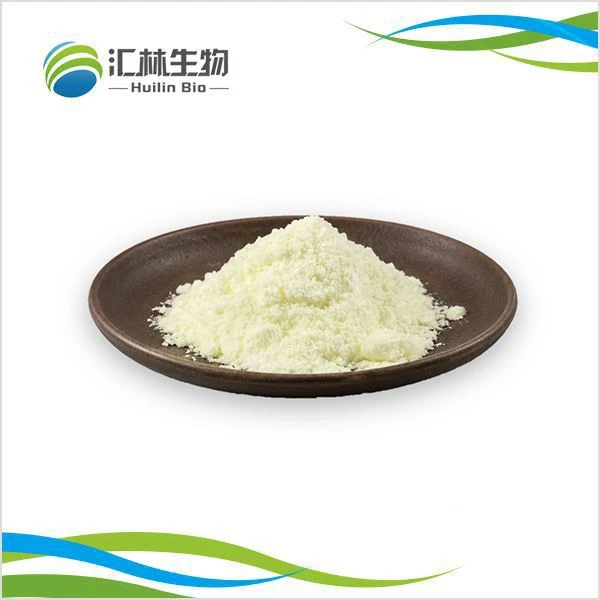
UV absorber UV-1 (CAS 57834-33-0) belongs to the formamidine class rather than to the benzophenone or benzotriazole families. It is a light yellow to yellow semi-solid, C17H18N2O2, molecular weight 282.34, and absorbs across the 240 - 340 nm range with its main band in the 300 - 330 nm region.
Polyurethane producers use it where the polymer itself is the thing being protected: flexible and rigid foams, integral skin foam, artificial leather coatings, adhesives, sealants and elastomers.
The chemistry that matters is the C=N bond conjugated between an aniline nitrogen and an ester-substituted ring. It is that conjugation, not a hydroxyl on a benzophenone, that puts the absorption where polyurethane degrades.
Specification
| Item | Specification | Test Method |
| Physical Description | / | / |
| Appearance | Light yellow to yellow semi-solid | Visual |
| Identification | Conforms to reference standard (retention time) | HPLC |
| Chemical Tests | / | / |
| Assay | ≥ 98.0% | HPLC, area normalization |
| Water | ≤ 0.5% | Karl Fischer |
| Residue on Ignition | ≤ 0.1% | Gravimetric, USP Chapter 281 |
| Heavy Metals | / | / |
| Heavy Metals (as Pb) | ≤ 10 ppm | ICP-MS |
Limits we release against; the measured values belong to the lot and are issued with it.
A Formamidine, Not a Benzophenone
Benzophenone and benzotriazole absorbers work through an intramolecular hydrogen bond that relaxes the excited state without emitting it. The formamidine class takes a different route: the chromophore is a conjugated C=N bridge between two aromatic systems, and the energy is dissipated through that bridge.
The practical consequence is a band positioned differently. UV-1 absorbs from 240 nm up to about 340 nm, with the strongest absorption in the 300 - 330 nm window, which is the region where polyurethane discolours and degrades. A benzophenone absorber sits further into the UV-B and is used across a wider range of polymers; this one is narrower and aimed at PUR.
It is not a radical scavenger and should not be read as one. Hindered amine light stabilisers interrupt oxidation chains; UV-1 absorbs incident radiation before it reaches the polymer. The two mechanisms are complementary, which is why both classes appear in the same formulation family.
What a Semi-Solid Means in Practice
Semi-solid is the form on the certificate, not a defect. At room temperature the material is a yellow mass that does not pour; warmed gently it becomes fluid enough to meter. That behaviour changes how it is handled but not what it does.
The advantage of the form is that it dissolves directly into the polyol component, whether polyester- or polyether-based, which is where a polyurethane formulator needs it. A solid absorber would have to be melted or dispersed first; a liquid would be easier to pump but more prone to migrating before the polymer sets.
The handling points follow from the form: keep the drum sealed because the material is hygroscopic enough to matter in a polyol system, warm it before dispensing rather than forcing it cold, and avoid holding it at temperature for long periods since the same conjugation that absorbs UV is sensitive to prolonged heat and light.
Three Absorber Classes Side by Side
The table sets out how the classes differ in what they are and how they are used. It describes the classes, not a ranking: which absorber belongs in a system follows from the polymer, the wavelength that hurts it, and the phase the additive has to enter.
| Class | Chromophore | Typical host | Handling form |
| Formamidine (this product) | Conjugated C=N bridge between aromatic systems | Polyurethane foam, coating, adhesive, sealant | Semi-solid, dissolved into the polyol |
| Benzophenone | Hydroxyl adjacent to a ketone, intramolecular hydrogen bond | Coatings, plastics, some cosmetic systems | Crystalline solid, soluble in organic media |
| Benzotriazole | Hydroxyl adjacent to an azo nitrogen, intramolecular hydrogen bond | Plastics, films, coatings where low migration is wanted | Crystalline solid, low volatility |
Migration is the axis most often compared across these classes, and it follows from molecular weight and volatility as much as from the chromophore. A low-molecular-weight absorber moves in a polymer more readily than a heavier one, which is why the formamidine class is used at the loadings typical of a polyurethane system rather than as a surface treatment.
Applications
Flexible and Rigid PU Foam - an absorber dissolved into the polyol before foaming, aimed at the 300 - 330 nm band where polyurethane yellows.
Coatings and Artificial Leather - protection of a polyurethane film or fabric coating where the polymer surface is the exposed part.
Adhesives and Sealants - an absorber added to a PUR adhesive or sealant where light exposure would otherwise discolour the bond line.
Elastomers - a light stabiliser for cast and RIM elastomers, where the same polyol-side dosing applies.
What a polymer system does with it depends on the polyol, the loading and the thermal schedule; the description here is of the material supplied, not of a finished part.
FAQ
Q: Is UV-1 a benzophenone?
A: No. It is a formamidine: the chromophore is a conjugated C=N bridge between an aniline nitrogen and an ester-substituted ring, without the hydroxyl that benzophenones and benzotriazoles rely on for their intramolecular hydrogen bond. The absorption band and the host polymers differ accordingly.
Q: Why is it supplied as a semi-solid rather than a liquid?
A: Because that is the physical state of the material at room temperature. It softens on warming to a flowable mass, which is how it is metered, and it dissolves directly into polyester or polyether polyol. A pumpable liquid would need a solvent, and a solid would need melting or dispersing first.
Q: Where does it absorb, and why does that matter for polyurethane?
A: From 240 nm up to about 340 nm, with the strongest absorption between 300 and 330 nm. That is the region where polyurethane degrades and yellows under light, which is why the absorber is aimed at PUR rather than at polymers that fail elsewhere in the spectrum.
Q: Does it replace a hindered amine stabiliser?
A: No, and the two are not interchangeable. UV-1 absorbs radiation before it reaches the polymer; a hindered amine interrupts the oxidation chain after damage has begun. Formulations often carry both because the mechanisms sit at different points in the process.
Q: How should the drum be stored and warmed?
A: Sealed, dry, at room temperature and away from light. Warm gently before dispensing rather than forcing cold material, and avoid holding it hot for long periods: the conjugated system that absorbs UV is also sensitive to prolonged heat and light.
Q: What appears on the certificate?
A: Assay by HPLC at ≥ 98.0%, water by Karl Fischer, residue on ignition, heavy metals by ICP-MS, and appearance as a light yellow to yellow semi-solid. There is no melting point to report, so identity rests on retention time against a reference standard.
Q: Can a solution grade in a specific polyol be arranged?
A: Yes, on request. Supplying the absorber pre-dissolved in a named polyol is a packing arrangement rather than a different product, and it is specified per order against the polyol the customer uses.
Supply, Documentation and Contact
UV absorber UV-1 is filled into 1 kg HDPE bottles packed in cartons, or 25 kg HDPE drums, and released against the specification for that batch. The semi-solid is filled warm and allowed to set in the pack, so the drum is opened to a uniform mass rather than to a separated layer.
Pre-dissolved grades in a named polyol, a different pack size, or a residual solvent panel can be arranged per order. Paperwork required at your border is prepared on request.
Contact: sales@huilinbio-tech.com
Technical information only. Uses are governed where the product is placed on the market.
Hot Tags: uv absorber uv-1 semi-solid, China, suppliers, manufacturers, factory, wholesale, buy, price, bulk, pure, natural, high quality, in stock, for sale


