


Xi'an Huilin Bio-Tech Co., Ltd. is one of the leading manufacturers and suppliers of isoamyl 4-(dimethylamino)benzoate liquid in China. With abundant experience, we are committed to providing high quality natural products with competitive price. Please feel free to wholesale bulk pure isoamyl 4-(dimethylamino)benzoate liquid for sale here from our factory.
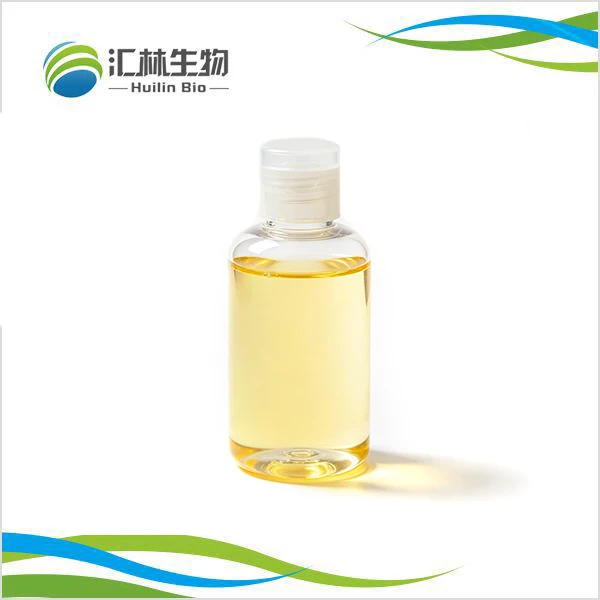
Isoamyl 4-(dimethylamino)benzoate (CAS 21245-01-2), listed in pharmacopoeial and cosmetic references as Padimate, is a light yellow to yellow oil with a tertiary aromatic amine and a branched five-carbon ester. Its formula is C14H21NO2 and its molecular weight is 235.32.
We supply it to formulators building oil-soluble UV-B absorbing systems, to coating and polymer producers who need an absorber that dissolves into the matrix rather than dispersing in it, and to groups preparing other dialkylaminobenzoate esters.
Two structural choices make it a liquid where its relatives are solids: the nitrogen carries two methyl groups and no hydrogen to hydrogen-bond with, and the ester carries a branched isoamyl chain rather than a straight one. Both push the melting point below room temperature.
Specification
| Item | Specification | Test Method |
| Physical Description | / | / |
| Appearance | Light yellow to yellow oil | Visual |
| Identification | Conforms to reference standard (retention time) | GC |
| Chemical Tests | / | / |
| Assay | ≥ 98.0% | GC, area normalization |
| Water | ≤ 0.5% | Karl Fischer |
| Residue on Ignition | ≤ 0.1% | Gravimetric, USP Chapter 281 |
| Heavy Metals | / | / |
| Heavy Metals (as Pb) | ≤ 10 ppm | ICP-MS |
Indicative limits for the grade. Batch data is issued per lot on its own certificate.
Why This Ester Is a Liquid
The 4-aminobenzoate family divides by what sits on the nitrogen. A primary amine such as benzocaine has two N-H bonds and packs as a crystalline solid; a secondary amine such as ethyl 4-(butylamino)benzoate keeps one N-H and still melts in the sixties; a tertiary amine with two methyl groups has none, and the molecule loses the hydrogen bonding that would otherwise order it into a lattice.
The ester end adds the second variable. A straight chain gives a molecule that can pack; a branched isoamyl chain does not, because the methyl branch interrupts the repeat distance. Taking the hydrogen bonding away and branching the chain at the same time is what leaves an oil at room temperature rather than a low-melting solid.
That is not a cosmetic detail. A liquid mixes into an oil phase without a melting step, disperses without a solvent, and does not recrystallise on storage at low temperature - which is the failure mode of a solid absorber dosed near its melting point.
Assay, Volatility and What the Certificate Reports
Assay is reported by gas chromatography at ≥ 98.0% on an area-normalisation basis. GC rather than HPLC is used because the molecule is volatile enough to pass a column cleanly at ordinary inlet temperatures, and because the ester separates from residual 4-dimethylaminobenzoic acid and from the higher-boiling diester by-products on a non-polar phase.
Water by Karl Fischer is capped at ≤ 0.5%, ignition residue at ≤ 0.1%, and lead at ≤ 10 ppm on an ICP-MS screen. Colour is recorded as light yellow to yellow: the tertiary amine is slower to oxidise than a primary one, but the oil still darkens on prolonged exposure to light and air.
Because the material is a liquid, there is no melting range to report. Density and refractive index are the physical constants normally used alongside retention time for identity on a liquid ester; both are reported per batch on request rather than held as release limits.
Padimate, Padimate O and the Secondary Amine
The names in this group overlap in a way that causes real confusion in correspondence: Padimate and Padimate O are different esters, and neither is the same as the butylamino compound sold alongside them. The table sets out what actually differs.
| Dimension | Padimate (21245-01-2) | Padimate O (21245-02-3) | Ethyl 4-(butylamino)benzoate (94-32-6) |
| Nitrogen | Tertiary, two methyl groups | Tertiary, two methyl groups | Secondary, one butyl group |
| Ester group | Isoamyl, branched C5 | 2-Ethylhexyl, branched C8 | Ethyl, linear C2 |
| Formula / MW | C14H21NO2 / 235.32 | C17H27NO2 / 277.40 | C13H19NO2 / 221.29 |
| Physical form | Light yellow to yellow oil | Pale yellow liquid | White crystalline powder |
| Melting behaviour | Below room temperature | Below room temperature | Melts at 68 - 70 °C |
| Typical role | Oil-soluble UV-B absorber | Oil-soluble UV-B absorber | UV-B absorbing intermediate |
Choose this ester when the absorber has to sit in an oil phase and the formulation calls for the shorter branched chain. Choose Padimate O when a longer, more lipophilic chain is wanted for a heavier emollient system. Choose the secondary amine when a solid that melts into a warm phase is preferred and an N-H is wanted for further chemistry.
Applications
Oil-Phase Absorbing Systems - an absorber that mixes into an oil phase without a melting step and stays liquid through low-temperature storage.
Coatings and Polymer Additives - a liquid absorber that dissolves into the matrix rather than dispersing as a solid, used where optical clarity of the film matters.
Ester Intermediates - a substrate for transesterification to other dialkylaminobenzoate esters, where the isoamyl group leaves as the alcohol.
Reference Work - a liquid reference for the 4-aminobenzoate family, used alongside the solid homologues to separate the effect of nitrogen substitution from that of the ester chain.
Final performance depends on the host phase, the loading level and the processing temperature; everything on this page describes the material as supplied, not a performance result in a finished formulation.
FAQ
Q: Is Padimate the same as Padimate O?
A: No. Padimate carries an isoamyl ester, CAS 21245-01-2, formula C14H21NO2 and molecular weight 235.32. Padimate O carries a 2-ethylhexyl ester, CAS 21245-02-3, formula C17H27NO2 and molecular weight 277.40. Both are liquid tertiary-amine absorbers, but they differ by three carbons and cannot be substituted by weight.
Q: Why is this one a liquid while other 4-aminobenzoates are solids?
A: Two reasons that act together. The nitrogen carries two methyl groups and no N-H, so there is no hydrogen bonding to order the molecules into a lattice; and the isoamyl chain is branched, which interrupts packing. Remove the hydrogen bonding and branch the chain, and the melting point falls below room temperature.
Q: Is it permitted as a UV filter?
A: It absorbs in the UV-B region as a material property. Whether a given cosmetic or industrial use is permitted depends on the list of permitted UV filters in the destination market, and that status has to be confirmed against the applicable annex rather than inferred from the substance name.
Q: Why is assay run by GC rather than HPLC?
A: Because the molecule is volatile enough to pass a column cleanly, and GC resolves it from residual 4-dimethylaminobenzoic acid and from the higher-boiling diester by-products without derivatisation. The result is reported on an area-normalisation basis at ≥ 98.0%.
Q: How does it behave in a formulation?
A: It is miscible with ethanol, cosmetic esters and most oils and insoluble in water. As a liquid it needs no melting step, does not recrystallise at low temperature, and disperses into an oil phase directly; the ester will hydrolyse under aqueous base, so basic aqueous systems are avoided until the point of use.
Q: How should it be stored and handled?
A: Ambient, sealed, dry and out of the light. The tertiary amine oxidises more slowly than a primary one, but the oil still darkens on prolonged exposure; because it is a liquid, drums should be kept upright and dispensed without prolonged open handling.
Q: Can the other dialkylaminobenzoate esters be supplied?
A: Yes, on request. The same route delivers different alcohols on the ester, and each homologue has its own molecular weight, viscosity and solubility profile, so the specification is written per product rather than carried across.
Q: What documentation accompanies the material?
A: A lot-specific certificate, a technical data sheet and a safety data sheet travel with each order. Density, refractive index or a residual solvent panel can be added to the release specification on request.
Supply, Documentation and Contact
Xi'an Huilin Bio-tech Co., Ltd. supplies isoamyl 4-(dimethylamino)benzoate as a light yellow to yellow oil in 1 kg aluminium bottles packed in cartons and 25 kg HDPE drums. Each shipment carries a batch-specific COA, a TDS and an SDS, and the COA reports the items listed above with their measured values.
A different alcohol on the ester gives a different viscosity and solubility, so each homologue is specified product by product rather than carried across from this one. If your market needs import documents, ask and they will be prepared.
Contact: sales@huilinbio-tech.com
A material description, not a statement of permitted use. Each market sets its own conditions.
Hot Tags: isoamyl 4-(dimethylamino)benzoate liquid, China, suppliers, manufacturers, factory, wholesale, buy, price, bulk, pure, natural, high quality, in stock, for sale


