


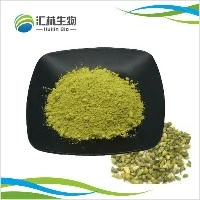


Is paeonol used in Chinese medicine? Yes, but not as an herb: it is the phenolic compound by which the pharmacopoeia standardises Moutan Cortex, the root bark of Paeonia suffruticosa. Paeonol powder at 99% is a different product from that herb, and the difference is regulatory before it is chemical.

1. The Herb and the Compound Are Two Different Products
Moutan Cortex is a pharmacopoeial crude drug, and paeonol powder at 99% is an isolated compound; nothing about the first transfers automatically to the second.
The herb is the dried root bark of Paeonia suffruticosa Andrews, known in Chinese medicine as mu dan pi. It belongs to the herbs that promote blood circulation and remove blood stasis, and that is how the modern literature describes its traditional use. Paeonol is the principal bioactive phenol in that bark, and it is the reason the bark is assayed the way it is.
The distinction is not academic. A buyer who asks for "TCM paeonol" is asking for two products at once: a crude drug sold by the kilogram of bark, and a purified isolate sold by the kilogram of crystalline powder. They have different monographs, different price points and different permitted uses. Anyone typing "is paeonol used in Chinese medicine" into a search box is really asking which of the two they need. Confusing them is the most common sourcing error in this category, and it usually surfaces at customs rather than at the bench.
2. The Pharmacopoeia Is Where the Two Meet
One number joins the bark to paeonol powder, and it explains both why the isolate exists commercially and why it is not a substitute for the herb.
The Chinese Pharmacopoeia monograph for Moutan Cortex measures paeonol by HPLC on the dried basis and sets a minimum of 1.2% for both the crude drug and the decoction pieces. That figure does two things at once. It defines the herb as a material that must contain paeonol, and it caps how much of the herb's mass is that compound: at 1.2%, a kilogram of compliant bark carries roughly 12 g of paeonol.
That arithmetic is the entire commercial case for the isolate. Reaching a gram of paeonol from bark means processing something in the order of 80 g of compliant material before extraction losses, which is why a standardised extract and a 99% crystalline powder occupy different shelves and different price bands. They are not grades of the same thing; they are different positions on the same supply chain. Both sit in our natural ingredients range, and comparing them there is faster than comparing certificates.
3. Tradition Does Not Become a Claim
"Is paeonol used in Chinese medicine" usually arrives with a second question attached: may I say so on a label? A documented history of use is not a permitted claim in either major market, and citing the tradition as substantiation is the fastest way to lose a regulatory argument.
In the United States a structure or function claim may describe the role of an ingredient in normal physiology without pre-approval, provided it is truthful, carries a substantiation file, and is notified to the agency within 30 days of marketing. It may not describe treating, preventing or curing a disease, and centuries of use in another medical system does not convert a disease claim into a structure claim.
In the European Union the position is narrower still: a health claim is usable only if it appears in the authorised list, and traditional use outside the Union is not a route onto that list. So a formulator in either market can say what the ingredient is and what it does in a formula, but cannot import the herb's indication into a cosmetic or supplement label. Paeonol powder sells into that constraint, not around it.
4. What the Isolate Is Actually Used For
Four industries buy paeonol powder, and each one is governed by a different constraint rather than by a different benefit.
| Market | Why the isolate, not the bark | What actually governs it |
| Pharmaceutical | Single-entity dosing and reproducible assay | A finished drug needs approval in the destination market |
| Cosmetic | Colour and odour control at low use levels | Product safety file, and no authorised EU health claim |
| Food and nutraceutical | Dose precision in a capsule or sachet | Ingredient status has to be confirmed market by market |
| Agricultural | Cost per active gram at field scale | Pesticide registration, not cosmetic or food rules |
The cosmetic row carries most of the volume for paeonol powder and most of the confusion. A formulator wants the redness and sebum story that the herbal literature implies, but the label may not carry it. What the label can carry is the ingredient's identity, its function in the formula, and a use level the safety file supports. The gap between what the literature describes and what the label may say is where a brand's regulatory lead earns their fee.
5. The Specification That Matters
For paeonol powder at this use level, identity and physical form decide whether the batch works, and the assay figure on its own decides very little.
| Parameter | Specification |
| CAS / formula / molecular weight | 552-41-0 / C9H10O3 / 166.17 |
| Assay (HPLC) | ≥ 99% |
| Appearance / odour | White to off-white crystalline powder; characteristic aromatic |
| Melting point | 49–52 °C |
| Particle size | 100% through 80 mesh |
| Loss on drying / residue on ignition | ≤ 0.5% / ≤ 0.1% |
| Heavy metals | ≤ 10 ppm |
| Microbiology | TPC ≤ 1,000 CFU/g; yeast and mould ≤ 100 CFU/g; E. coli and Salmonella negative |
| Order and packing | MOQ 100 g; 1 kg foil bag or 25 kg fibre drum; 24-month shelf life |
Two rows in that paeonol powder specification are worth arguing about before you sign a purchase order. The melting point range is a quality signal: a batch that melts below 49 °C is either impure or wet, and neither shows up in an assay figure. The moisture limit matters for the same reason, because loss on drying moves the assay without moving the label. Ask for both on the certificate of analysis, not just the purity headline.
6. Two Numbers That Decide Your Formula
The answer to "is paeonol used in Chinese medicine" decides what goes into the jar; solubility and melting point decide whether it stays there, and they constrain a formulator far more than the 99% figure that sells the powder.
Paeonol powder dissolves to about 4,965 mg/L in water at 25 °C, which is roughly 0.5% weight by volume. At the top of the usual cosmetic use range, a formula that is 70% water sits at just under 60% of saturation in its aqueous phase. That is workable, but it leaves no headroom: add an electrolyte, shift the pH, or store the batch cold and the compound has nowhere to go but out of solution.
The melting point is the second constraint and the less obvious one. At 49–52 °C the material melts at a temperature a sealed warehouse can approach in summer and a jacketed process vessel passes without effort. Melting is reversible, but recrystallisation changes particle size and dissolution rate, so a batch that got hot is not the same batch even when the assay is unchanged.
7. Frequently Asked Questions
Q: Is Paeonol Used In Chinese Medicine?
A: Yes, as the defining compound of a herb rather than as a herb itself, which is why paeonol powder and the bark are sold as separate things. Moutan Cortex, the root bark of Paeonia suffruticosa, is the traditional material, and paeonol is the phenol its monograph requires and measures. Practitioners used the bark; laboratories and formulators use the isolate, which is a different regulatory object.
Q: Is Paeonol Powder The Same As Mu Dan Pi?
A: No. Mu dan pi is a crude drug sold as dried root bark and assayed to a minimum paeonol content. Paeonol powder at 99% is an isolated crystalline compound. One is a herbal material with a monograph, the other is a purified active with a specification. Buying one and expecting the other is the most common error in this category.
Q: How Much Paeonol Does The Bark Contain?
A: The pharmacopoeial minimum is 1.2% on the dried basis, measured by HPLC for both the crude drug and the decoction pieces. At that floor, a kilogram of compliant bark carries roughly 12 g of paeonol before extraction losses. Higher-grade bark runs above the minimum, which is why raw material sourcing moves the cost of a standardised extract.
Q: Can I Put Traditional Use Claims On A Cosmetic Label?
A: For paeonol powder, no - not as a route to an authorised claim. In the United States only a structure or function statement about normal physiology is available, with a substantiation file and a notification. In the European Union a claim must appear in the authorised list, and traditional use outside the Union does not put it there. Both markets require a separate safety assessment.
Q: What Use Level Is Normal In Skincare?
A: Between 0.01% and 0.2% in the finished formula, which sits below the roughly 0.5% solubility ceiling in water. The upper end is where the aqueous phase approaches saturation, so formulas that also carry salts or alcohol need checking before scale-up. Above the solubility limit the compound crystallises on storage rather than staying in solution.
Q: What Should I Check On The Certificate Of Analysis?
A: For paeonol powder, check assay by HPLC, melting point, loss on drying and heavy metals, in that order of diagnostic value. The assay confirms identity and strength, but a melting point below 49 °C or moisture above 0.5% will change how the batch behaves in a formula without showing up in the purity figure. Ask for the particle size distribution too.
Buying paeonol for a cosmetic, nutraceutical or research programme? Paeonol powder ships from Xi'an Huilin Bio-tech Co., Ltd. at ≥ 99% by HPLC, CAS 552-41-0, 100% through 80 mesh, from a 100 g sample to 25 kg drums, with the batch certificate issued against the specification you send. Tell us the use level and the market you are selling into, and we will tell you which line of the specification will decide your batch.
Written for trade buyers and formulators; not medical advice.
Sources
-
1. Chinese Pharmacopoeia Commission. Pharmacopoeia of the People's Republic of China. Vol. I. Beijing: China Medical Science Press; 2020. Moutan Cortex monograph.
-
2. Identification of anticoagulant ingredients from Moutan Cortex. PubMed. pubmed.ncbi.nlm.nih.gov/40091648
-
3. PubChem. Paeonol, CID 11092. pubchem.ncbi.nlm.nih.gov/compound/11092
-
4. US Food and Drug Administration. Structure/function claims. fda.gov
-
5. Regulation (EC) No 1924/2006 on nutrition and health claims made on foods. EUR-Lex
-
6. EU Register of nutrition and health claims. ec.europa.eu