


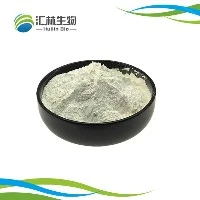
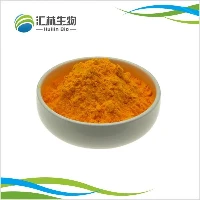

Oligopeptide-1 is the same three-amino-acid sequence sold under at least four names, and one of those names carries copper while the others do not. That single difference changes colour, storage temperature and minimum order, so a purchase order written on the name alone can buy the wrong substance without anyone noticing. Oligopeptide-1 powder and copper tripeptide-1 are the two products this page separates.
1. Oligopeptide-1 Is Gly-His-Lys, With Or Without Copper
The peptide is a tripeptide of glycine, histidine and lysine. On our catalogue it appears twice: as the metal-free powder under the name Oligopeptide-1, and as the copper complex under the name Copper Tripeptide-1. Both are legitimate products; they are not interchangeable in a formula.
| Property | Oligopeptide-1 | Copper Tripeptide-1 |
| Also sold as | Tripeptide-1, GHK | GHK-Cu, copper peptide |
| CAS on our sheet | 49557-75-7 | 89030-95-5 |
| Purity offered | 95% and 98%, HPLC | 99%, HPLC |
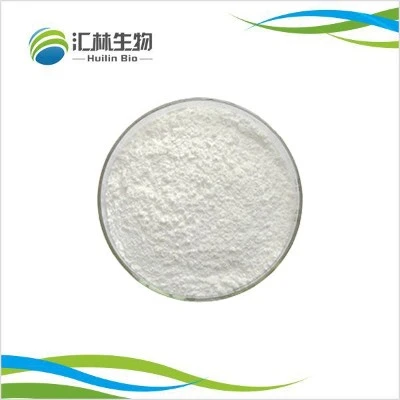
| Appearance | White to off-white lyophilized powder | Blue lyophilized powder |
| Storage | Cool, dry place | Cool, dry, 2 to 8 degrees recommended |
| Minimum order | 1 g | 50 g |
The colour is the fastest visual check in the warehouse. A white powder labelled Copper Tripeptide-1 is not the copper complex, and a blue powder labelled Oligopeptide-1 has picked up copper somewhere in the process.

2. The Four Names Do Not All Point At The Same Substance
Oligopeptide-1, Tripeptide-1, GHK and GHK-Cu are used almost interchangeably in correspondence, and three of the four describe the metal-free peptide while the fourth does not.
Our sheet states the relationship directly: Oligopeptide-1 is Tripeptide-1, which is GHK, the sequence Gly-His-Lys. The name GHK-Cu is reserved for the complex. A buyer who accepts "GHK" as shorthand for either product has accepted a name that cannot distinguish them.
The collapse happens fastest in an RFQ. A request for quotation that says "Oligopeptide-1, GHK, 100 g" can be answered with a white powder, a blue powder or an acetate salt, and all three answers look responsive. None of the three is wrong, and only one of them is the substance the buyer had in mind.
One more number circulates, and it needs separate treatment. Suppliers quote CAS 2097691-58-0 for Oligopeptide-1, and PubChem carries no record under it. Directories that list the number publish no molecular formula, no molecular weight and no structure beside it, and their own description of the substance moves between the growth factor and the tripeptide in two adjacent paragraphs. A number that cannot be tied to a formula cannot be checked against a certificate, which makes it unusable as a purchase specification even where the market uses it.
3. Three CAS Numbers Resolve To Three Different Formulas
This is where the name problem becomes a documented one. Look up the three numbers that circulate for this peptide and PubChem returns three different formulas.
| CAS | PubChem formula | Molecular weight | What it resolves to |
| 72957-37-0 | C16H28N6O6 | 400.43 | The tripeptide plus one acetic acid |
| 49557-75-7 | C14H24N6O4 | 340.38 | The metal-free tripeptide |
| 89030-95-5 | C14H23CuN6O4 with a positive charge | 402.92 | The copper complex |
PubChem names them. The 400.43 record is titled glycyl-L-histidyl-, monoacetate and the 340.38 record glycyl-L-histidyl-L-lysine, and the arithmetic agrees: 400.43 minus 340.38 is 60.05, one molecule of acetic acid, so the first is a salt of the second rather than a different peptide. The third differs by 62.54 from the free peptide, which is copper in place of two hydrogens.
Two consequences follow. A certificate that pairs 72957-37-0 with a molecular weight of 340 states two things that cannot both be true of one substance, and that pairing is common enough in this trade to be worth checking on every lot. And a certificate that pairs a copper product with 49557-75-7 is quoting the metal-free number.
The salt form is not a detail. If the material is the acetate at 400.43 and the formula is dosed on peptide content, one gram of powder delivers 0.85 grams of peptide, because 340.38 divided by 400.43 is 0.85. That is a fifteen percent shortfall that no assay figure will flag, since the assay may well read 98 percent against the salt.
4. What The Copper Changes Inside The Drum
The complex is not a marketing variant of the peptide. Copper changes what the material tolerates, and three of those consequences show up before the formula is written.
› Storage tightens from a cool dry place to 2 to 8 degrees, because the complex is the less forgiving solid
› Minimum order rises from 1 g to 50 g, which changes what a sample request costs
› Appearance moves from white to blue, giving the receiving bay a check that needs no instrument
The colour is also a limitation. A blue powder cannot go into a product that has to be water-clear, and that rules out the format before any claim is discussed.
For the broader question of what copper peptides are used for, we keep that material in a separate article so this page stays on identity.
5. The Two Assay Figures Are Not Comparable
Oligopeptide-1 is offered at 95% and 98% by HPLC; the copper product at 99% by HPLC. Reading those three numbers as a ranking would be a mistake, because they describe different things.
For the metal-free peptide, the assay is a statement about peptide content, and the balance is water, counter-ion and synthesis residuals. For the copper complex, an HPLC percentage says nothing about how much copper is bound, which is the figure that actually distinguishes one lot from another. Ask for the copper content as a separate line, and for the method used to obtain it.
There is a second reason the two percentages do not rank. HPLC on the complex measures the peptide backbone, and a lot that has lost part of its copper can still integrate cleanly. Two lots can both read 99 percent and differ in the figure the customer actually needs. That is why the copper line, with its limit and its method, belongs beside the assay rather than in a note.
6. Oligopeptide-1 Is Not Human Oligopeptide-1
The most expensive confusion around this name is not GHK-Cu. It is the other substance that shares the string.
Human epidermal growth factor is a different material and it is not the tripeptide. PubChem resolves CAS 62253-63-8 to human epidermal growth factor, C270H401N73O83S7 at 6222, against 340.38 for the tripeptide, so the two names that differ by one word sit eighteen times apart in mass. A brief that says Oligopeptide-1 and means EGF will be quoted by a supplier who is answering the question that was written, not the one that was meant.
7. What To Put On The Order
Four lines settle the identity question, and each one blocks a specific failure.
› Name and CAS together, with the copper status stated in words, not implied
› Molecular formula expected on the certificate, so a salt cannot pass as the base
› Copper content with its limit and method, for the complex only
› Appearance stated, because white against blue is the cheapest check available
A specification that carries all four can be received without an argument. One that carries only a name cannot.
8. Matching The Form To The Format
The table below is the short version. The middle column is what to order, and the last column is what to check before the batch is released.
| Format | Form to order | Why | Verify before release |
| Clear aqueous serum | Oligopeptide-1 | The metal-free powder does not colour the base | Assay, appearance, clarity after four weeks |
| Opaque cream or emulsion | Either, decided by the claim file | Opacity hides the blue of the complex | Copper content if the complex is used |
| Sample or bench trial | Oligopeptide-1 at 1 g | The smaller minimum order reaches a lab faster | Identity of the lot against the standard |
| Bulk production | Either, by specification | Price per gram of peptide decides at this volume | Batch traceability and retention sample |
Frequently Asked Questions
Q: Is Oligopeptide-1 The Same As Copper Tripeptide-1?
A: Same amino acid sequence, different substance. Oligopeptide-1 is the metal-free tripeptide Gly-His-Lys with CAS 72957-37-0 on our sheet. Copper Tripeptide-1 is that sequence complexed with copper, CAS 89030-95-5, and it is blue rather than white. One cannot be substituted for the other at the same weight, because the copper adds 62.54 to the molecular weight.
Q: Why Do Three Different CAS Numbers Appear For This Peptide?
A: Because three substances are in circulation. 72957-37-0 resolves to C16H28N6O6 at 400.43, which is the tripeptide with one acetic acid. 49557-75-7 resolves to C14H24N6O4 at 340.38, the metal-free peptide. 89030-95-5 resolves to the copper complex at 402.92. A certificate that pairs a CAS with the wrong formula is the failure to catch.
Q: What Is The Molecular Weight Of Oligopeptide-1?
A: It depends which species is meant. The free tripeptide is 340.38; the acetate form is 400.43; the copper complex is 402.92. Our sheet pairs 49557-75-7 with C14H24N6O4 at 340.38. If a supplier quotes a different CAS beside that weight, the two lines describe different species and one of them is wrong.
Q: Does The Copper Form Need Different Storage?
A: Yes. Our sheet places the metal-free powder in a cool, dry place and recommends 2 to 8 degrees for the copper complex, which is the less stable solid. Both carry a 24-month shelf life on our documentation. The practical rule is that the blue powder should not sit on a bench at room temperature for a week.
Q: Is Human Oligopeptide-1 The Same Ingredient?
A: No. Human epidermal growth factor is a different material, listed under CAS 62253-63-8 and weighing 6222, against 340.38 for the Gly-His-Lys tripeptide. The names differ by one word and the masses by a factor of eighteen. When a brief says Oligopeptide-1, write the CAS beside it so a supplier cannot answer the other question.
Q: Which Purity Should A Formulator Specify?
A: Our metal-free peptide is offered at 95% and 98% by HPLC and the copper complex at 99%. Choose by what the certificate has to prove rather than by the larger number. For the complex, the copper content matters more than the HPLC percentage, and it should be requested as its own line with its own method.
Xi'an Huilin Bio-tech Co., Ltd. supplies Oligopeptide-1 and Copper Tripeptide-1 as cosmetic raw materials, with the CAS number, formula and appearance stated on each specification sheet.
Sources
-
1. CAS 72957-37-0, record CID 22214678. PubChem, U.S. National Library of Medicine. https://pubchem.ncbi.nlm.nih.gov/compound/22214678
-
2. CAS 49557-75-7, record CID 73587. PubChem, U.S. National Library of Medicine. https://pubchem.ncbi.nlm.nih.gov/compound/73587
-
3. CAS 89030-95-5, record CID 71587328. PubChem, U.S. National Library of Medicine. https://pubchem.ncbi.nlm.nih.gov/compound/71587328
-
4. CAS 62253-63-8, record CID 16143379 (human epidermal growth factor). PubChem, U.S. National Library of Medicine. https://pubchem.ncbi.nlm.nih.gov/compound/16143379
-
5. Inventory of Existing Cosmetic Ingredients in China (IECIC), National Medical Products Administration. https://www.nmpa.gov.cn/