



Xi'an Huilin Bio-Tech Co., Ltd. is one of the leading manufacturers and suppliers of ecklonia cava extract phlorotannins in China. With abundant experience, we are committed to providing high quality natural products with competitive price. Please feel free to wholesale bulk pure ecklonia cava extract phlorotannins for sale here from our factory.
Ecklonia cava extract powder is a phlorotannin-standardised extract of the brown alga Ecklonia cava, supplied at ≥ 90 % total phlorotannins. The actives are phloroglucinol-based polymers - eckol, dieckol and phlorofucofuroeckol A among them - and the grade is measured as total polyphenols by the Folin-Ciocalteu method.
What separates this grade from a generically labelled "brown algae polyphenol" is not the number but the two things behind it: the species and the method. Phlorotannins occur only in brown algae, and their profile differs from one species to the next; the 90 % figure is a colorimetric sum, so it means little until the reference standard is named.
The grade is used where a concentrated phlorotannin input is needed at a small dose - capsules, powder blends and cosmetic formulations. Because the material is a defined mixture rather than a single substance, identity is carried by the chromatogram and the marker compounds, not by a CAS number or a melting point.
Identity
| Item | Value |
| Product name | Ecklonia cava extract, phlorotannin-standardised |
| Structural class | Phlorotannins - polymers of phloroglucinol |
| Monomer | Phloroglucinol, C6H6O3, 126.11 |
| Marker compounds | Dieckol, eckol, phlorofucofuroeckol A |
| Degree of standardisation | ≥ 90 % total phlorotannins |
| CAS / EC | Not assigned; the product is a mixture |
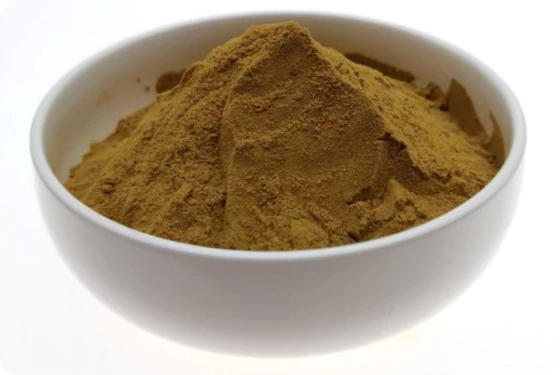
| Appearance | Brown powder |
Identity on the certificate rests on two things: the chromatographic fingerprint against a reference, and the marker figures reported for the lot. There is no melting range and no molecular weight to cite, because there is no single molecule to describe.
What Phlorotannins Are
A phlorotannin is a polymer of phloroglucinol - 1,3,5-trihydroxybenzene - and the class is found only in brown algae. The units are joined either carbon to carbon, carbon to oxygen, or both, which gives six structural families: fucols, phlorethols, fucophlorethols, fuhalols, carmalols and eckols.
In Ecklonia cava the characteristic members are the eckol series. Dieckol, a six-unit member of that series, is the single most abundant oligomer, and phlorofucofuroeckol A is the other marker normally reported.
This is not the same chemistry as tea polyphenols. Catechins are flavan-3-ols built on a C6-C3-C6 skeleton with a sugar-free but defined ring system; phlorotannins are acetate-derived phloroglucinol chains with no flavonoid skeleton and no glycosidic form. The two are quantified differently and are not interchangeable at equal weight.
What the 90 % Figure Covers
The assay is total polyphenols by Folin-Ciocalteu: the sample reduces the reagent, and the colour is read at 765 nm against a reference standard. It is a summation, not a single-peak purity, and it does not say which oligomers are present.
The number moves with the standard. Gallic acid, phloroglucinol and a mixed polyphenol standard do not give the same result on the same sample, and the spread can run to double digits. This is not a defect of our material; it is a property of the method, and the European safety assessment of a 90 % Ecklonia cava extract recorded exactly this objection - that the Folin-Ciocalteu method with a polyphenol standard is prone to yield erroneous values - before accepting the specification on the strength of full compositional data.
The practical consequence is that a 90 % figure is only comparable when the method and the standard are stated. Our certificate names both, together with the wavelength, and carries the HPLC figures for the markers alongside.
Specification and Release Basis
| Item | Specification | Test Method |
| Assay, total phlorotannins | ≥ 90.0 % | Folin-Ciocalteu, 765 nm |
| Appearance | Brown powder | Visual |
| Identification | Fingerprint corresponds to reference | HPLC |
| Dieckol | Reported per batch | HPLC |
| Eckol | Reported per batch | HPLC |
| Phlorofucofuroeckol A | Reported per batch | HPLC |
| Moisture | ≤ 5.0 % | Gravimetric, 105 °C |
| Ash | Reported per batch | Gravimetric |
| Iodine | Reported per batch | ICP-MS |
| Heavy metals, as Pb | ≤ 10 mg/kg | ICP-MS |
| Lead, arsenic, cadmium, mercury | Pb ≤ 2; As ≤ 2; Cd ≤ 1; Hg ≤ 0.5 mg/kg | ICP-MS |
| Total plate count | < 1,000 CFU/g | Plate count |
| Yeast and mould | < 100 CFU/g | Plate count |
| E. coli and Salmonella | Negative for both | Culture |
| Solubility | Soluble in water and aqueous ethanol | Visual |
| Particle size | ≥ 95 % through 80 mesh | Sieve |
Every lot of Ecklonia cava extract powder is released against this table. Tested per batch - see Certificate of Analysis. Tighter limits are available on request.
Dieckol, Eckol and the Figure Behind the Total
The total is a sum, and a sum can stay flat while the profile moves. Two lots can both read 90 % and differ in how much of that 90 % is dieckol.
Dieckol is the marker that carries most of the information. In published characterisation of 90 % Ecklonia cava extracts, dieckol accounts for approximately 21 % of the total phlorotannins - around a fifth of the material, which makes it a usable single-compound check on a mixture that has no CAS number.
That is why the certificate reports dieckol, eckol and phlorofucofuroeckol A per lot rather than fixing them as limits. A fixed limit would be a promise the raw material cannot keep across harvests; a reported figure lets the incoming laboratory read the lot against its own specification.
The Daily Intake Figure and What It Corresponds To
The European authorisation is for use in food supplements by individuals over the age of 12. The safety assessment behind it set the maximum daily intake at 163 mg for adolescents aged 12 to 14, 230 mg for those above 14, and 263 mg for adults - figures derived from a no-observed-adverse-effect level of 750 mg/kg body weight per day and an uncertainty factor of 200. The applicant had proposed 360 mg per day for adults; the assessment settled on 263.
Two things follow, and both are easy to get wrong.
First, the limit is written on the extract, not on the phlorotannin content. At 90 %, 263 mg of extract delivers about 237 mg of phlorotannins; 230 mg delivers about 207 mg, and 163 mg about 147 mg. Buying a higher-assay material does not raise the ceiling - it lowers the weight of powder that fits under it.
Second, the ceiling is a property of the ingredient file, not of the supplier. A different extract of the same alga, standardised differently, is a different entry.
Iodine and the Marine Matrix
Brown algae concentrate iodine from seawater, and an alcohol extract carries part of it through. The European assessment noted that iodine intake from this material may be of concern for people at risk of thyroid disease, and that combining it with other iodine-containing supplements could push total intake above the upper level.
Iodine is therefore a reported figure on our certificate rather than an assumption. It is measured by ICP-MS alongside the heavy metals, because the same marine route that delivers the phlorotannins delivers the halogens and the trace elements with them.
Ecklonia Cava Against Four Neighbouring Products
Five things get called "brown algae extract". Only one of them is this grade.
| Substance | Relation to this grade | What it changes in use |
| Ecklonia cava fucoidan | Sulfated polysaccharide from the same alga | A different fraction entirely; no phloroglucinol units, and it is specified as a polysaccharide, not a polyphenol |
| Fucoxanthin | Carotenoid pigment from the same alga | Sold as 1 % by HPLC or 10 % by UV depending on the method - the two numbers describe the same class of material |
| Kelp (Laminaria) polyphenol extract | Different genus of brown alga | Lower phlorotannin content in the raw material and a different profile; usually sold at an extract ratio or at 10 to 40 % total polyphenols, not 90 % |
| Green tea polyphenols | Flavan-3-ols, not phloroglucinol polymers | Different chemistry, different assay, different regulatory route |
| "Brown algae polyphenol 90 %", species and method unstated | A label, not a specification | The figure cannot be checked without the species and the standard, so it is not comparable to this grade |
Solubility, Handling and Packaging
The powder dissolves in water and in aqueous ethanol. In a capsule fill or a powder blend it is weighed directly; in a liquid preparation it goes in at the front of the process, because phlorotannins oxidise once they are in solution and darken as they do.
The material is hygroscopic and light-sensitive. Moisture pick-up shows up as caking rather than as a chemical change, and light exposure shows up as colour drift, so the packaging is both a moisture and a light barrier: 1 kg foil bags, and 25 kg fibre drums with a double polyethylene liner.
Storage is sealed, cool, dry and away from light. Under those conditions the powder is stable for 24 months in unopened packaging.
Regulatory Position by Market
European Union. Phlorotannins from Ecklonia cava are authorised as a novel food for use in food supplements, on the basis of a safety assessment published in 2017. The authorised population is individuals over 12 years of age, and the intake figures set by that assessment are the 163, 230 and 263 mg per day described above.
United States. The material is sold as a dietary supplement raw material. A new dietary ingredient notification is filed per ingredient and per dose, and the determination belongs to the brand that files it; what we supply is the specification, the batch certificate and the composition statement the filing rests on.
China. The material is supplied as a raw material against contract specification. Where a food-use approval is required in China, that is a separate determination made for the material and the application.
Other markets. The determination belongs to the regulatory team in the destination market. Documentation to support import requirements is available on request.
Where This Grade Is Used
Dietary supplement capsules. Ecklonia cava extract powder at 90 % keeps the capsule count low relative to the intake ceiling, which is the main reason formulators specify it rather than a 20 % extract.
Powder blends and stick sachets. The material disperses into a dry blend and dissolves on reconstitution; at a 90 % loading the colour is deep brown and is usually masked in the blend rather than corrected.
Cosmetic formulations. Supplied as a raw material to manufacturers who have already fixed the ingredient in their formula. The colour and the oxidation behaviour are the two properties that decide where it can sit in a formula.
Research and reference work. The marker profile - dieckol, eckol, phlorofucofuroeckol A - makes the grade usable as a characterised reference material for analytical work.
Questions Buyers Ask Before the First Order
Q: Does Ecklonia cava extract have a CAS number?
A: No. It is a mixture of phlorotannins, not a single substance. The individual markers have their own identifiers - phloroglucinol is PubChem CID 359 - but none of them identifies the extract.
Q: Is the 90 % a purity?
A: No. It is total polyphenols by Folin-Ciocalteu, read at 765 nm against a named standard. It is a summation across the phlorotannin population, not the share of one peak.
Q: Why does the certificate have to name the standard?
A: Because gallic acid, phloroglucinol and mixed polyphenol standards do not give the same value on the same sample. Without the standard the figure is not comparable between suppliers - the European assessment made the same point about the method itself.
Q: What is dieckol and why report it?
A: Dieckol is the most abundant single phlorotannin in this species, at roughly a fifth of the total. It is the one figure that shows whether a 90 % lot still has the profile it is supposed to have.
Q: Is this the same as kelp polyphenol?
A: No. Ecklonia cava and Laminaria are different genera with different phlorotannin profiles and different raw-material contents. A 90 % specification on one is not a 90 % specification on the other.
Q: Is it the same as fucoidan from the same alga?
A: No. Fucoidan is the sulfated polysaccharide fraction; this is the polyphenol fraction. Same seaweed, different molecule, different specification, different regulatory entry.
Q: How does the daily intake figure apply to a 90 % grade?
A: The ceiling is written on the extract, not on the phlorotannin content. At 90 %, 263 mg of extract carries about 237 mg of phlorotannins.
Q: What documents come with a batch?
A: Certificate of analysis, technical data sheet and SDS, with the non-animal-origin, BSE-TSE-free and allergen statements issued alongside the certificate. Anything further that the destination market requires is prepared on request.
Supplier
Xi'an Huilin Bio-tech Co., Ltd. supplies Ecklonia cava extract powder and the related marine fractions - fucoidan, fucoxanthin and alginate oligosaccharide - from Shaanxi. Material is sourced against a written specification, and every batch ships with the certificate that carries the figures shown on this page. Documentation to support import requirements in the destination market is available on request.
This page describes a raw material supplied to supplement, cosmetic and formulation manufacturers. It is not a finished product. Final application, labelling and the regulatory determination in the destination market belong to the manufacturer of the finished product.
Hot Tags: ecklonia cava extract phlorotannins, China, suppliers, manufacturers, factory, wholesale, buy, price, bulk, pure, natural, high quality, in stock, for sale, Ashwagandha Root Extract Powder, Boswellia Serrata Extract Powder, Natural Ingredients, Red Ginseng Extract Powder, Standardized Extract, Wild Yam Extract Powder


