


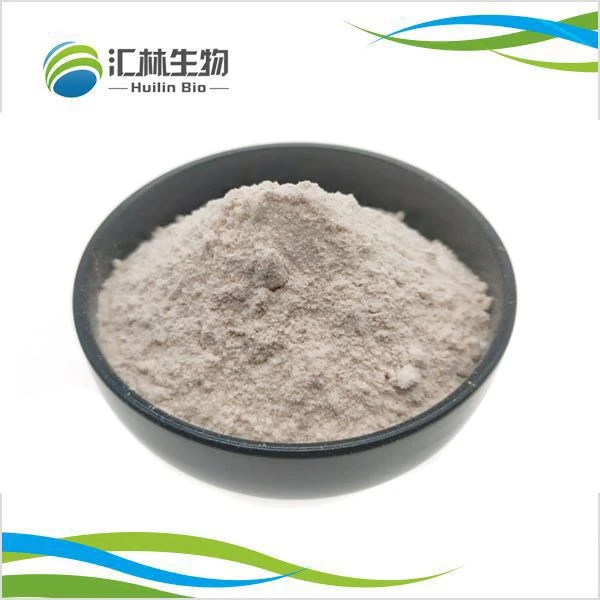
Xi'an Huilin Bio-Tech Co., Ltd. is one of the leading manufacturers and suppliers of magnolol powder in China. With abundant experience, we are committed to providing high quality natural products with competitive price. Please feel free to wholesale bulk pure magnolol powder for sale here from our factory.
Magnolol powder is a single purified compound: a biphenyl neolignan isolated from the bark of Magnolia officinalis, supplied at ≥ 98 % by HPLC as white to off-white needle crystals.
The bark contains two of these compounds side by side - magnolol and honokiol - and they share the same molecular formula and the same molecular weight. Everything that follows on this page exists because of that coincidence: what separates them, how a certificate proves which one you have, and why the honokiol figure matters even when you are buying magnolol.

What Magnolol Powder Is
Magnolol is a biphenyl carrying two hydroxyl groups and two allyl groups: C18H18O2, molecular weight 266.3, CAS 528-43-8. It crystallises as white needles that melt near 103 °C, and it is strongly lipophilic - practically insoluble in water, soluble in ethanol, chloroform and dilute alkali.
In the plant it occurs together with its isomer honokiol in the bark of Magnolia officinalis, the tree whose bark is used in Chinese medicine as houpo. A 98 % grade is the purified single compound, not a bark extract: the extract is a mixture of the two neolignans plus other bark constituents, and it is supplied as a different product.
Magnolol and Honokiol: Same Formula, Different Molecule
| Item | Magnolol | Honokiol |
| CAS | 528-43-8 | 35354-74-6 |
| Molecular formula | C18H18O2 | C18H18O2 |
| Molecular weight | 266.3 | 266.3 |
| Substitution | Allyl groups at 5 and 5' | Allyl groups at 3 and 5' |
Because the mass is identical, no molecular weight check, no "total neolignan" figure and no bark-extract assay can tell the two apart. Only chromatographic retention against a reference standard can, which is why the certificate names the standard and reports honokiol as its own line.
A 98 % magnolol grade leaves at most about two percent for everything else, honokiol included. Reporting that residual figure is more useful than writing "conforms", because the buyer can see whether the lot is a clean single compound or a mixture that happens to sum to 98 %.
Specification and Release Basis
| Item | Specification | Test Method |
| Assay, as magnolol, dried basis | ≥ 98.0 % | HPLC |
| Appearance | White to off-white needle crystals or crystalline powder | Visual |
| Identification | Retention time corresponds to magnolol reference standard | HPLC |
| Honokiol | Reported per batch | HPLC |
| Loss on drying | ≤ 1.0 % | Gravimetric, 105 °C |
| Ash | ≤ 1.0 % | Gravimetric |
| Heavy metals, as Pb | ≤ 10 mg/kg | ICP-MS |
| Lead | ≤ 2 mg/kg | ICP-MS |
| Arsenic | ≤ 2 mg/kg | ICP-MS |
| Total aerobic count | ≤ 1,000 CFU/g | Plate count |
| Yeast and mould | ≤ 100 CFU/g | Plate count |
| E. coli and Salmonella | Negative for both | Culture |
| Particle size | ≥ 95 % through 80 mesh | Sieve |
| Bulk density | Reported per batch | Tapped |
Every lot of magnolol powder is released against this table. Tested per batch - see Certificate of Analysis. Tighter limits are available on request.
What the Certificate Covers
The assay is a chromatographic figure on the dried basis, so it already corrects for moisture; loss on drying at 1.0 % keeps that correction small and keeps the powder free-flowing.
Honokiol is reported rather than limited, because the acceptable level depends on the application: a cosmetic formulator buying a single compound wants it low, while a supplement producer building a two-neolignan blend may want it higher and will buy the extract instead. Reporting the figure lets both read the same certificate.
Identity is carried by retention time against a magnolol reference standard, not by the assay alone. With an isomer of identical mass in the same raw material, a single peak at the right retention time is the only evidence that the isolation worked.
Solubility and Handling
The crystals are practically insoluble in water and soluble in ethanol, chloroform and dilute alkali, where the phenolic hydroxyls ionise. In formulation that points to the oil or ethanol phase, or to a pre-dissolved concentrate; a clear aqueous system is not where this material goes without a solubiliser.
The powder is a crystalline solid with a low bulk density and a tendency to carry static charge, so containment during weighing matters. Sealed, cool, dry and away from light, it holds its specification for 24 months; it is packed in 1 kg foil bags inside 25 kg fibre drums with a double polyethylene liner.
Regulatory Position by Market
China. The botanical source is a materia medica used in Chinese medicine, and the bark is not on the list of substances that may be used both as food and as medicine. Magnolol is supplied as an isolated compound for cosmetic and supplement manufacturing; ordinary food use is a determination for the destination market.
European Union. Used as a cosmetic ingredient. Food and supplement use requires a novel food determination for the specific ingredient; the medicinal history of the bark does not transfer to the isolated compound.
United States. Sold as a dietary supplement ingredient. No GRAS affirmation covers magnolol as a food ingredient.
Other markets. Check the destination's position on both the isolated compound and the botanical source; several markets regulate the bark and the isolate separately.
Where This Grade Is Used
Cosmetic formulations. Magnolol powder is supplied for oil phases, anhydrous products and ethanol-based systems where a lipophilic neolignan is specified.
Supplement manufacturing. Used where a single-compound grade is required rather than a bark extract; the ratio to honokiol is fixed by the formula, not by the certificate.
Oral care and other emulsions. The lipophilic profile suits systems built around ethanol or oil rather than water.
Questions Buyers Ask Before the First Order
Q: Is magnolol the same as honokiol?
A: No. They are isomers with the same formula and the same molecular weight, 266.3, but different substitution and different CAS numbers. Only retention time against a reference standard distinguishes them.
Q: Why does the certificate report honokiol separately?
A: Because a 98 % magnolol grade still contains up to about two percent of other material, and honokiol is the relevant one. Reporting it lets the buyer judge whether the lot is a clean single compound.
Q: Is this a bark extract or a single compound?
A: Magnolol powder is a single compound. The extract contains both neolignans and other bark constituents and is supplied as a separate product.
Q: Does it dissolve in water?
A: Practically not. It is soluble in ethanol, chloroform and dilute alkali, so formulations start from an oil or ethanol phase.
Q: What is the melting point?
A: Near 103 °C for the pure compound; the certificate reports the measured value for the lot.
Q: How should it be stored?
A: Sealed, cool, dry and away from light. The crystalline powder is stable for 24 months in unopened packaging.
Q: Do you also supply honokiol?
A: Yes. Honokiol is supplied as its own grade with its own specification, so the two can be bought separately or as a defined blend.
Q: What documents come with a batch?
A: Certificate of analysis, technical data sheet and SDS, together with an allergen statement. Anything further that the destination market requires is prepared on request.
Supplier
Xi'an Huilin Bio-tech Co., Ltd. supplies magnolol powder at 98 % and the corresponding honokiol grade, both isolated from Magnolia officinalis bark. Material is sourced against a written specification, and every batch ships with the certificate that carries the figures shown on this page. Documentation to support import requirements in the destination market is available on request.
This page describes a raw material for cosmetic and supplement manufacturing. It is not a finished cosmetic or supplement, and it is not intended for direct consumption. Final application performance depends on the formulation and on the regulatory determination made in the destination market.
Hot Tags: magnolol powder, China, suppliers, manufacturers, factory, wholesale, buy, price, bulk, pure, natural, high quality, in stock, for sale, 98 Ferulic Acid Powder, Artemisinin Powder, Curcumin Extract Powder, Herb Extracts, Resveratrol Powder 98 , Vincamine Powder


