



Xi'an Huilin Bio-Tech Co., Ltd. is one of the leading manufacturers and suppliers of chlorhexidine acetate powder in China. With abundant experience, we are committed to providing high quality natural products with competitive price. Please feel free to wholesale bulk pure chlorhexidine acetate powder for sale here from our factory.
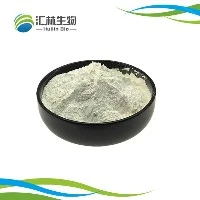
Chlorhexidine diacetate powder is the diacetate salt of chlorhexidine, a cationic biguanide. It is supplied as a white to almost white crystalline powder, CAS 56-95-1, molecular weight 625.5, and it is used in cosmetic formulations as a permitted preservative at a maximum of 0.3 % expressed as chlorhexidine.
The salt form is the part that matters in practice. Chlorhexidine base weighs 505.4; the diacetate weighs 625.5, so one gram of this powder carries 0.808 g of the base. Every regulatory limit and every formulation calculation is written against the base, not against the powder on the bench.
What Chlorhexidine Diacetate Is
Chlorhexidine is a symmetric biguanide: two 4-chlorophenyl arms joined through a hexamethylene chain, with guanidine groups that carry a positive charge in solution. That charge is the whole mechanism of the molecule - it binds to the negatively charged surface of a microbial cell, and the binding is why the material is used at very low concentrations.
The base itself is poorly soluble in water. Two acetic acid molecules per base give the diacetate, and the salt is far easier to handle: a crystalline powder, sparingly soluble in water, soluble in ethanol 96 %, slightly soluble in glycerol and propylene glycol. The acetate is what makes a workable preservative raw material out of an otherwise intractable base.
The name causes more confusion than the chemistry. Chlorhexidine acetate and Chlorhexidine diacetate are the same substance on the same CAS number; there is no monoacetate in commerce. What is genuinely different is the other salts - dihydrochloride and digluconate - which have their own molecular weights and their own supply forms.
The 0.3 % Limit Is Written as Chlorhexidine
Chinese and European cosmetic rules both express the limit as chlorhexidine, not as the salt. That single sentence decides how much powder a formula can carry.
| Basis | Molecular weight | Figure |
| Chlorhexidine base | 505.4 | 0.3 % maximum, as written in the regulation |
| Chlorhexidine diacetate | 625.5 | 0.371 % - the same limit expressed as this powder |
| Conversion factor | 505.4 ÷ 625.5 = 0.808 | base content of the powder |
Read the table in the other direction and the risk appears: 0.3 % of the powder delivers only 0.242 % of base. A formula that weighs the powder against the regulatory number, without converting, sits below the intended concentration while looking compliant on paper.
Identity
| Item | Value |
| Chemical name | 1,1'-Hexamethylenebis[5-(4-chlorophenyl)biguanide] diacetate |
| CAS | 56-95-1 |
| Molecular formula | C22H30Cl2N10·2C2H4O2 |
| Molecular weight | 625.5 |
| Base content | 80.8 % |
| Appearance | White to almost white crystalline powder |
Identity is confirmed on the certificate by infrared spectrum against a reference standard, by the cetrimide colour test, and by the acetate reaction.
Specification and Release Basis
| Item | Specification | Test Method |
| Assay, as chlorhexidine diacetate, dried basis | 99.0 – 101.0 % | Titration, perchloric acid |
| Appearance | White to almost white crystalline powder | Visual |
| Identification A | Infrared spectrum corresponds to reference standard | IR |
| Identification B | Deep red colour produced | Cetrimide test |
| Identification C | Acetate reaction complies | Chemical test |
| Loss on drying | ≤ 3.5 % | Gravimetric, 105 °C |
| Sulphated ash | ≤ 0.15 % | Gravimetric |
| 4-Chloroaniline | ≤ 500 ppm | HPLC |
| Impurities A, H, N | ≤ 0.15 % each | HPLC |
| Impurities I and O | ≤ 0.4 % combined | HPLC |
| Impurity K | ≤ 0.3 % | HPLC |
| Unspecified impurities | ≤ 0.10 % each | HPLC |
| Total impurities | ≤ 0.8 % | HPLC |
Every lot is released against this table. Tested per batch - see Certificate of Analysis. Tighter limits are available on request.
What the Certificate Covers
The assay is a titration on the dried basis, so the figure already corrects for moisture - which is why loss on drying has its own limit at 3.5 % and why the two numbers should be read together.
The impurity profile is where this molecule differs from a plant extract. Four-chloroaniline is the marker that belongs to the synthesis rather than to any raw material: it is limited at 500 ppm and reported on every certificate. The named impurities A, H, N, I, O and K come from the same route, and the total is capped at 0.8 %. A certificate that shows only an assay figure is not describing this product fully.
Solubility and Compatibility
The powder is sparingly soluble in water, soluble in ethanol 96 %, and slightly soluble in glycerol and propylene glycol. In practice that points to aqueous-alcoholic systems, or to a pre-dissolved addition into the water phase before emulsification.
Because the molecule is cationic, the surfactant system is the first thing to check: anionic surfactants and soaps are the classic incompatibility for chlorhexidine salts, and a formula built on them will not carry the preservative as intended. Non-ionic and cationic systems are the usual alternatives.
Storage is unremarkable: sealed, cool, dry, away from light. The powder is stable under those conditions for 24 months in unopened packaging. It is packed in 1 kg foil bags, and in 25 kg fibre drums with a double polyethylene liner for larger lots.
Regulatory Position by Market
China. Chlorhexidine is a permitted cosmetic preservative under the Cosmetics Safety Technical Specification, Table 4, entry 11, at a maximum of 0.3 % expressed as chlorhexidine. It is not a food additive. Biocidal use is governed by separate biocide rules and is a different supply chain; this grade is supplied against the cosmetic specification.
European Union. Chlorhexidine appears in Annex V of Regulation (EC) No 1223/2009 as a permitted preservative, at a maximum of 0.3 % expressed as chlorhexidine. Biocidal uses fall under the Biocidal Products Regulation and are not covered by the cosmetic entry.
United States. The OTC monograph covers chlorhexidine gluconate, not the diacetate. In cosmetics, a preservative is used on the formulator's responsibility; there is no pre-market approval of the ingredient.
Other markets. Check the permitted preservative list of the destination market before the formula is fixed; the 0.3 % figure is widely adopted, but the wording of the basis differs.
Where This Grade Is Used
Cosmetic preservation. The material's function in a formula is to suppress microbial growth in the finished product, within the permitted limit. It is used in both rinse-off and leave-on products where the surfactant system is compatible.
Not for food contact. Chlorhexidine is not a food additive and this grade is not supplied for food-contact surfaces, food equipment or drinking-water treatment.
Not a pharmaceutical grade. This specification is the cosmetic one. Pharmaceutical supply is a separate grade with its own documentation.

Questions Buyers Ask Before the First Order
Q: Is chlorhexidine acetate the same as chlorhexidine diacetate?
A: Yes. Both names refer to CAS 56-95-1; the diacetate is the only acetate salt in commerce.
Q: Why do some documents say 0.3 % and others 0.371 %?
A: The regulation is written as chlorhexidine base. 0.3 % of base equals 0.371 % of this powder, because the powder is 80.8 % base.
Q: What is 4-chloroaniline and why is it limited?
A: It is the characteristic impurity of chlorhexidine synthesis, limited at 500 ppm and reported on every batch certificate.
Q: Does it dissolve in water?
A: Sparingly. It is soluble in ethanol 96 % and slightly soluble in glycerol and propylene glycol, so aqueous-alcoholic systems or a pre-dissolved water-phase addition are the usual routes.
Q: How does it differ from chlorhexidine gluconate?
A: Different salt, different molecular weight (897.7 against 625.5), and normally supplied as a 20 % aqueous solution rather than a powder. The two are not interchangeable by weight.
Q: Can it be used as a food preservative?
A: No. It is not a food additive in China or the EU; the permitted use covered by this grade is cosmetic preservation.
Q: Is this a USP grade?
A: The specification follows the USP monograph limits for chlorhexidine acetate, including the related-substance and 4-chloroaniline limits. The certificate states the methods used.
Q: What documents come with a batch?
A: Certificate of analysis, technical data sheet and SDS. A non-animal-origin statement and an allergen statement are issued with the certificate. Anything further that the destination market requires is prepared on request.
Supplier
Xi'an Huilin Bio-tech Co., Ltd. supplies chlorhexidine diacetate powder against the specification above. Material is sourced against a written specification, and every batch ships with the certificate that carries the figures shown on this page. Documentation to support import requirements in the destination market is available on request.
This page describes a raw material for industrial and cosmetic formulation use. It is not a finished cosmetic or medicinal product, and it is not intended for direct use on the body or for direct consumption. Final application performance depends on the formulation and on the regulatory determination made in the destination market.
Why choose us?
- We offer a wide range of high-quality Supplement Ingredients to meet your specific needs.
- For a long time, our company respects contracts and keeps promises, and has been deeply supported and trusted by customers, and has achieved a good reputation in the Chlorhexidine Acetate Powder industry.
- Our products are designed to meet the unique needs of our customers with excellence.
- Our risk awareness is that violation is risk and safety is benefit.
- We are dedicated to delivering products that are innovative, effective, and of the highest quality.
- We strictly regulate business operations in accordance with the requirements of market laws to ensure the orderly progress of production and business activities.
- Our knowledgeable and professional team is committed to providing exceptional customer service and products.
- With the help of forward-looking strategic vision, our company effectively integrates capital and technology, and rapidly grows into a well-known enterprise.
- We are a reliable source for your Supplement Ingredients needs.
- In the era of knowledge economy characterized by information technology, guided by knowledge and aimed at enhancing core competitiveness, the effective acquisition, accumulation and use of knowledge is the driving force for our company to develop Chlorhexidine Acetate Powder with independent intellectual property rights and improve its competitiveness.
Hot Tags: Chlorhexidine Acetate Powder, China, suppliers, manufacturers, factory, wholesale, buy, price, bulk, pure, natural, high quality, in stock, for sale, Allantoin Powder 99 , D Panthenol Powder, Glycyrrhizic Acid Powder, Hydrolyzed Silk Powder, Symwhite Powder, Tocopherol Powder


