
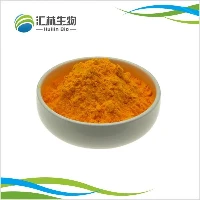

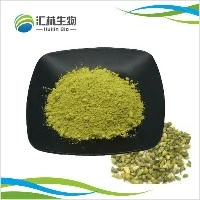
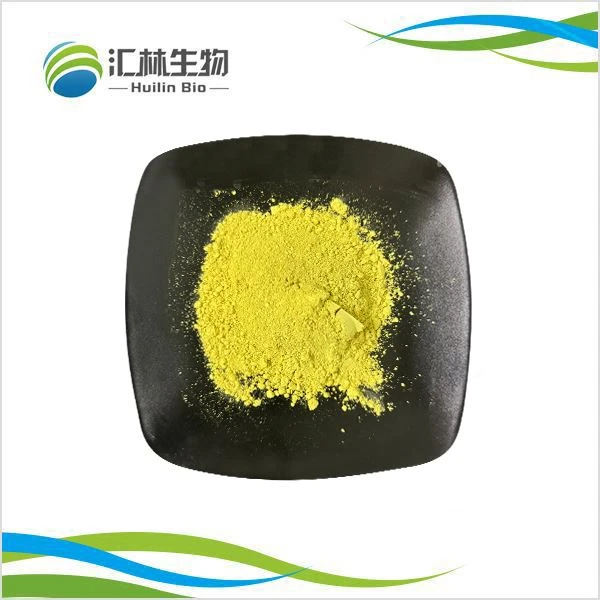
Xi'an Huilin Bio-Tech Co., Ltd. is one of the leading manufacturers and suppliers of berberine hydrochloride powder in China. With abundant experience, we are committed to providing high quality natural products with competitive price. Please feel free to wholesale bulk pure berberine hydrochloride powder for sale here from our factory.
What the 97 % Actually Measures
Berberine hydrochloride powder (C20H18ClNO4, CAS 633-65-8) is a quaternary isoquinoline alkaloid salt, and "97 %" on a certificate can mean three different quantities. This page states which one, because the gap between them is large enough to matter in a batch record.
| The material | Molecular weight | Berberine in it |
| Berberine cation, C20H18NO4+ | 336.4 | 100 % |
| Berberine hydrochloride, anhydrous | 371.81 | 90.5 % |
| Berberine hydrochloride dihydrate | 407.84 | 82.5 % |
Multiply by the 97.0 % assay and the same certificate yields 87.8 % berberine on an anhydrous basis, or 80.0 % if the lot is the dihydrate. Eight percentage points of active, from one word left off a specification.
Two consequences follow. A kilogram of this material carries 0.878 kg of berberine on an anhydrous basis, or 0.800 kg as the dihydrate - so 1 kg of berberine needs 1.14 kg or 1.25 kg of material respectively. And a certificate that reports assay without naming the hydrate state cannot be reconciled against your previous lot.
Our certificates state the basis and report the batch moisture beside it. If your incoming specification reads "≥ 97 %" alone, that is the first line we will ask you to tighten.
Release Data
| Item | Specification | Method |
| Assay, as berberine hydrochloride, dried basis | ≥ 97.0 % | HPLC, berberine HCl reference standard |
| Berberine cation equivalent | ≥ 87.8 % anhydrous; ≥ 80.0 % dihydrate | Calculation on assay and moisture |
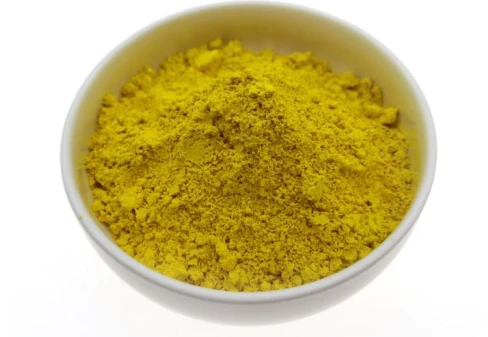
| Appearance | Yellow crystalline powder | Visual |
| Identification | Retention time concordant with reference | HPLC |
| Loss on drying | Reported per batch, hydrate state stated | Gravimetric, 105 °C |
| Related alkaloids, palmatine and jatrorrhizine | Reported per batch | HPLC |
| Heavy metals, as Pb | ≤ 10 mg/kg | ICP-MS |
| Arsenic | ≤ 2 mg/kg | ICP-MS |
| Total plate count | Reported per batch | Plate count |
| Conclusion | Conforms when tested by the stated methods | / |
Assay, moisture and the alkaloid profile are released together on every certificate, because a 97 % figure is only meaningful next to the moisture value that qualifies it. Batch number, production date, report number and signature travel with the shipment.
Source, Species and the Synthetic Alternative
The molecule is the same whether it is extracted or built; the paperwork is not.
Botanical route. Coptis chinensis rhizome is the usual source, with Phellodendron and Berberis used by other producers. Species and plant part belong on the specification, not only in conversation, because the regulatory lists that name berberine also name permitted sources and parts.
Synthetic route. Berberine is produced synthetically at commercial scale. In the European Union this matters directly: synthetic berberine used in food or food supplements falls under the novel food regulation, which places it on a different path from a botanical extract.
The distinction is testable, and it is being tested. A 2026 stable-isotope study separated botanical from synthetic berberine by δ13C - botanicals around −33 ‰ to −32 ‰, synthetics around −30.6 ‰ to −29.7 ‰ - and found that six of nine commercial samples sold as natural sat in the synthetic range. If natural origin is on your label, the analytical evidence has to come from somewhere other than a supplier's sentence.
We declare the route on the certificate. Where a buyer needs third-party confirmation of origin, we will say what we can and cannot support before a claim goes on a label.
Regulatory Position by Market
This is the part of the product where a page can mislead a buyer most easily, so it is written conservatively.
China. Berberine hydrochloride is a pharmaceutical substance, not a food ingredient. It appears in medicinal products under drug registration, and no food-additive or food-raw-material status exists for it. A supplier listing it under food additives is describing something that has no Chinese standard behind it.
European Union. EFSA endorsed a draft opinion on 29 January 2026 concluding that no safe level of intake could be established for any of the thirteen berberine-containing plant preparations reviewed, citing in vitro genotoxicity signals and the absence of an adequate repeated-dose study on berberine itself. The mandate runs under Article 8(2) of Regulation (EC) 1925/2006, whose outcomes include prohibition, restricted conditions of use, or Community scrutiny. Several member states already cap isoquinoline alkaloids at 10 mg per day expressed as berberine, and others do not authorise the source plants at all. No final opinion had been adopted when this page was last reviewed, so the EU position should be treated as unsettled rather than settled in either direction.
United States. Berberine is sold as a dietary supplement ingredient. The legal question for a finished product is whether the particular chemical form was marketed before 1994 - a new-dietary-ingredient determination, not a general permission. FDA has issued warning letters against berberine products whose labelling claimed blood-sugar effects, treating them as unapproved new drugs.
Canada. Berberine appears in the NHPID as a medicinal ingredient, with permitted botanical sources and parts enumerated. A label naming a species that is not on that list has a problem independent of its berberine content.
Elsewhere. Requirements differ by market and change. We supply specification, certificate and compositional statement; the permitted-use determination belongs to your regulatory team.
Impurity Profile
A 97 % alkaloid is 3 % something else, and what that something is depends on the route.
From botanical material, the expected companions are the protoberberine alkaloids that co-occur in the source plant - palmatine and jatrorrhizine most visibly. Their levels tell you how well the purification ran, and they are the first thing a pharmacopoeial reviewer asks about.
From synthetic material, the question shifts. A 2025 review of published berberine syntheses found that ten of twelve routes involve conditions conducive to nitrosamine formation. That is not a finding about any particular supplier's product; it is a reason to ask the question, and to ask it in writing.
We report the alkaloid profile per batch and state the synthetic route where it applies, so a buyer can decide whether a nitrosamine risk assessment belongs in their file.
Where It Is Used
Capsule and tablet blends. Supplied as a raw material to manufacturers whose formula already specifies the grade. The finished-product claim and its substantiation belong to the brand.
Nutrition powder blends. Where a 97 % alkaloid is the intended input rather than a standardised extract.
Formulation trials. Small quantities for bench work before a specification is fixed - which is also the right moment to settle the assay basis question above.
This material is not offered as a food additive, and we do not describe it as a pharmaceutical active for our part; those categories require a licence and a filing that differ by market.
Questions Buyers Ask
Q: Is 97 % the berberine content or the salt content?
A: The salt, on a dried basis. Berberine cation is 90.5 % of the anhydrous salt, so 97 % assay equals 87.8 % berberine - or 80.0 % if the lot is the dihydrate.
Q: Are berberine chloride and berberine hydrochloride the same product?
A: Yes. Both names describe the same salt with CAS 633-65-8. Reference standards are sold under either name, which causes avoidable confusion in specifications.
Q: Do you supply botanical or synthetic material?
A: Declared per lot on the certificate, because the route changes the EU regulatory path and the impurity questions. It should never be left to inference.
Q: What is the difference from a Coptis extract?
A: A standardised extract such as Coptis chinensis extract carries the plant's other constituents at their natural ratios and is specified by ratio or by marker content. This is a purified single alkaloid at 97 %, with a different specification and a different regulatory treatment.
Q: Which documents arrive with a batch?
A: Certificate of analysis covering assay, moisture, alkaloid profile, heavy metals and arsenic; a signed specification sheet; the safety data sheet; and a compositional statement for filing.
Q: Can the material be used in the EU?
A: That determination is not ours to make, and the position is in flux. We will provide what your regulatory team asks for; we will not characterise the product as authorised there.
Supplier
Berberine hydrochloride powder is supplied by Xi'an Huilin Bio-Tech Co., Ltd. with per-batch certificates stating assay, moisture, alkaloid profile and the declared botanical or synthetic origin.
Where a buyer needs a source statement or third-party origin data for a label claim, we will confirm what is supportable before the order rather than after.
Lead time and freight terms are quoted with the order; FOB, CIF and DDP are workable by destination.
This page describes a raw material for manufacturing use. It is not a finished consumer product, and nothing here is a statement about the effect of any product on any person. Regulatory status differs by market and is the buyer's determination; we supply the documentation a filing requires.
Hot Tags: berberine hydrochloride powder, China, suppliers, manufacturers, factory, wholesale, buy, price, bulk, pure, natural, high quality, in stock, for sale